
NEW YORK, August 5, 2026, 09:11 EDT — Pfizer shares moved higher in U.S. premarket trade as four key therapies countered the drop in COVID-related revenue by 1.5 times.
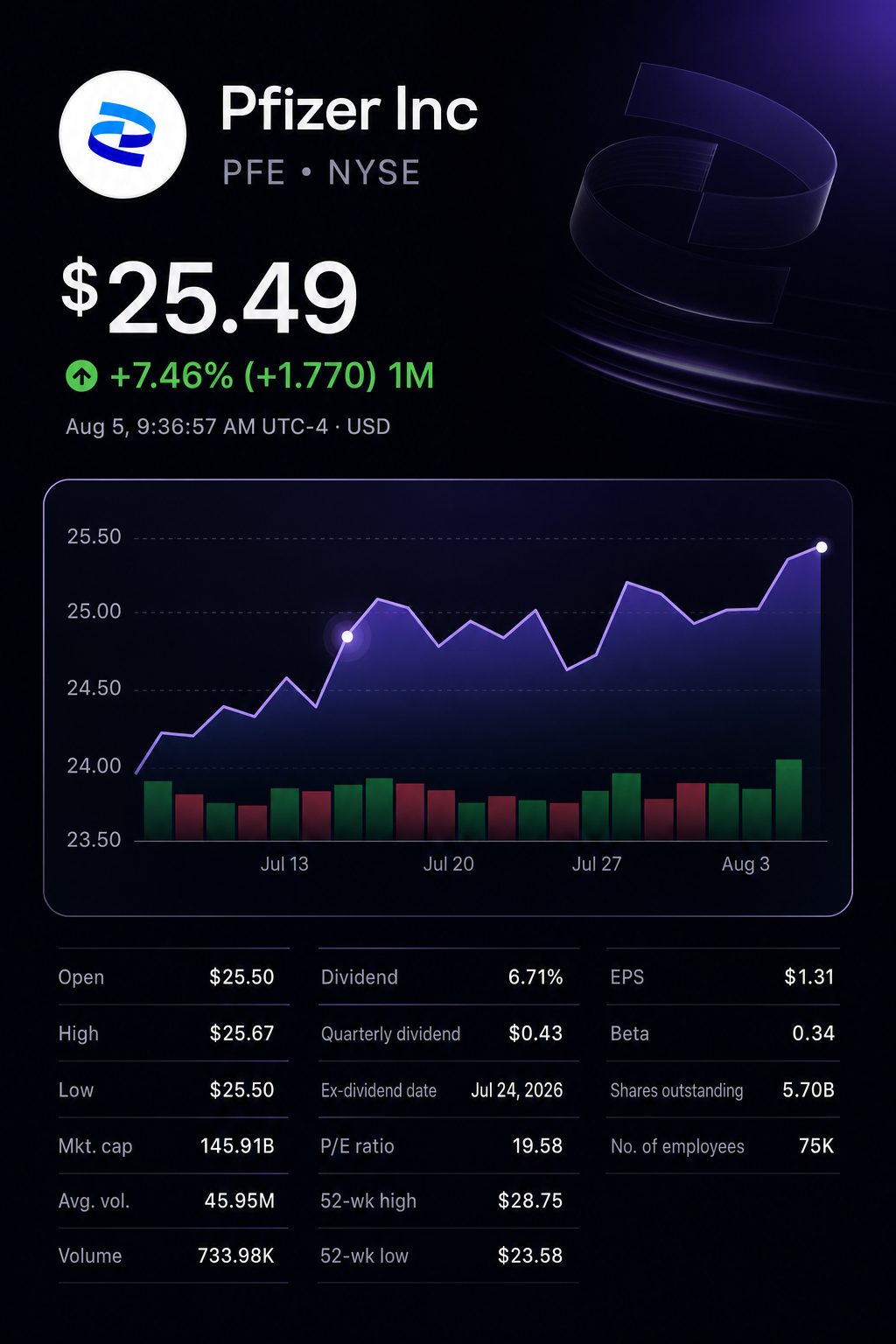
- Pfizer shares most recently traded at $25.41, gaining 1.48% compared with the previous session’s close.
- Adjusted earnings per share for the second quarter came in at $0.77, surpassing the consensus forecast of $0.68.
- Four growth brands contributed $797 million, while Pfizer’s two COVID products saw a decline of $526 million.
In the second quarter, Pfizer Inc. NYSE:PFE posted a more robust transition in revenue following the pandemic. Products including Eliquis, Vyndaqel, Padcev and Lorbrena contributed an additional $797 million compared to the same period last year. This increase was 1.52 times greater than the combined decrease from Comirnaty and Paxlovid.
The ratio offers the most transparent indication to investors. Pfizer’s overall revenue now remains steady without reliance on COVID sales. However, the company continues to require sustained pipeline successes.
The quarter also surpassed both key Wall Street forecasts.
| Metric | Q2 2026 | Q2 2025 | Consensus estimate | Surprise |
|---|---|---|---|---|
| Revenue | $15.034 billion | $14.653 billion | $14.40 billion | +4.4% |
| Adjusted diluted EPS | $0.77 | $0.78 | $0.68 | +13.2% |
| GAAP net income/(loss) | $(248) million | $2.910 billion | — | — |
| Reported EPS/(loss) | $(0.04) | $0.51 | — | — |
Consensus numbers reflect early projections from analysts. Surprise percentages derive from both company-reported and consensus data.
Revenue increased by 3% on a reported basis and by 1% operationally. When excluding COVID-related products, operational sales climbed 5%. Medicines that were recently launched or acquired saw growth of 18%.
The main driver behind the shift is the product bridge.
| Product | Q2 2026 revenue | Q2 2025 revenue | Dollar change | Reported change |
|---|---|---|---|---|
| Eliquis | $2.425 billion | $2.003 billion | +$422 million | +21% |
| Vyndaqel family | $1.762 billion | $1.615 billion | +$147 million | +9% |
| Padcev | $667 million | $542 million | +$125 million | +23% |
| Lorbrena | $354 million | $251 million | +$103 million | +41% |
| Four-brand subtotal | $5.208 billion | $4.411 billion | +$797 million | +18.1% |
| Comirnaty | $261 million | $381 million | −$120 million | −32% |
| Paxlovid | $21 million | $427 million | −$406 million | −95% |
| COVID subtotal | $282 million | $808 million | −$526 million | −65.1% |
Pfizer’s disclosed product revenue serves as the basis for dollar changes and subtotals.
The four brands with positive performance made up 34.6% of revenue for the quarter. Comirnaty and Paxlovid accounted for just 1.9%. The composition has shifted significantly.
Pfizer increased the 2026 revenue midpoint by $500 million. Stronger non-COVID demand contributed $1.5 billion, while reduced COVID outlook subtracted $1 billion.
| 2026 outlook item | Previous guidance | Guidance bridge | Revised guidance |
|---|---|---|---|
| Revenue | $59.5–$62.5 billion | +$1.5 billion non-COVID; −$1.0 billion COVID | $60.5–$62.5 billion |
| Adjusted diluted EPS | $2.80–$3.00 | +$0.10 operating performance; −$0.10 licensing charge | $2.80–$3.00 |
| Adjusted SI&A expense | $12.5–$13.5 billion | Unchanged | $12.5–$13.5 billion |
| Adjusted R&D expense | $10.5–$11.5 billion | Unchanged | $10.5–$11.5 billion |
The EPS bridge is based on Pfizer’s guidance reconciliation. Data shown are company projections.
The EPS range remains steady. Pfizer is offsetting expenses and a licensing fee with its sales buffer. However, it is not projecting accelerated profit gains at this stage.
Adjusted research and development expenses increased by 12%, as selling, information and administrative spending decreased by 3%. The adjusted operating margin stood at 35%. Chief Executive Albert Bourla said, “We are creating efficiencies … and we reinvest in R&D.”
The cost program is substantial. Pfizer anticipates achieving an additional $2.5 billion in net savings in the period from 2027 to 2029. Overall, the company is targeting total program savings of $9.7 billion by 2029. This represents 15.8% of the midpoint of 2026 revenue as a basis for scale, but is not intended as a margin projection.
GAAP figures showed a much weaker performance. Pfizer reported a net loss of $248 million following $4.3 billion in non-cash impairment charges. Of those, $3.8 billion were related to sigvotatug vedotin, and $525 million stemmed from Oxbryta.
Analyst opinions remained strongly divided following the report.
| Firm | Analyst | Recommendation | Target | Implied move from $25.41 | Action date |
|---|---|---|---|---|---|
| Jefferies NYSE:JEF | Akash Tewari | Buy | $34 | +33.8% | August 5 |
| Berenberg | Kerry Holford | Neutral | $25 | −1.6% | August 5 |
| JPMorgan Chase NYSE:JPM | Chris Schott | Neutral | $28 | +10.2% | August 4 |
Targets reflect analyst estimates and not official Pfizer forecasts. Implied movements use the most recent $25.41 price.
Broader sentiment stays prudent. The mean price target stands at $28.38, suggesting a potential gain of 11.7%. Analysts’ current ratings comprise 18 Hold recommendations, with nine rated as Buy or Overweight.
Pfizer’s market value is positioned between that of a peer facing a patent cliff and faster-growing competitors.
| Company | Latest quote | Change versus prior close | Market value |
|---|---|---|---|
| Pfizer NYSE:PFE | $25.41 | up 1.48% | $144.8 billion |
| Bristol Myers Squibb NYSE:BMY | $65.89 | up 0.66% | $134.6 billion |
| Merck & Co. NYSE:MRK | $128.00 | up 0.26% | $316.1 billion |
| Eli Lilly NYSE:LLY | $1,115.68 | down 0.39% | $999.5 billion |
Market data overview ahead of the U.S. cash market open. Percentage shifts are based on displayed prices and absolute differences.
Pfizer has a market value of $144.8 billion, a figure that is just above that of Bristol Myers Squibb. However, this is less than half the market capitalization of Merck. The company’s valuation is roughly 15% of Eli Lilly’s.
Trung Huynh, an analyst at Royal Bank of Canada NYSE:RY, described the beat as broad-based. He noted that Pfizer needs to achieve significant milestones in 2026 to restore its growth status. Investors are focusing on mevrometostat and the amylin obesity initiative from Metsera.
Risks persist. Eliquis and other established medicines are set to lose exclusivity. A low rate of COVID cases may limit Paxlovid’s performance. Progress could be hindered by pipeline setbacks, obesity tolerability issues, and leverage of 2.7 times.
Pfizer’s next challenge is straightforward. The company needs to maintain the 1.52-times replacement ratio for more than a single quarter. While cost reductions may help preserve margins, only new pipeline successes can bring back a growth multiple.
Related articles: NYSE:PFE