
NEW YORK, August 9, 2026, 16:02 EDT — U.S. markets have closed for the weekend.
- Shares of Pfizer rose 7.0% over the past week, compared to a 3.6% increase for the S&P 500.
- The 6.43% yield is higher than the 5.4% gain implied by FactSet’s consensus price target.
- Adjusted earnings for the second quarter surpassed consensus expectations by 13.2%.
Pfizer Inc. NYSE:PFE ended Friday’s session at $26.76, marking its sixth consecutive day of gains. Shares climbed 7.0% across the week, outpacing the S&P 500’s performance by almost double.
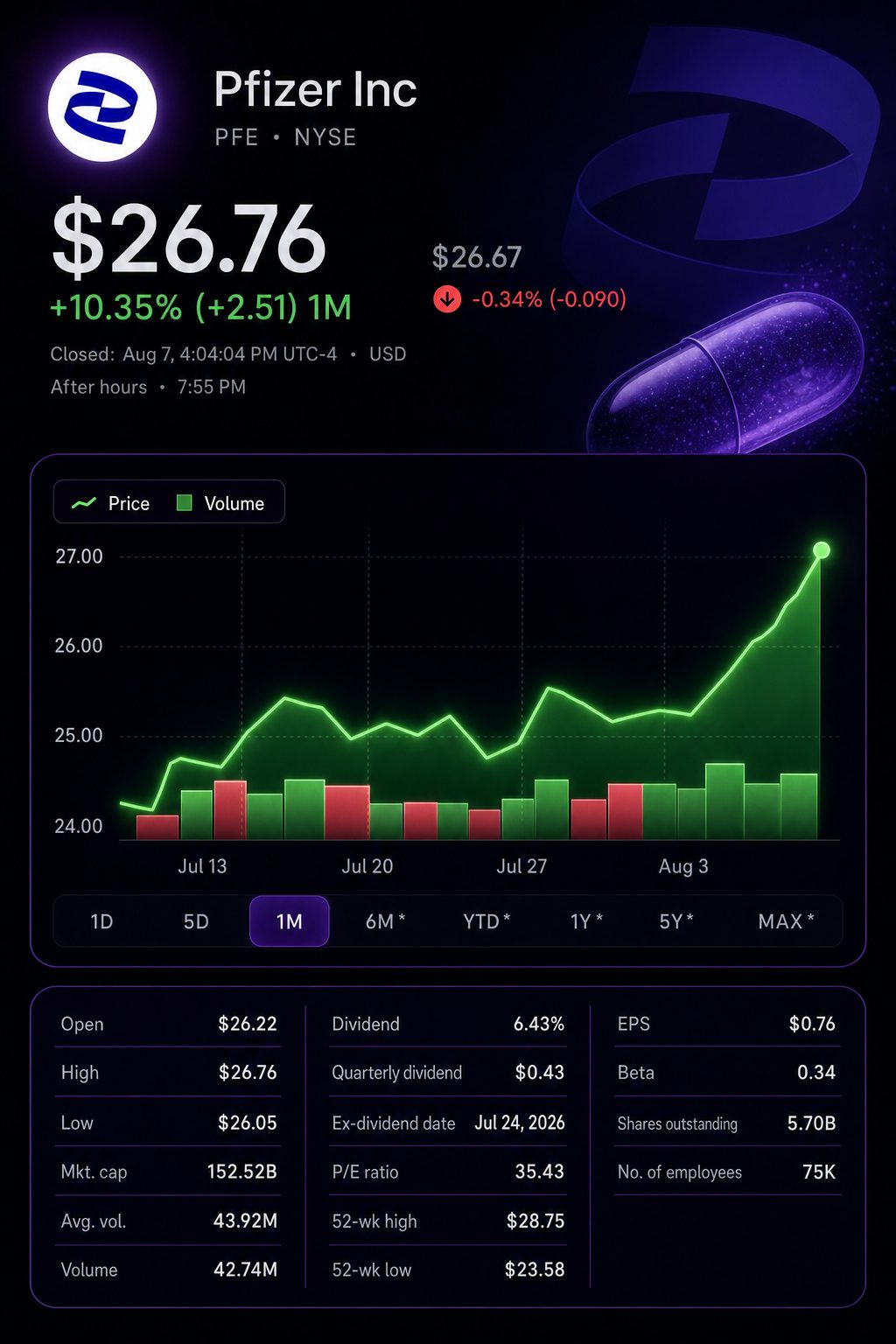
The dividend holds greater modeled importance compared to analyst targets. Pfizer’s yield is 6.43%, and the FactSet average target of $28.21 indicates potential upside of 5.4%.
A representative calculation suggests a gross return of 11.8% across one year, on the condition that the dividend remains unchanged and the average target is achieved. This does not constitute a forecast.
This calculation is based on Friday’s closing price, existing guidance, and the annualized dividend.
| Valuation measure | Value | Investor comparison |
|---|---|---|
| Friday close | $26.76 | Rose 7.0% during the week |
| Indicated annual dividend | $1.72 | 6.43% yield |
| FactSet average price target | $28.21 | 5.4% potential gain |
| 2026 adjusted EPS guidance midpoint | $2.90 | 9.2 times price-to-guided EPS |
| Dividend plus target upside | 11.8% | Illustrative, before tax |
The second-quarter outperformance prompted the rerating. Adjusted earnings came in at $0.77 per share, topping the forecast of $0.68. Revenue surpassed consensus by 4.4%.
According to the official results and projections from analysts, the following scorecard is presented.
| Metric | Reported or revised | Comparator | Difference |
|---|---|---|---|
| Second-quarter revenue | $15.034 billion | $14.4 billion consensus | 4.4% above |
| Adjusted EPS | $0.77 | $0.68 consensus | 13.2% higher |
| Reported net income | $(248) million | $2.910 billion profit a year earlier | Shifted to loss |
| 2026 revenue guidance | $60.5 billion–$62.5 billion | $59.5 billion–$62.5 billion previously | Midpoint rises $500 million |
| 2026 adjusted EPS guidance | $2.80–$3.00 | Unchanged | $2.90 midpoint |
The sales composition outperformed headline numbers. Excluding COVID, revenue increased by 5% on an operational basis. Products that were launched and acquired saw growth of 18%.
Eliquis, which is co-marketed with Bristol Myers Squibb Co. NYSE:BMY, brought in $2.425 billion. Padcev and Lorbrena each recorded double-digit growth.
Pfizer’s product table highlights both the drivers of growth and the ongoing impact from COVID.
| Product | Q2 sales | Reported change | Operational change |
|---|---|---|---|
| Eliquis | $2.425 billion | up 21% | up 19% |
| Vyndaqel family | $1.762 billion | up 9% | up 8% |
| Padcev | $667 million | up 23% | up 23% |
| Lorbrena | $354 million | up 41% | up 37% |
| Comirnaty | $261 million | down 32% | down 34% |
| Paxlovid | $21 million | down 95% | down 95% |
The pandemic-related business continued to contract. Paxlovid dropped 95% in operational terms, and Comirnaty saw a 34% decrease.
The guidance bridge highlights the trade-off. Pfizer increased its non-COVID product forecast by $1.5 billion, while cutting anticipated COVID sales by $1 billion. As a result, the midpoint climbed by just $500 million.
Cost reductions are becoming a larger driver for earnings. Pfizer has introduced an additional $2.5 billion in savings for the years 2027 to 2029, bringing the company’s total anticipated savings to $9.7 billion. “We are creating efficiencies … and we reinvest in R&D,” Chief Executive Albert Bourla said. Reuters
Capital allocation highlights a familiar conflict. Pfizer allocated $5.3 billion to internal research over the first half, while cash dividends totaled $4.9 billion—equivalent to 92% of its research spending.
Pfizer continues to deliver a standout yield compared to similar companies. Its yield is 2.54 percentage points higher than Bristol Myers. GSK plc NYSE:GSK and Merck & Co. Inc. NYSE:MRK have even lower yields.
| Company | Friday close | Dividend yield | Pfizer yield premium |
|---|---|---|---|
| Pfizer NYSE:PFE | $26.76 | 6.43% | — |
| Bristol Myers Squibb NYSE:BMY | $64.72 | 3.89% | 2.54 points |
| GSK NYSE:GSK | $52.96 | 3.37% | 3.06 points |
| Merck NYSE:MRK | $128.58 | 2.64% | 3.79 points |
Analysts maintained a cautious stance following the beat. Both Bernstein and Guggenheim reduced their price targets on Friday, but kept their current recommendations. The consensus at FactSet is still Hold.
| Date | Firm or data set | Recommendation | Price target |
|---|---|---|---|
| Aug. 7 | Bernstein | Market Perform | $29, lowered from $30 |
| Aug. 7 | Guggenheim | Buy | $31, reduced from $35 |
| Aug. 5 | Rothschild & Co Redburn | Neutral | $25, raised from $24 |
| Aug. 5 | Jefferies | Buy | Not disclosed |
| Aug. 4 | JPMorgan | Neutral | Not disclosed |
| Current | FactSet consensus | Hold; 8 Buy, 1 Overweight, 18 Hold, 2 Sell | $28.21 average |
Trung Huynh, analyst at RBC Capital, described the quarterly performance as broad-based. Huynh noted Pfizer requires new catalyst delivery to restore its growth profile. Investors are monitoring mevrometostat and Metsera’s obesity pipeline.
The trading week will close one day prior to a change in financial leadership. CFO Dave Denton departs August 15, with Cecile Guegan stepping in as interim CFO on August 16.
Risks: Dividend cover may be reduced by patent expirations, failed trials, or pricing pressures. Continued decline from COVID would heighten strain. The $4.3 billion impairment this quarter also points to ongoing acquisition risk.
Related articles: NYSE:PFE