
VELDHOVEN, Netherlands, April 22, 2026, 22:11 (CEST)
- ASML boss Christophe Fouquet said the chip equipment maker won’t be the industry bottleneck in 2026, pointing to higher capacity and improved productivity.
- ASML lifted its 2026 revenue outlook to 36 billion-40 billion euros last week, following first-quarter results showing 8.8 billion euros in sales and net income of 2.8 billion euros.
- Risks are still out there when it comes to stricter U.S. export controls on China. ASML is sticking to its view that China will account for roughly 20% of its 2026 sales. There’s also lingering uncertainty over how quickly customers will pick up its next-gen EUV tools.
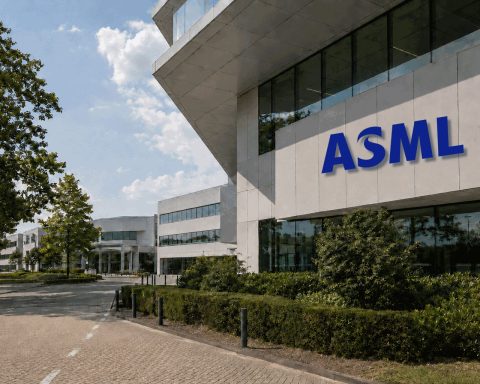
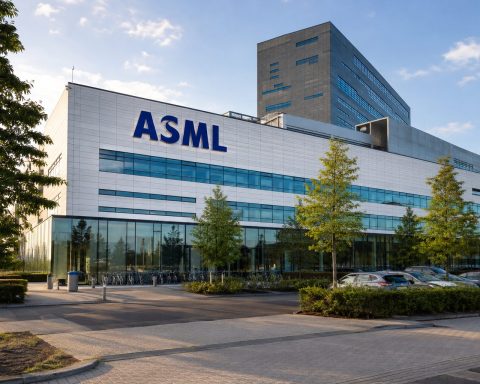
ASML on Wednesday pledged it won’t be the choke point in next year’s push to ramp up AI chip production, following heavy investment to boost capacity of its lithography systems—the gear that etches circuits onto chips. Chief Executive Christophe Fouquet, speaking at the Dutch company’s annual general meeting, said the firm would prevent bottlenecks “by all possible means.” Reuters
Timing is key here: ASML is right in the thick of the advanced chip supply chain. The company bumped up its 2026 sales target last week, now looking at 36 billion to 40 billion euros. That news followed first-quarter results—8.8 billion euros in sales, 2.8 billion euros in net income—as ASML flagged that customers are speeding up capacity plans for 2026 and later. Growing AI infrastructure budgets are part of the story.
On the call, Fouquet pointed to persistent tightness for both advanced logic chips—those handling core computing tasks—and memory chips, saying demand would “continue to outpace supply” for some time. Memory makers, he noted, have already sold out inventory for the year and are bracing for supply constraints to stick around past 2026, even with new production lines coming online. ASML Brand Portal
ASML’s fortunes remain closely linked to capital plans at TSMC and memory giants Samsung, SK Hynix, and Micron—each dependent on ASML equipment for their leading-edge expansions. Last week, Reuters noted upbeat guidance from both ASML and TSMC, signaling another round of robust outlays by major cloud players eager for high-performance chips from Nvidia, AMD, and Broadcom.
ASML stands alone as the supplier for EUV—extreme ultraviolet—lithography, the most advanced equipment in the chipmaking world. CFO Roger Dassen said ASML targets shipping 60 units from its current-gen EUV portfolio in 2026, with room to ramp up to 80 units the following year. The company is still building out its older DUV, or deep ultraviolet, lineup, where it runs up against Nikon from Japan and SMEE in China.
Fouquet didn’t mince words on execution risk. If ASML misses deadlines, he warned investors, customers might start considering competitors or alternative tech. Start-ups like Substrate, xLight, and Lace? To him, they’re “ideas, not competition today.” Reuters
ASML shares have taken off this year, driven by investors who see the company as a “picks-and-shovels” play for the AI boom. That’s the phrase Richard Carlyle at Capital Group brought up earlier this month. Following the first-quarter results, Reflexivity co-founder Giuseppe Sette said ASML’s performance pointed to strength in semiconductors, despite ongoing anxiety about a possible AI bubble clouding the sector. Reuters
Politics remains the key short-term threat. ASML is sticking with its view that China will make up roughly 20% of sales in 2026, according to Dassen. Still, if U.S.-driven export restrictions tighten further, numbers might end up near the lower edge of the company’s forecast—even though “some of that demand could be absorbed by other customers” in today’s market. Reuters
The pace at which customers will move to ASML’s high-NA EUV platform—a more advanced, significantly costlier machine—remains an open question for the next phase of growth. TSMC’s Kevin Zhang told Reuters the chipmaker continues to “leverag[e] existing EUV technology” to deliver smaller and faster chips, holding off for now on the expensive new platform that runs about $400 million per unit. Reuters
At Wednesday’s annual meeting, shareholders signed off on a final dividend of 2.70 euros per share—bringing ASML’s total 2025 payout to 7.50 euros. They also renewed the company’s buyback mandate, allowing repurchases of up to 10% of issued capital. Routine as those votes might be, the meeting saw persistent questioning around execution and capacity.
The sector continues to act like there’s more left in the current upcycle. On Wednesday, European chip-equipment names—including ASML, BESI, and STMicroelectronics—climbed after upbeat earnings and capex outlooks fed conviction that spending in semiconductors and data centers is holding up.
![US Stock Market Today 08/26/2026 [UPDATE: 00:14 EDT] [Intuit Slides 10% as QQQ Starts New Trade Date Lower]](https://ts2.tech/wp-content/uploads/2026/08/US-market-dashboard-2026-08-26-0006-480x384.jpg "US Stock Market Today 08/26/2026 [UPDATE: 00:14 EDT] [Intuit Slides 10% as QQQ Starts New Trade Date Lower]")