
MADRID, August 5, 2026, 18:13 CEST
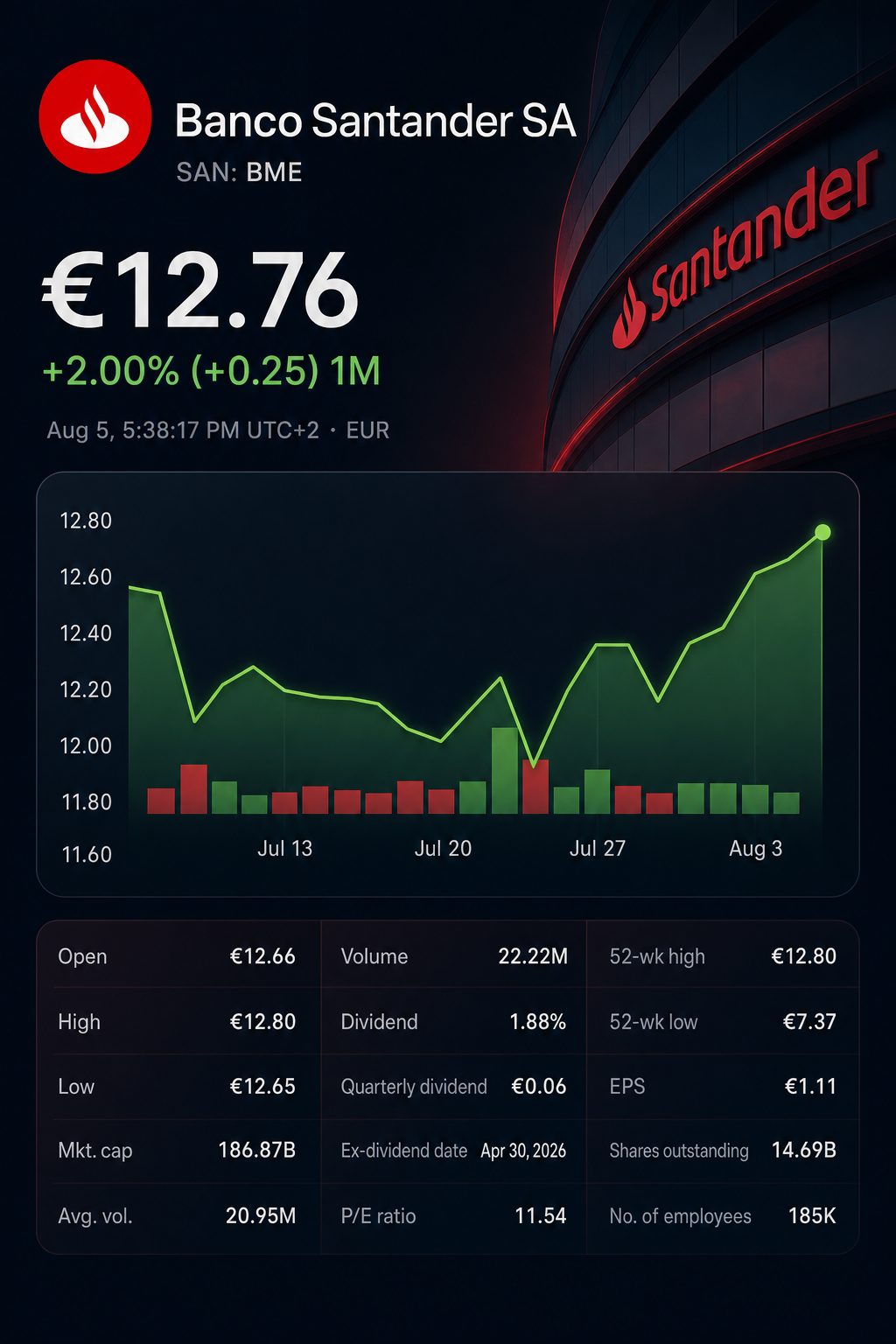
- The stock ended the session at €12.75, gaining 0.85%, after reaching an intraday high of €12.798.
- With Federal Reserve approval, Webster Financial Corporation’s NYSE:WBS $12.2 billion transaction remains set to close on August 20.
- The acquisition represents 4% of Santander’s assets and aims for 7%-8% EPS accretion by 2028.
Shares of Banco Santander, S.A. BME:SAN rose 0.85% on Wednesday, closing at €12.75 and reaching a new 52-week high. The Spanish cash market did not open, with trading-at-last finishing at 17:45 CEST.
The Federal Reserve’s approval finalised the regulatory requirements listed by the firms. Previous authorisations had been granted by the OCC and the European Central Bank. Santander and Webster anticipate completing the deal on August 20.
The investment thesis now relies on earnings leverage. Webster accounts for roughly 4% of Santander’s total assets. Management is aiming for group EPS accretion of 7%-8% by 2028, equating to 1.75 to 2 times Webster’s share of assets.
Shares of Spanish banks showed mixed movement. Banco Bilbao Vizcaya Argentaria, S.A. (BME:BBVA) dropped 1.26%. CaixaBank, S.A. BME:CABK rose 1.03%. Banco de Sabadell, S.A. (BME:SAB) edged down 0.15%. Closing prices and listed valuation details appear below.
| Spanish bank | Close | Daily move | Displayed P/E | Market value |
|---|---|---|---|---|
| Santander | €12.75 | up 0.85% | 11.54x | €187.5 bln |
| BBVA | €24.29 | down 1.26% | 12.92x | €135.6 bln |
| CaixaBank | €12.76 | up 1.03% | 14.57x | €89.0 bln |
| Sabadell | €3.40 | down 0.15% | 10.53x | €16.8 bln |
Santander started a five-session rise following the close on July 29, with shares up 6.7% since then. On July 30, shares increased 2.48%, and on August 3, they added 2.01%.
Executive Chair Ana Botín described the banks as “a perfect match.” Santander projects the merged U.S. balance sheet will total approximately $327 billion, encompassing $185 billion in loans and $172 billion in deposits. Webster Financial
The company’s estimates indicate the execution hurdle and capital cost. The capital figure after closing is still an estimate.
| Metric | Starting point | Company target | Change or investor read-through |
|---|---|---|---|
| Deal impact on EPS | 4% of total assets | 7%-8% EPS increase | Asset share grows 1.75-2.0x |
| Net loan/deposit ratio | 109% | Roughly 100% | Decrease by 9 percentage points |
| Yearly pre-tax cost cuts | Combined expense level | $800 mln, or 19% | Fully realised by end-2028 |
| Group CET1 capital | 14.0% in June | Expected 12.8% after deal closes | Down 120 basis points |
| Return on invested capital | — | Near 15% by 2028 | Target set by company |
Deposits play a key role in the thesis. Santander projects that Webster will bring down the U.S. loan-to-deposit ratio by nine points. Improved funding composition is set to decrease funding costs.
Management has some flexibility following recent figures. Underlying profit for the first half increased by 15% to €7.33 billion. Group RoTE stood at 15.6%. Jefferies Financial Group Inc. NYSE:JEF stated, “NII dynamics look strong, and so do costs.” Santander
Price targets provide limited upside. The average from 20 analysts stands at €13.04, which is just 2.3% higher than where shares finished on Wednesday.
| Analyst snapshot | Buy | Hold | Sell | Average target | Return versus €12.75 |
|---|---|---|---|---|---|
| Current, August 5 | 17, or 85% | 2, or 10% | 1, or 5% | €13.04 | +2.3% |
| Bloomberg, June 30 | 78% | 19% | 4% | €12.51 | -1.9% |
Santander published Bloomberg percentages, which are rounded.
The consensus target has increased since June, but the share price has outpaced it. This indicates that execution, rather than regulatory approval, is becoming the primary factor influencing valuation.
Risks: Santander’s capital buffer is smaller as a result of the transaction. Provisions in the second quarter increased by 13% to €3.35 billion. Any reduction in savings or a decline in credit quality could eliminate the modest target-price upside.
Key data is set for release next week in three of Santander’s top markets. Scheduled reports cover U.S. inflation, U.K. economic growth, and industrial output in the euro area.
| Date | Release | Investor relevance |
|---|---|---|
| August 12 | U.S. July CPI, 08:30 ET | Impact on U.S. interest rate forecasts, Webster funding implications |
| August 13 | UK second-quarter and June GDP, 07:00 BST | Trends in credit demand, effects on TSB integration |
| August 13 | Euro-area June industrial production | Lending conditions for businesses in Spain and Europe |
The upcoming milestone for the company falls on August 20, when regulatory approval is expected to shift to final closure. Achieving $800 million in yearly cost reductions by the end of 2028 presents the greater challenge.
Related articles: NYSE:WBS