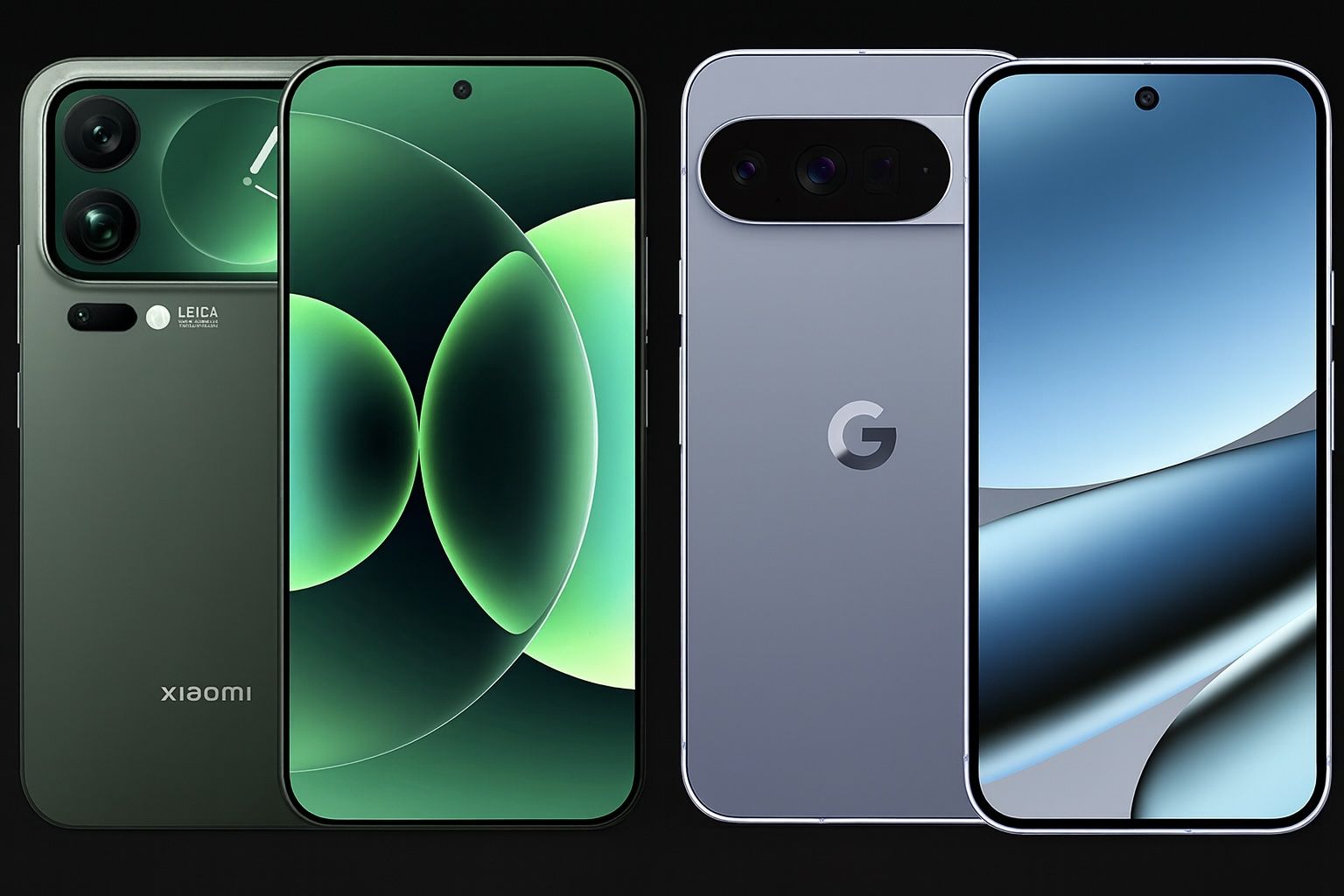

- Xiaomi’s battery behemoth vs Google’s AI flagship: The new Xiaomi 17 Pro Max packs a colossal 7,500 mAh battery with 100 W fast charging, a capacity rivaling two-day endurance theverge.com. Google’s Pixel 10 Pro XL is slimmer on battery at 5,200 mAh (45 W charging) phonearena.com, but leverages Google’s AI-centric Tensor G5 chip for efficiency and 7 years of software updates store.google.com.
- Second screen vs smarter software: Xiaomi’s secondary rear display (a 2.5″ by 1.8″ screen in the camera bump) serves as a selfie viewfinder, notification panel, music controller, and even mini-game screen theverge.com wired.com. As Wired notes: “We don’t need a second screen, but I’m already using it more than I expected to.” wired.com Google counters with Magic Cue and other AI features that proactively surface info (like adding a meetup to your calendar from a text) – a “glimpse of the future, with all the messiness of now mixed in.” theverge.com theverge.com In short, Xiaomi bets on novel hardware, while Pixel doubles down on intelligent software.
- Camera tech and zoom shootout: Both flagships boast triple-lens camera arrays. The Xiaomi 17 Pro Max uses a Leica-tuned trio of 50 MP sensors (wide, ultra-wide, telephoto) ts2.tech, including a 5× periscope telephoto with a bright f/2.6 aperture that even does 30 cm macro shots ts2.tech. The Pixel 10 Pro XL similarly offers a 50 MP main camera and 48 MP ultra-wide, plus a 48 MP 5× telephoto lens phonearena.com – and pushes zoom further with 100× “Pro Res” digital zoom aided by AI phonearena.com. Apple’s iPhone 17 Pro Max, by comparison, introduced an 8× optical-quality zoom (200 mm focal length, the longest on any iPhone) apple.com, while Samsung’s Galaxy S25 Ultra sticks with dual telephoto lenses (3× and 5×) and a massive 200 MP main sensor phonearena.com phonearena.com. Xiaomi’s approach favors brighter optics (its periscope has a wider aperture than Pixel’s f/2.8 tomsguide.com), whereas Pixel leans on computation – as one reviewer put it, the Pixel’s cameras are “still-excellent” with new tricks like upgraded portrait mode and on-device editing by AI tomsguide.com theverge.com.
- Design, display and build: Xiaomi’s 17 Pro Max and Google’s Pixel 10 Pro XL are both big-screen beasts – 6.9-inch and 6.8-inch OLED displays, respectively theverge.com blog.google – but take different design philosophies. Xiaomi’s phone adopts a flat front screen with slim bezels and a tougher glass that the company dramatically demonstrated by having an ice skater glide over it theverge.com. It’s surprisingly sleek for its battery size, weighing in at 231 g and “thinner and lighter than Apple’s 17 Pro Max,” according to Xiaomi theverge.com. The Pixel 10 Pro XL features Google’s familiar aluminum-and-glass design with the iconic camera bar, now refined with uniform bezels and a new “Super Actua” OLED that hit 3,000 nits peak brightness in testing – “the brightest display we’ve ever tested,” Tom’s Guide notes tomsguide.com tomsguide.com. Both phones are IP68 water-resistant and feel premium in hand; the Xiaomi even offers a quirky optional Retro GamePad case that turns the rear screen into a mini Game Boy theverge.com wired.com. Pixel’s design is more conservative but polished, coming in muted tones like Obsidian or Porcelain, while Xiaomi goes bold with its attention-grabbing rear display “Dynamic Back Display” on the Pro Max models ts2.tech blog.google.
- Performance and internals: The Xiaomi 17 Pro Max is one of the first phones rocking Qualcomm’s new Snapdragon 8 Elite Gen 5 chipset (with up to 16 GB RAM and 1 TB storage in top configs) wired.com. Early reports show this chip to be a mobile powerhouse – “perhaps the fastest smartphone chip in the world,” as Notebookcheck put it ts2.tech – even outpacing Apple’s A19 in sustained gaming performance and running cooler under load notebookcheck.net notebookcheck.net. The Pixel 10 Pro XL uses Google’s custom Tensor G5 chip built on a more efficient TSMC process, which prioritizes on-device AI and machine learning tasks. In everyday use, the Tensor G5 feels “snappy” and runs cooler than prior Pixels theverge.com, but in raw CPU/GPU it isn’t aimed to beat Qualcomm or Apple’s latest. In fact, Pixel still lags behind in graphics-heavy tasks – “underpowered for tasks like gaming,” as Tom’s Guide notes tomsguide.com – yet it’s more than sufficient for the AI-heavy features Google offers. Both phones run Android 16: Xiaomi with its new HyperOS 3 skin (China-first rollout) ts2.tech and Pixel with Google’s clean Android experience enhanced by Gemini AI integration. Notably, Google guarantees 7 years of OS updates and feature drops for the Pixel 10 series store.google.com, an area where Xiaomi can’t quite match (its support typically spans 3–4 years). Xiaomi’s advantage lies in bleeding-edge tech integrations (Wi-Fi 7, advanced cooling, etc.), whereas Google’s advantage is long-term software support and AI optimization.
- Battery life and charging: This is a tale of two extremes. Xiaomi’s 7,500 mAh battery is the headline – a “mammoth” cell enabled by new silicon-carbon anode tech and an L-shaped design to cram in capacity without a brick-like phone ts2.tech. The result is a device that Xiaomi claims can outlast the iPhone in video playback and truly deliver multi-day use theverge.com theverge.com. Even the smaller Xiaomi 17 (non-Pro) has 7,000 mAh, eclipsing most rivals. The 17 Pro Max supports 100 W wired charging (fills about 0–100% in roughly 30 minutes) and 50 W wireless theverge.com – far faster than Google’s charging speeds. The Pixel 10 Pro XL’s 5,200 mAh battery, while the largest ever in a Pixel tomsguide.com, is more conventional: Google promises “all-day” longevity and up to 25 W wireless via the new Qi2-based “Pixelsnap” magnetic charger phonearena.com phonearena.com. In real tests, the Pixel XL can easily last a full day (Tom’s Guide got ~14.3 hours web use in adaptive mode) tomsguide.com, but it “lags behind its main rivals on battery efficiency,” requiring daily charging for heavy users tomsguide.com tomsguide.com. Apple’s iPhone 17 Pro Max, for instance, got a thicker body this generation to fit a bigger battery and is rated for an impressive 39 hours of video playback (Apple’s longest ever) wired.com. Ultimately, Xiaomi clearly wins on pure battery size and charging speed – it’s literally a “battery monster” – whereas Pixel banks on Tensor’s optimizations and Google’s adaptive battery software to squeak out improvements. Both phones also offer reverse wireless charging to top up accessories, but Xiaomi’s sheer capacity gives it the edge if battery endurance is your priority.
- Price and value: Xiaomi has aggressively undercut the competition on pricing – in China the 17 Pro Max starts at ¥5,999 (about $840), a fraction of Western flagship prices theverge.com. Even accounting for import costs, that’s remarkable for a phone with top-tier specs and unique features. Google’s Pixel 10 Pro XL, by contrast, starts at $1,199 in the US for 256 GB (Google dropped the 128 GB base model) tomsguide.com. While Google kept Pixel prices static versus last year phonearena.com, it’s still a premium-priced device on par with Samsung and Apple flagships. Speaking of which, Apple’s iPhone 17 Pro Max also begins at $1,199 (128 GB) wired.com, and Samsung’s Galaxy S25 Ultra debuted at $1,299 for 256 GB phonearena.com phonearena.com. In markets where it’s sold, Xiaomi is positioning the 17 Pro Max as a disruptor – you get an enormous battery, cutting-edge Snapdragon chip, and even a second screen for hundreds less than an iPhone or Pixel. The caveat: as of now it’s only available in China (global release is expected in early 2026, likely around MWC) theverge.com. Pixel phones, on the other hand, are available in Google’s key markets (North America, Europe, etc.) with full warranty and support. So, Xiaomi offers better bang for buck on paper, but Pixel offers peace of mind and service in regions where Xiaomi might not officially reach. Buyers will have to weigh importing the Xiaomi or waiting for its international launch versus buying the readily available Pixel or other local options.
Rival Flagships & What’s Next
The Xiaomi 17 Pro Max and Pixel 10 Pro XL are entering a crowded flagship arena in late 2025. Apple’s iPhone 17 Pro Max is a formidable rival, with Apple’s A19 Pro chip making it “the most powerful smartphone around” in benchmarks wired.com and camera upgrades like that 8× telephoto to keep Apple fans loyal apple.com. Samsung’s Galaxy S25 Ultra (launched January 2025) remains a powerhouse too: a 6.9-inch AMOLED with S-Pen, a 200 MP main camera, dual zoom lenses (up to 5× optical, plus 10× hybrid) and a trusty 5,000 mAh battery phonearena.com phonearena.com – though its battery seems almost modest next to Xiaomi’s 7,500 mAh unit. The S25 Ultra introduced more AI smarts in its One UI 7 software and continues Samsung’s legacy of offering a do-it-all device (at a steep $1,299 base price) phonearena.com phonearena.com.
Looking ahead, other upcoming models are on the horizon. Xiaomi is rumored to unveil an even more extreme Xiaomi 17 Ultra in 2026 with further camera enhancements theverge.com. Google’s Pixel family is expanding too – this year saw the introduction of a Pixel 10 Pro Fold (a foldable variant) and we can expect a Pixel 10a or Pixel 11 next year continuing Google’s AI-centric strategy. Meanwhile, brands like OnePlus and Vivo are preparing their own Snapdragon 8 Gen 5 flagships; Qualcomm has over a dozen OEMs lined up to use this chip in new devices “in the coming days” notebookcheck.net. In other words, the competition will only heat up: OnePlus 15 is already teased with the same chipset for early 2026, and Samsung’s Galaxy S26 Ultra (expected in Q1 2026) will likely raise the stakes on display tech and camera zoom to answer Apple and Xiaomi’s moves phonearena.com.
Experts see this battle as indicative of two diverging approaches. Google is leaning hard into AI-driven user experiences – the Pixel 10 Pro XL comes with features like Call Assist and Camera Coach (an AI tutor for better photos) that aim to make the phone feel smarter and more helpful over time theverge.com phonearena.com. Xiaomi, conversely, is pushing the hardware envelope – bigger batteries, extra screens, new materials – to grab attention and one-up specs. “Xiaomi’s 17 series is meant to ‘benchmark the iPhone’… same-generation, same-tier” said Xiaomi’s Lu Weibing, signaling their intent to go head-to-head with Apple on innovation ts2.tech. And in many respects the 17 Pro Max does challenge or exceed the iPhone and Galaxy on raw specs, while undercutting them on price ts2.tech ts2.tech.
For consumers, 2025’s flagship choices have never been more interesting. If you prize battery life, fast charging and unconventional features, the Xiaomi 17 Pro Max is a bold and comparatively affordable pick – “a compelling value flagship” at its price ts2.tech. If you value polished software, cutting-edge AI, and long-term support, the Pixel 10 Pro XL delivers Google’s best vision of a helpful smartphone (albeit at a premium cost). And of course, stalwarts like Apple’s iPhone 17 Pro Max and Samsung’s Galaxy S25 Ultra offer their own advantages in ecosystem and all-round performance. Each has its edges – Apple with unmatched chip performance and a cohesive ecosystem, Samsung with versatility and an S-Pen, Google with AI and computational photography, and Xiaomi with battery and innovation per dollar.
Ultimately, the Xiaomi 17 Pro Max vs Pixel 10 Pro XL matchup highlights a dynamic smartphone landscape: one where a newcomer can pack in a second screen and a super-sized battery to shake up the status quo ts2.tech ts2.tech, and an incumbent like Google responds with smarter software and user-centric features to add value beyond the spec sheet theverge.com theverge.com. For tech enthusiasts, it’s a win-win – these devices push each other to be better. As one reviewer concluded after testing the Pixel 10 Pro XL against its rivals: “some of the most interesting phone comparisons of 2025” are unfolding now tomsguide.com. And as 2026 approaches, this flagship fight is only just getting started.
Sources: Xiaomi launch coverage theverge.com theverge.com theverge.com; TS2 Tech analysis ts2.tech ts2.tech ts2.tech; Wired hands-on (Simon Hill) wired.com wired.com; Tom’s Guide review tomsguide.com tomsguide.com; The Verge review theverge.com theverge.com; Qualcomm/Notebookcheck report notebookcheck.net; Google Store and Blog store.google.com theverge.com; PhoneArena specs and releases phonearena.com phonearena.com phonearena.com; Apple and Samsung official info apple.com wired.com phonearena.com.
Related articles: NASDAQ:GOOGL