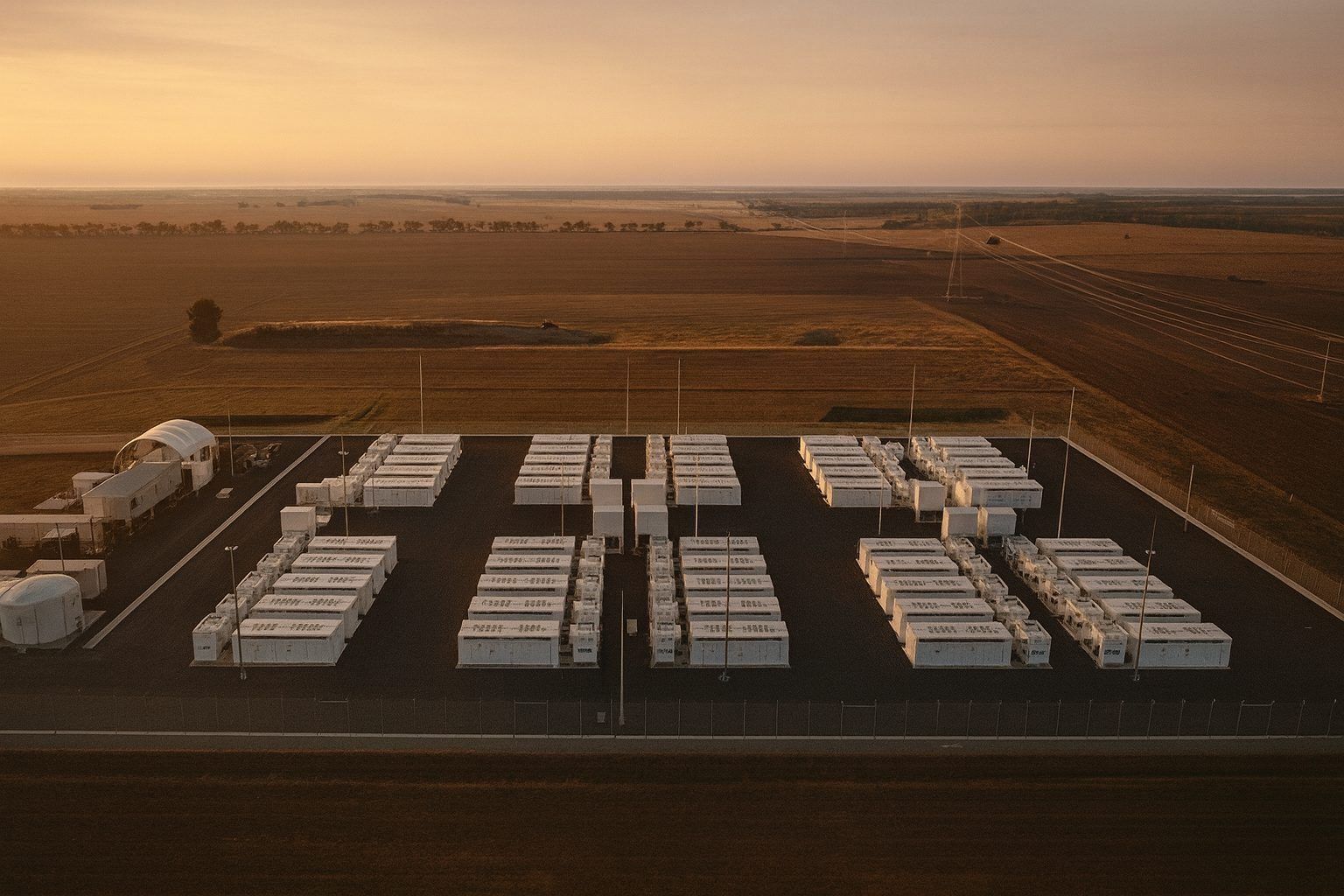
As of December 6, 2025, batteries have moved from the margins of the power system to center stage. Prices are falling faster than expected, grid‑scale storage has already blown past its 2025 deployment target, and new mega‑projects announced today—from the U.S. to Angola and Uzbekistan—show how rapidly batteries are reshaping the world’s electric grids. At the same time, U.S. automakers and researchers are racing to commercialize next‑generation chemistries that could push costs even lower.
This article brings together the latest reporting—including coverage summarized from The New York Times on falling battery prices and grid reliability, Canary Media’s analysis of the storage industry’s 2025 goal, and MIT’s deep dive on American battery innovation—along with fresh news from December 6, 2025.
Key takeaways
- Battery pack prices are at record lows — around $115 per kWh globally in 2024, down 20% year‑on‑year, with analysts expecting further declines and some forecasts pointing to sub‑$100 packs in leading markets. iesna.com+1
- Grid‑scale storage has already exceeded the U.S. industry’s 35 GW-by-2025 goal, with more than 40 GW of batteries connected to the grid and 4.7 GW added in Q3 2025 alone. TechCrunch+1
- December 6, 2025 headlines show the trend going global: record U.S. clean‑energy installations with a storage boom, a 75 MW battery‑backed solar park in Angola, and new battery energy storage systems (BESS) in Uzbekistan’s grid overhaul. SolarQuarter+2SolarQuarter+2
- U.S. innovation is pivoting to new chemistries such as lithium‑manganese‑rich (LMR) batteries, which General Motors plans to commercialize in EVs by 2028, with costs comparable to LFP but higher range. MIT News
- Research firms now project the global BESS market will grow around 17.5% annually through 2030, while new public‑market listings like Bimergen Energy’s planned NYSE American debut underscore growing investor appetite. The Manila Times+1
1. Battery prices have crossed a critical threshold
For more than a decade, analysts have said that battery prices below roughly $100 per kilowatt‑hour would unlock mass deployment of electric vehicles and grid storage. The world isn’t quite there yet on average—but it’s getting close, and some markets are already flirting with that threshold.
BloombergNEF data, summarized by industry analysts and trade groups, shows:
- Global average lithium‑ion battery pack prices fell to about $115 per kWh in 2024, a 20% drop from 2023, the steepest annual decline since 2017. iesna.com
- That global average conceals large regional differences. Vendor analyses drawing on BNEF and other sources suggest Chinese manufacturers are already offering packs in the mid‑$90s per kWh, with prices in the U.S. and Europe roughly 30–50% higher due to higher labor and manufacturing costs. BSLBATT
- Overcapacity is now a defining feature of the market. One industry summary, again based on BNEF figures, estimates fully commissioned cell factories can produce roughly 3.1 TWh per year—more than 2.5 times 2024 demand. iesna.com+1
Supply has run ahead of demand as manufacturers built aggressively to serve EV and storage booms that are arriving, but more slowly than anticipated. At the same time, lithium carbonate prices have crashed from around $70,000 per ton in 2022 to under $15,000 in 2024, while cobalt has more than halved in price, easing one of the biggest cost pressures on battery packs. BSLBATT
Looking ahead, BloombergNEF expects most clean‑energy technologies to see cost reductions between 2% and 11% in 2025, with battery prices continuing to trend downward, though at a more moderate pace than 2024’s sudden drop. BloombergNEF+1
Other forecasts are even more aggressive. A June 2025 industry analysis synthesizing vendor data and analyst forecasts concludes:
- Average lithium‑battery prices in 2025 are projected around $100 per kWh or slightly below,
- With battery packs in China potentially dropping under $100 per kWh, while U.S. and European prices lag but trend down. BSLBATT
These figures aren’t official BNEF forecasts, but together they paint a clear picture: battery costs have entered a range where grid‑scale storage and EVs are competitive, even without heroic subsidies—and in some markets, they are simply the cheapest option.
2. Cheaper batteries are already stabilizing power grids
The headline of the New York Times piece—“How Batteries Got Cheaper and Made the Electric Grid More Reliable”—captures a story that’s now playing out across multiple continents. While the article itself sits behind a paywall, aggregator summaries and industry reporting highlight the same core narrative: an experimental grid battery installed in Chile’s Atacama Desert about 15 years ago has given way to a world where batteries are a mainstream tool for grid reliability and renewable integration. CuratedSci+1
Texas and California: live testbeds for battery‑backed grids
In the United States, Texas and California have become proof‑of‑concept states for battery‑backed renewables:
- In Texas, batteries now provide as much as 80% of regulation services—the quick, fine‑tuned adjustments that keep the grid in balance—according to analysis highlighted by Utility Dive. Utility Dive
- In California, large‑scale batteries have become essential for managing the steep evening ramp when solar output plunges and demand rises, helping the state avoid the rolling blackouts that plagued it earlier in the decade. Utility Dive
Utility Dive notes that these shifts aren’t primarily the result of mandates; they are driven by market fundamentals. Batteries now do key grid services more cheaply and flexibly than fossil peaker plants, and falling prices are widening the range of situations where storage is the economic winner. Utility Dive
2025: another record year for U.S. storage
Wood Mackenzie and the American Clean Power Association (ACP) describe 2025 as another record‑breaking year for utility‑scale energy storage, even as they warn of policy headwinds later in the decade: Energy-Storage.News
- Q2 2025 saw an all‑time high for U.S. utility‑scale installations: 4.9 GW / 15 GWh, up 63% year‑on‑year.
- Total 2024 deployments surpassed 12.3 GW of battery power capacity and 37 GWh of energy, roughly one‑third higher than 2023. Energy-Storage.News
- The five‑year outlook still shows cumulative installations reaching around 88 GW / 281 GWh by 2029, even in the face of trade and permitting challenges. Energy-Storage.News
These numbers are consistent with the story highlighted by Canary Media and TechCrunch: an industry target set when grid storage was still a curiosity has already been blown past.
3. Grid storage crushes its 2025 goal
Back in 2017, the U.S. Energy Storage Association and Navigant set what looked like an ambitious goal: 35 GW of grid‑connected battery capacity by the end of 2025. At the time, the country had only about 0.5 GW of installed storage—so the target implied a roughly 70‑fold expansion in eight years. TechCrunch
Fast‑forward to late 2025:
- By Q3 2025, the U.S. had already installed more than 40 GW of batteries, according to ACP data summarized by Canary Media and TechCrunch—meaning the goal was not just achieved but significantly surpassed before year’s end. TechCrunch+1
- In the third quarter alone, 4.7 GW of new battery capacity came online, nearly half of all new renewable power additions to the grid over that period. TechCrunch+1
Storage is no longer a sideshow:
- The industry is now second only to solar in terms of annual additions to the U.S. power grid. TechCrunch+1
- In interconnection queues, batteries lead by a wide margin, with several times more storage capacity proposed than new gas plants, reflecting investor expectations that batteries are the peaking resource of the future. Energy-Storage.News+1
At the project level, the scale is equally striking. For example, recent reporting highlights Australia’s first 6 GWh battery, part of a multi‑technology “grid resiliency hub” in Queensland, designed for eight hours of discharge—far beyond the two‑to‑four‑hour batteries that dominated early deployments.
4. December 6, 2025: today’s headlines show storage going global
The user asked specifically for current news from December 6, 2025, and today’s stories underscore how far and how fast battery storage is spreading.
U.S. Q3 2025: record clean‑energy build, record storage
The American Clean Power Association’s Q3 2025 report, released today via SolarQuarter, shows: SolarQuarter
- 11.7 GW of new utility‑scale clean energy (solar, wind, and storage) installed in Q3, a 14% increase over the same quarter in 2024.
- Enough new capacity to power more than 1.6 million homes.
- Battery storage alone hit 4.7 GW, the largest quarterly addition on record.
However, ACP warns that policy uncertainty is already slowing future growth:
- Power purchase agreements fell 31% year‑on‑year in Q3, and total clean‑energy contracting was down 38% for the first three quarters of 2025 compared to 2024.
- Developers are pausing deals while they wait for final tax credit guidance and “foreign entity of concern” (FEOC) rules that will determine which projects qualify for full incentives. SolarQuarter+1
In other words, the near‑term numbers look spectacular, but the post‑2025 pipeline is less certain—a theme echoed by Wood Mackenzie’s forecast that annual storage installations may not surpass 2025 levels again until 2029. Energy-Storage.News
Angola: sub‑Saharan Africa’s largest off‑grid solar‑plus‑storage park
In Angola, the government today inaugurated sub‑Saharan Africa’s largest off‑grid solar park, a project that pairs a 25 MW solar plant with a 75 MW battery system serving remote communities far from the national grid: SolarQuarter
- The system will provide 24‑hour power to about 130,000 people in the Moxico Leste region, more than 1,500 km from Luanda.
- It uses a large battery energy storage system with blackstart capability, allowing the local grid to restart itself after a blackout.
- The project is part of a broader electrification program that aims to serve 60 remote locations, reach over 200,000 households, save nearly 10 million liters of fuel per year, and cut roughly 37,000 tons of CO₂ annually. SolarQuarter
This is a textbook case of where storage delivers value beyond simple arbitrage: it turns intermittent solar into a 24/7 power source where extending transmission lines would be prohibitively expensive.
Uzbekistan: $11 billion in new energy infrastructure, including BESS
Also today, Uzbekistan announced the commissioning of 42 new energy facilities worth $11 billion, including new wind farms and at least one battery energy storage system in the Tashkent region: SolarQuarter
- The projects, inaugurated by President Shavkat Mirziyoyev, form part of a broader strategy backed by about $35 billion in recent clean‑energy investment.
- The country plans to add 17 GW of renewable capacity by 2030, with storage playing a growing role in stabilizing the grid and integrating new wind and solar. SolarQuarter
Australia: Victoria’s first SEC battery hub comes online
In Victoria, Australia, the relaunched State Electricity Commission (SEC) has opened its first publicly owned energy project, centered on the Melbourne Renewable Energy Hub. Reporting indicates the hub uses 444 battery units providing around 1.6 GWh of storage—a sizable resource for local reliability and price smoothing. Herald Sun
While local political debate is focusing on how much this will cut household bills, the technical message is clear: public‑sector‑backed storage hubs are now part of mainstream energy strategy.
Markets: BESS stocks and global growth forecasts
Finally, today’s headlines also highlight the financial side of the storage boom:
- A Manila Times newswire piece cites a Mordor Intelligence report projecting the global BESS market will grow at about 17.56% compound annual growth rate through 2030, driven by grid reliability needs, renewable integration, and data‑center demand. The Manila Times+1
- CoinCentral reports that Bimergen Energy Corporation (ticker: BESS) is preparing to uplist from OTCQB to the NYSE American on December 11, 2025, explicitly to expand its utility‑scale battery storage business. CoinCentral
Together, these stories show that grid storage is no longer a niche industrial product—it’s becoming a mainstream asset class and policy priority.
5. Inside the innovation pipeline: how the U.S. is trying to lead
Falling prices are one part of the story; the chemistries and supply chains behind those prices are changing just as fast. That’s the focus of MIT’s December 1, 2025 article, “Driving American battery innovation forward,” which recaps a talk by Kurt Kelty, vice president of battery, propulsion, and sustainability at General Motors, at the MIT Energy Initiative (MITEI) Fall Colloquium. MIT News
Kelty outlined three priorities for GM’s battery strategy:
- Affordability – Batteries still make up about 30% of an EV’s cost, so cutting pack prices is critical to mass adoption. MIT News
- Performance – Improving range, charging speed, and energy density to make EVs compelling for more drivers.
- Localized supply chains – Reducing reliance on imported materials, especially from China, to build a more resilient North American battery ecosystem. MIT News
LMR: a “bridge” chemistry between LFP and high‑nickel cells
Kelty highlighted lithium‑manganese‑rich (LMR) cathodes as a key breakthrough:
- Traditional high‑energy EV batteries have moved from cobalt‑heavy chemistries to nickel‑rich formulas to reduce cost and ethical risks.
- LMR batteries go further by cutting nickel content and boosting manganese, which is globally abundant and inexpensive, pushing costs down while keeping range close to high‑nickel cells. MIT News
- According to Kelty, LMR offers costs comparable to lithium‑iron‑phosphate (LFP)—the low‑cost chemistry widely used in China—but with range closer to today’s long‑range EV batteries, making it attractive for mainstream U.S. vehicles. MIT News
LMR chemistries have been known for years, but manufacturers struggled to commercialize them at scale. GM now says it has cracked those challenges and plans to bring LMR‑based EVs to market in 2028, positioning the chemistry as a workhorse for the next decade. MIT News
AI‑accelerated R&D and vehicle‑to‑grid (V2G)
Kelty also described how AI‑driven “virtualization” is speeding up battery design:
- GM’s engineers now model variations in nickel, manganese, and other elements using AI tools that simulate performance and safety at cell, pack, and vehicle level—shrinking experiments that used to take months into days. MIT News
On the grid side, Kelty emphasized vehicle‑to‑grid (V2G) as a future tool for flexibility:
- With bidirectional chargers, EVs could charge at night when power is cheap and feed power back to the grid during high‑price daytime hours, effectively acting as a distributed battery fleet that lowers bills and stabilizes the system. MIT News
GM is also exploring direct participation in grid‑scale storage markets, pointing to data‑center growth as a major driver of future demand for long‑duration batteries. MIT News+1
Beyond automakers: reuse, new chemistries and long‑duration storage
The broader innovation ecosystem is just as active:
- Redwood Materials, co‑founded by former Tesla CTO JB Straubel, is building a business around repurposing used EV batteries into grid‑scale storage systems, leveraging the fact that many packs still have substantial capacity when they leave vehicles. Redwood plans to deploy around 20 GWh of storage by 2028 and recently raised $350 million to support the effort. TechCrunch
- Startups like Base Power are leasing batteries to homeowners and aggregating them into virtual power plants, blurring the lines between residential and utility‑scale storage. TechCrunch
- Others are pursuing non‑lithium approaches—thermal batteries, new flow‑battery chemistries, and even ocean‑based systems—that aim to deliver multi‑day or seasonal storage at lower cost than lithium‑ion, particularly for industrial and data‑center applications. TechCrunch+1
From a policy and industrial‑strategy standpoint, Kelty’s message was clear: the U.S. has the R&D and manufacturing base to lead, but must move quickly to build out domestic supply chains and keep up with China’s scale advantage. MIT News+1
6. What this means for households, utilities, and climate goals
Putting all these threads together—falling prices, record deployments, today’s global headlines, and the innovation pipeline—gives a sense of where the battery story is heading.
For households and EV drivers
- Cheaper batteries mean cheaper EVs. As pack costs approach or dip below $100 per kWh, analysts expect many electric models to reach upfront price parity with comparable gasoline cars, especially once tax credits are factored in. BSLBATT+1
- Home batteries become more compelling. Lower prices, plus new tariffs and net‑metering changes in places like California, make it increasingly attractive to pair rooftop solar with a battery for backup and bill management. Energy-Storage.News+1
- V2G could turn cars into money‑earning assets. If utilities and regulators enable it, EV owners might one day earn revenue or bill credits for letting their cars discharge during peak hours, while still meeting their daily driving needs. MIT News+1
For utilities and grid planners
- Batteries are becoming the default peaking resource. Instead of building new gas peaker plants, utilities are increasingly turning to four‑ and eight‑hour batteries to manage ramps, balance renewables, and defer transmission upgrades. Energy-Storage.News
- Policy still matters. The U.S. 2025 boom is real, but FEOC rules, tax‑credit guidance, and trade policy will shape whether the buildout accelerates or stalls in the late 2020s, as ACP and Wood Mackenzie warn. SolarQuarter+1
- Long‑duration storage is the next frontier. To deeply decarbonize grids and handle multi‑day weather events, utilities will eventually need storage that lasts beyond a few hours. That’s where thermal, flow, and novel chemistries now in development could play a major role. TechCrunch+1
For climate and global development
Today’s news from Angola and Uzbekistan shows that storage is not just a rich‑country solution:
- Off‑grid solar‑plus‑storage is leapfrogging diesel in remote regions, delivering 24/7 electricity at lower operating cost while eliminating fuel shipments and emissions. SolarQuarter
- Emerging economies are using BESS to integrate large volumes of wind and solar without compromising reliability, helping them meet climate targets and reduce dependence on imported fossil fuels. SolarQuarter+1