NEW YORK, July 30, 2026, 15:57 EDT — Shares of BigBear.ai NYSE:BBAI climbed 8% in early trade before its earnings report, with revenue projections indicating the second half must show greater strength to meet the company’s full-year guidance.
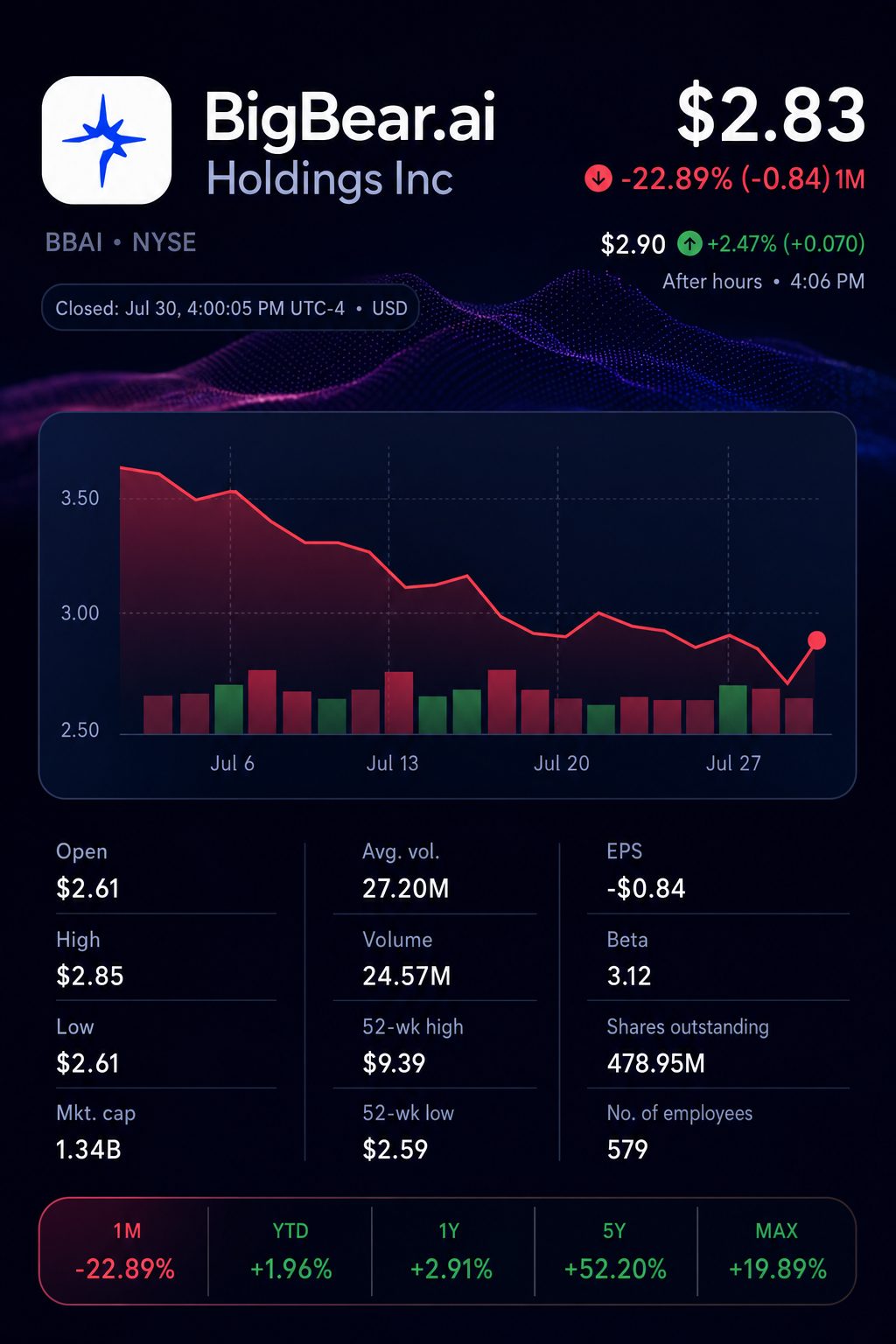
BigBear.ai was last seen trading around $2.80, an increase of 8.1%, in the closing minutes of the regular session.
The initial consensus estimates project revenue at $36.4 million, with a per-share loss of four cents.
The midpoint of guidance implies a remaining $39.6 million revenue hurdle for the quarter.
Shares of BigBear.ai Holdings, Inc. NYSE:BBAI climbed 8.1% to $2.80 late Thursday with regular trading still underway. The company was scheduled to release its report following the market close.
Quarterly revenue is significant as guidance calls for a stronger performance in the latter half. Achieving the $36.4 million consensus would mean $79.2 million must be generated by December.
This amounts to $39.6 million for the quarter, 8.9% higher than the Q2 consensus. The figure is also 21.8% above sales from the same period last year.
Market prices and valuations late in the session were logged at approximately 3:42 p.m. EDT.
BigBear.ai surpassed all peer stocks. The spread indicates that earnings expectations were likely the main factor behind Thursday’s action.
Early consensus indicates an increase compared to last year’s low baseline.
Period
Revenue
Year-on-year change
Status
Q2 2025
$32.5 million
-18%
Reported
Q1 2026
$34.4 million
-1%
Reported
Q2 2026
$36.4 million
+12%
Preliminary consensus
Gross margin for the first quarter increased to 34.0% compared with 21.3%. The main driver of the gain was Ask Sage revenue. However, adjusted EBITDA—a non-GAAP metric—declined, resulting in a $9.9 million loss.
The following guidance calculations are initial estimates and are based on the consensus Q2 revenue figure of $36.369 million.
2026 projection
Total revenue for year
H2 revenue required
Average per quarter in H2
Average compared to Q2 estimate
Guidance lower end
$135.0 million
$64.2 million
$32.1 million
-11.7%
Guidance midpoint
$150.0 million
$79.2 million
$39.6 million
+8.9%
Guidance upper end
$165.0 million
$94.2 million
$47.1 million
+29.5%
No boost is necessary at the low end. A definite increase is needed at the midpoint. To meet targets at the high end, over $47 million will be required in every upcoming quarter.
Backlog provides some assurance, though not a guarantee. As of March, backlog climbed to $281.9 million, representing a 14% increase compared to December. BigBear.ai’s cash and investment holdings stood at $431.5 million, while its debt totaled $16.5 million.
First-quarter results reflect improved product profitability alongside a decline in cash generation.
Metric
Q1 2026
Q1 2025
Change
Revenue
$34.4 million
$34.8 million
-0.9%
Gross margin
34.0%
21.3%
up 12.8 percentage points
Adjusted EBITDA
-$9.9 million
-$7.0 million
$2.9 million decline
Operating cash flow
-$18.0 million
-$6.7 million
$11.3 million decline
Weighted-average shares
473.1 million
252.3 million
up 87.5%
The results are uneven. Product mix saw a significant improvement. However, spending and operational cash consumption increased.
Chief Executive Kevin McAleenan stated in May: “These wins keep us on track to meet our topline revenue target for 2026.” The upcoming earnings call should clarify the timeline for conversion. SEC
BigBear.ai traded at $2.80 per share, putting its market capitalization at roughly $1.32 billion. This represents 8.8 times the mid-point of its revenue guidance. When adjusting for cash and investments and including debt, the company’s enterprise value stands at about $910 million, or approximately 6.1 times mid-point forecast sales.
Risks are elevated. Government projects may face postponements, scaling back, or cancellations. A backlog does not ensure future revenue. Additionally, a greater share count restricts potential gains per share during a recovery.
Results were due at approximately 4:15 p.m. EDT, with the conference call planned for 4:30 p.m. Investors are focusing on revenue, backlog conversion, gross margin, cash usage, and guidance for the full year.
BigBear.ai shares last changed hands near $2.80 late Thursday, marking an 8.1% rise from Wednesday’s $2.59 finish. The stock traded between $2.60 and $2.83, with volume at approximately 23.8 million shares. The price remains nearly 70% under its 52-week high of $9.39. The rally occurred just hours ahead of the planned second-quarter earnings release. There was no clear confirmed trigger for the rebound.
What are Wall Street forecasts for second-quarter earnings?
Analysts expect revenue around $36.4 million, representing a roughly 12% increase from the same period last year. Forecasts for EPS show projected losses between four and five cents. BigBear.ai is expected to release results at about 4:15 p.m. Eastern on July 30. The most recent released quarter is still Q1, based on the latest confirmation. This puts increased focus on guidance and backlog metrics rather than the reported EPS number.
Is BigBear.ai on track to meet its 2026 revenue target?
Management reiterated its full-year revenue outlook of $135 million to $165 million. Revenue for the first quarter totaled $34.4 million, a decrease of 1% compared to a year earlier. To meet the lower end of the forecast, each of the remaining quarters must bring in $33.5 million. Achieving the midpoint requires $38.5 million per quarter, while the upper end calls for $43.5 million. Securing $36.4 million in the second quarter would place the company on track for the bottom of the target range, but not the midpoint. To hit higher targets, performance will need to strengthen in the latter half of the year.
What level of reliability does the $281.9 million backlog hold?
Backlog increased 14% from the prior period to $281.9 million as of March 31. Of this total, $79.1 million was funded, representing approximately 28% of overall backlog. The balance consisted of unfunded portions and options on contracts yet to be exercised. This backlog is not assured to convert into recognized revenue. Standard clauses allow government clients to end contracts for convenience.
Is there real progress in operating profitability?
Gross margin increased to 34.0% from 21.3%, supported by Ask Sage. However, operating loss grew to $24.3 million from $21.2 million. Adjusted EBITDA loss also deepened, rising to $9.9 million from $7.0 million. SG&A expenses rose 29% to $29.2 million, surpassing gross profit for the quarter. While margins saw substantial improvement, operating profitability remained negative.
How robust is the balance sheet of BigBear.ai?
At March 31, cash and available-for-sale investments stood at $431.5 million. Convertible debt principal left at quarter-end was roughly $17.7 million. Operating cash burn in the first quarter totaled $18.0 million; free cash flow was negative $18.3 million. While the balance sheet remains robust, the rate of cash burn still warrants close attention. A single quarter’s burn rate is not enough to determine a lasting runway.
What level of concern does shareholder dilution present?
The number of outstanding shares reached 477.0 million in Q1, up from 437.0 million, marking a 9.2% rise over three months. Year-on-year, weighted shares increased approximately 87% to 473.1 million. Around 38.1 million shares were issued through debt conversion, eliminating $124.6 million in notes. The balance sheet improved through deleveraging, though per-share ownership was diluted.
Can elevated short interest lead to a squeeze?
As of July 15, short interest stood at 145.8 million shares, or around 30.6% of the public float. Depending on the method, days-to-cover estimates range between four and six. Elevated short interest can intensify earnings-driven price swings in either direction, but this does not ensure a short squeeze.
Has the Ask Sage purchase delivered results?
Ask Sage posted $6.1 million in revenue and a $0.6 million net loss for Q1. BigBear.ai acquired the company and associated assets for $272.1 million. Annualizing Ask Sage's Q1 revenue suggests an acquisition multiple of nearly 11 times. This estimate does not account for factors such as growth, potential synergies, seasonality, or purchase accounting impacts. While Ask Sage improved margins, overall company revenue decreased by 1%. The acquisition now requires accelerated growth to justify its cost.
What are the stock's valuation and price target projections?
At $2.80 per share, 478.9 million shares result in an estimated equity value of around $1.34 billion. This corresponds to roughly 10.5 times the company’s stated 2025 revenue. Plugging in the $150 million midpoint guidance drops the multiple to 8.9 times. After removing March net cash, the simplified enterprise value multiple is about 6.2 times. Average published price targets sit between $5.00 and $5.50, depending on which analysts are considered. These targets suggest an upside of about 79% to 96% from the $2.80 share price. The upcoming Q2 earnings release could prompt quick revisions to those targets.
Khadija Saeed is a financial markets reporter at TS2.tech. Her coverage ranges from stocks and technology to emerging industries and developments across global markets. She studied economics and finance at the London School of Economics and worked in market research before becoming a financial journalist. Follow Khadija Saeed on Google News.