
UPDATED: LONDON, May 6, 2026, 13:00 BST
- Digital identity is moving from pilot projects into public wallets, dating apps, video calls and enterprise logins.
- Regulators are tightening rules around biometrics, while companies are looking for ways to prove a user is human without building large stores of sensitive data.
- The hard question is no longer whether biometrics work. It is who stores the proof, who audits it and what happens when it fails.
Blockchain-based identity management for biometric authentication is getting a new test in 2026 as governments, security firms and consumer apps push digital identity systems beyond the crypto niche and into daily online access.
The shift matters now because two pressures have arrived at once. AI-generated fraud is making old checks less reliable, while privacy laws are forcing companies to reduce what they collect and store. NIST’s July 2025 digital identity update added controls for injection attacks and forged media, and also brought subscriber-controlled wallets into its federation model.
Europe is adding another deadline. EU member states are due to make digital identity wallets available to citizens, residents and businesses by the end of 2026, giving banks, telecoms, public agencies and private platforms a clearer path to ask users for verifiable credentials rather than repeated document uploads.
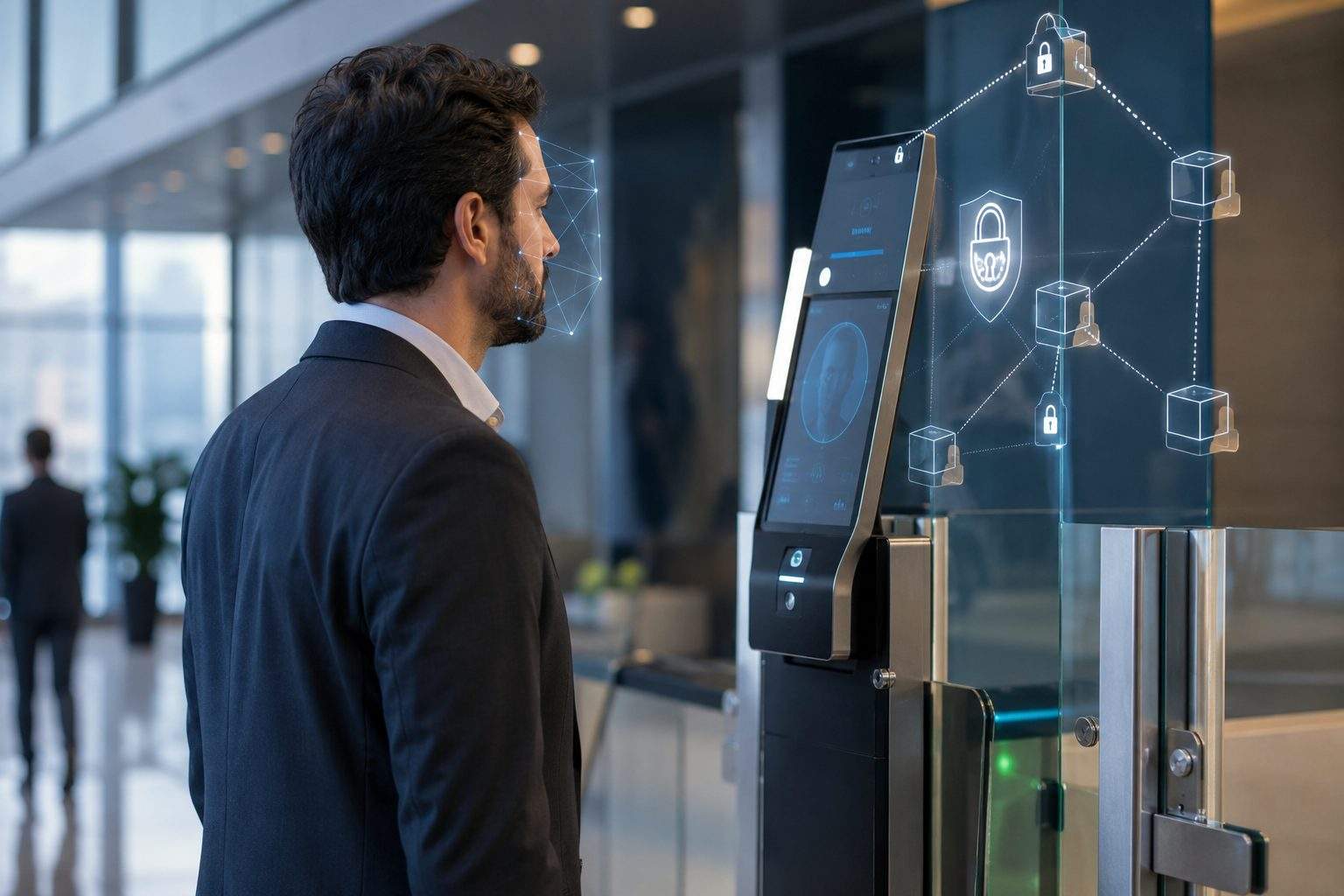
The technology is simple to describe, harder to run. A biometric check uses a face, fingerprint, iris, palm or other body trait to verify a person. A blockchain-based identity system, in this context, usually means the proof of identity or a cryptographic credential can be checked without relying on one central database controlled by a single company.
That is the promise behind decentralized identifiers, or DIDs. The World Wide Web Consortium made DIDs a web standard in 2022, describing them as identifiers that can be decoupled from central registries, identity providers and certificate authorities.
Companies are already pushing the idea into the market. World, formerly known as Worldcoin, announced integrations in April with services including Tinder, Zoom, DocuSign, Okta and Shopify, Axios reported. “When anything can be fake, you don’t know who and what to trust,” Tiago Sada, chief product officer at Tools for Humanity, told the outlet. Axios
Humanity Protocol, a blockchain identity firm using palm scans, raised $20 million at a fully diluted valuation of $1.1 billion in January 2025, Reuters reported. Founder Terence Kwok told Reuters the protocol lets people “prove they are human” without revealing personal details, a pitch aimed at bots, fake accounts and online fraud. Reuters
Enterprise identity vendors are moving too, though with less crypto branding. Ping Identity said in January it had completed its acquisition of Keyless, adding what it calls zero-knowledge biometrics, a method intended to verify a person without storing biometric data in a retrievable form. Ping CEO Andre Durand said “AI is accelerating identity-based attacks,” while Keyless CEO Andrea Carmignani said the technology can re-verify users “without ever exposing biometric data.” News Release Archive
The competitive field is still uneven. World is betting on iris scans and a proof-of-human network, Humanity Protocol is using palm biometrics, and Ping is folding privacy-preserving biometric checks into enterprise identity software. The common thread is a move away from passwords and repeated document checks, but the business models differ sharply.
The risk is that blockchain does not erase the hardest problem: biometric data is not a secret in the same way a password is. NIST says biometric traits can often be obtained without consent, that biometric comparison is probabilistic, and that biometrics should only be used as part of multi-factor authentication with a physical authenticator.
Regulators have already shown they will intervene. Spain’s data protection watchdog said in December 2024 that Worldcoin must delete iris-scanning data after a Bavarian decision found the venture breached the EU’s General Data Protection Regulation, Reuters reported. Spain’s High Court had earlier upheld a temporary ban on the iris-scanning project.
There is also a broader European limit around biometric systems. EU guidance on the AI Act says real-time remote biometric identification in public spaces for law enforcement is restricted to narrow exceptions, underscoring how sensitive the category remains even when the use case is not ordinary consumer login.
For companies, the near-term opening is not a universal identity card on a blockchain. It is narrower: prove age without showing a birth date, prove personhood without a passport upload, or re-check a worker before a high-risk transaction.
That may be enough. If the systems cut fraud without creating fresh biometric databases, adoption could spread through finance, travel, hiring and online marketplaces. But if audits are weak, matching errors rise, or regulators find consent was thin, blockchain-based biometric identity could become another privacy fight before it becomes infrastructure.
Related articles: Cybersecurity