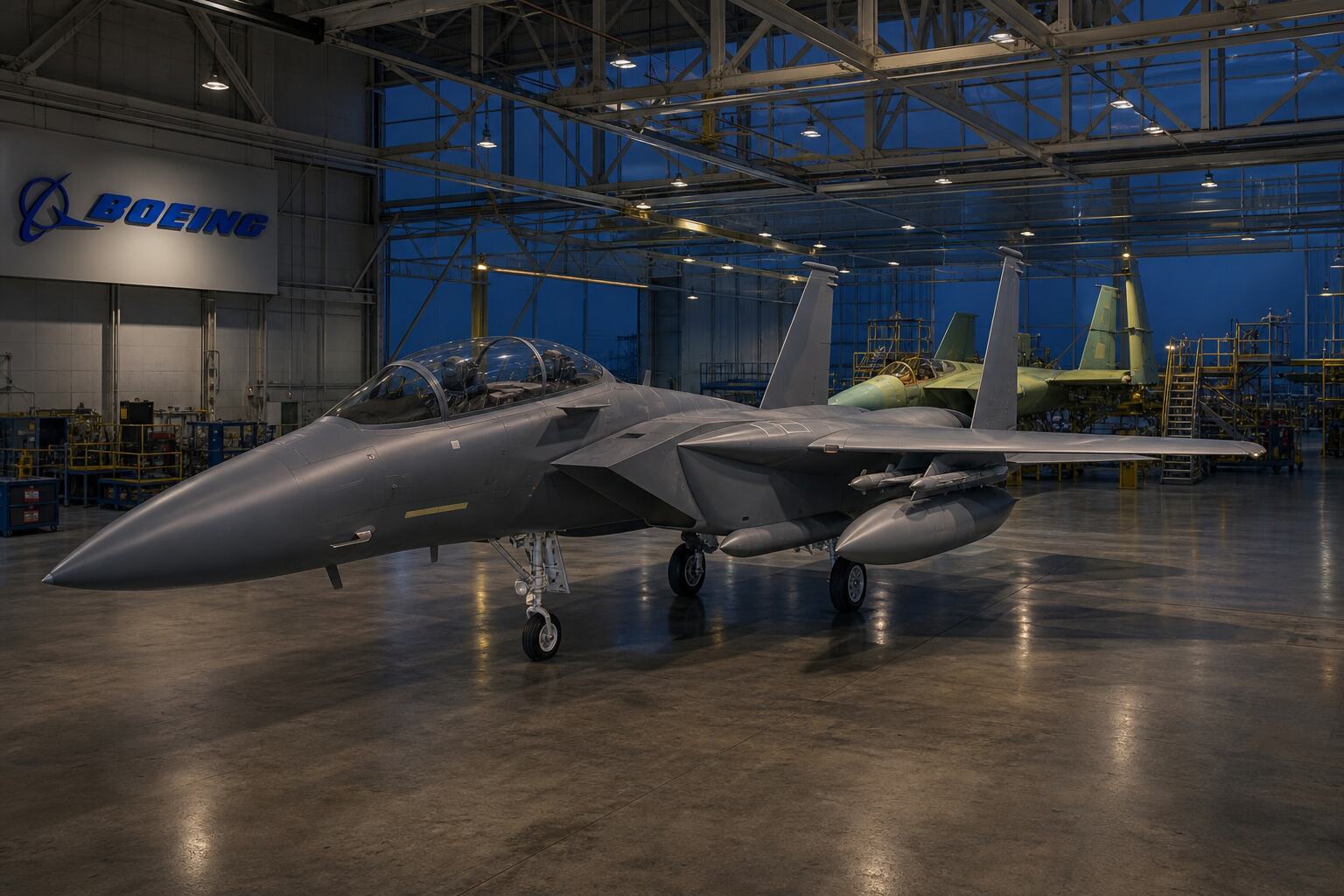

ST LOUIS, September 5, 2026, 13:24 CDT — Boeing Co. NYSE:BA has moved the first Kadena-bound F-15EX out of its St. Louis plant. The fighter’s departure puts steel behind a much larger headline. Yet the $131.23 billion contract ceiling framing this franchise arrived with just $343,740 funded.
That gap matters more than the ceremony. The ceiling is a vehicle for future orders, upgrades and support. It is not $131 billion of revenue, cash or backlog today.
Boeing shares closed Friday at $212.25, up 0.81%. They gained 2.15% over the holiday-shortened week, according to Nasdaq market data. The stock move cannot be pinned on one defense program.
Boeing ended the week at its high
NYSE daily closes, U.S. dollars
Friday volume was 4.59 million shares. Source: Nasdaq historical data.
A ceiling, not a purchase order
The Air Force awarded Boeing an indefinite-delivery, indefinite-quantity contract on Aug. 24. Its scope spans aircraft production, modernization, retrofits, sustainment and depot capability through 2037.
The official award notice states the ceiling and initial obligation side by side. Future task orders determine how much work Boeing actually wins. Some spending can also flow to suppliers.
Three numbers that are not interchangeable
The headline contract figure sits outside Boeing’s booked-accounting measures
Initial funding equals about 0.00026% of the ceiling.
These categories are not additive. Sources: Air Force contract notice and Boeing’s June 30 Form 10-Q.
Boeing reported $85.32 billion of total Defense, Space & Security backlog at June 30. Its quarterly filing excludes purchase options and unfunded government amounts from contractual backlog.
The F-15 ceiling is therefore 1.54 times the whole segment’s current backlog. That sounds powerful. It also shows why treating the ceiling as booked business would distort Boeing’s economics.
The program of record is far smaller
The Pentagon’s latest acquisition report budgets 268 U.S. aircraft. Two are development jets and 266 are procurement units.
Its then-year acquisition estimate is $36.93 billion, about 28% of the broad IDIQ ceiling. The distinction is logical. The contract can also carry sustainment, upgrades, depot work and foreign sales for several F-15 variants.
What the funded program actually measures
Program estimates come from the April 2026 Pentagon MSAR. Segment margin comes from Boeing’s 10-Q.
The segment’s margin makes execution unusually important. BDS generated $15.08 billion of first-half revenue and $218 million of operating earnings. In the second quarter alone, it lost $15 million on $7.48 billion of sales.
A longer production run can spread factory costs and support suppliers. Israel signed for 50 F-15 aircraft in December, the Pentagon report said. Still, volume only helps shareholders when pricing and delivery discipline protect margin.
The jet moved. The schedule has not recovered
The first aircraft designated for Kadena departed on Aug. 28 for further work in Portland. It is scheduled to reach Japan during fiscal 2027, according to the 18th Wing’s Sept. 3 announcement.
Wing commander Brig. Gen. John Gallemore called the flight “an important next step toward bringing the F-15EX home to Kadena.” It is progress, not a cure for the line’s delays.
The production clock is still red
Current Pentagon schedule and delivery estimates
Required Lot 4+ output: two aircraft per month. Those deliveries have slipped from 2026 into 2028.
Source: Pentagon F-15EX acquisition report. The report cites a 15-week 2025 machinists’ strike and recovery problems.
The report projects only six of 12 Lot 3 aircraft by year-end. Boeing had been required to finish that lot in early 2026. Lot 4 deliveries that should have started this year have shifted into 2028.
Later lots carry a second problem. Radar, mission computer, electronic-warfare equipment and engines need refreshes as parts age out. The program lacks an approved cost estimate for Lots 9 through 12 and is using government estimates for initial budget sizing.
Wall Street prices a cleaner Boeing
Analyst expectations remain bullish across the company. Nasdaq’s compilation shows 17 buy calls, one hold and no sells among the firms contributing to its target-price consensus.
The consensus assumes more than one fighter line
Analyst targets versus Boeing’s $212.25 Friday close
The $250-to-$305 range implies 17.8% to 43.7% upside. Source: Nasdaq analyst research. Targets are forecasts, not guarantees.
The consensus target is $274.67, 29.4% above Friday’s close. That view spans commercial-aircraft recovery, cash generation and defense execution. The F-15EX alone cannot deliver it.
The risks are unusually visible. Production may miss another milestone. Supplier shortages can raise cost, and later-lot redesign may weaken margins. Governments can also order far less than an IDIQ ceiling allows.
The next useful signals are not larger contract numbers. Watch funded task orders, monthly jet output and BDS margin. Those three measures will show whether the F-15 franchise is becoming earnings.