
NEW YORK, August 22, 2026, 10:30 a.m. EDT
- Boeing engineers and technical staff turned down proposed four-year contracts on Friday.
- The bargaining group, which has 17,000 members, authorized a strike to take effect once their contracts end on October 6.
- The 737-10 has completed its scheduled certification flights, with engineering close-out work still pending.
- Boeing shares fell 7.5% over the past week, though they are still trading under the average analyst price target.
The Boeing Company NYSE:BA is up against a labor deadline amid a critical stage in its 737-10 certification efforts. On Friday, engineers and technical staff turned down Boeing’s proposals and voted to authorize a strike following the expiration of their contracts on October 6.
The possibility of an assembly-line halt is not imminent. The bargaining units represent roughly 13,000 engineers and 4,000 technical staff. Their influence lies in areas such as design support, testing, and final certification.
| Labor measure | Professional unit | Technical unit |
|---|---|---|
| Members represented | Roughly 13,000 | Roughly 4,000 |
| Offer rejected | 64% | 72% |
| Strike authority | Granted | Granted |
| Current contract expires | Oct. 6, 2026 | Oct. 6, 2026 |
This places a spotlight on the timing. Boeing wrapped up the final planned certification flight for the 737-10 on July 28, following 976 test flights and over 2,060 flight hours. The company still needs to address remaining findings and obtain the amended type certificate.
The Federal Aviation Administration approved the smaller 737-7 on August 3. The FAA mandated new flight-control software, updated crew alert systems and changes to the engine anti-ice system design. Inspectors will continue to oversee production and monitor safety practices at Boeing plants.
| 737 milestone | Status | Investor relevance |
|---|---|---|
| 737-7 certification | FAA gave approval Aug. 3 | Refurbishment work and initial deliveries able to start |
| 737-10 flight testing | All planned tests finished | Engineering still needs to be finalized |
| Renton production | Shifting toward 47 units a month | Aids both deliveries and cash flow |
| Everett North Line | Running at low production rate | Essential to reach 52 per month and higher |
| SPEEA contract | Set to end Oct. 6 | Could disrupt certification, support activity |
The financial stakes are significant. Boeing reports that the MAX family has secured over 7,200 orders, with 2,360 planes handed over as of June. That leaves an estimated 4,840 aircraft on the backlog—equivalent to around 7.8 years of production at a pace of 52 jets per month, prior to accounting for cancellations, changes in aircraft mix or new orders.
Production extends beyond a single news cycle. Boeing advanced to a rate of 47 aircraft per month in the second quarter. The Everett facility is designed to back output of 52 jets per month and potentially more, following regulatory clearance and an initial low-rate phase.
Deliveries are driving better financial results. Revenue in the second quarter increased 8% to $24.56 billion. Boeing generated $631 million in free cash flow, reversing a $200 million outflow from the previous year. The Commercial Airplanes division, however, reported a $322 million loss.
| Q2 measure | 2026 | 2025 | Change |
|---|---|---|---|
| Total revenue | $24.56bn | $22.75bn | +8% |
| Commercial deliveries | 171 | 150 | +14% |
| Free cash flow | $631m | -$200m | +$831m |
| Commercial margin | -2.7% | -5.1% | +2.4 pts |
| Total backlog | $715bn | — | All-time high |
Chief Executive Kelly Ortberg stated that operations had become “more stable” and that major certification programs were progressing according to plan. The labor vote marks the initial significant challenge to that assertion since the outcome in July.
Boeing reports its turned-down proposal included a 28.5% increase in total wage funds over four years, alongside inflation protections and stock awards. The company has moved forward with a backup plan. According to SPEEA, members are seeking considerable enhancements before agreeing to a new proposal.
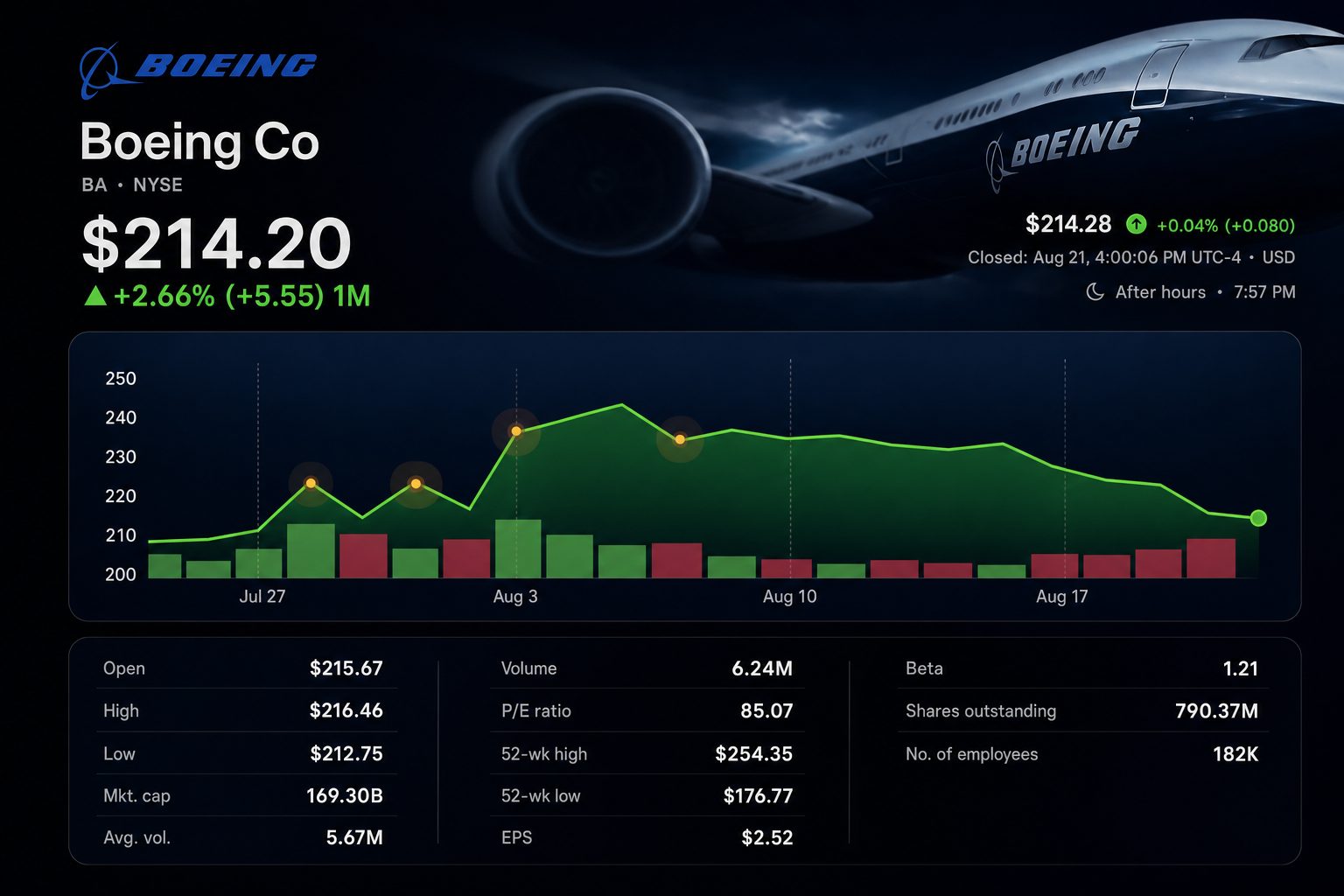
The stock endured a tough week. BA ended Friday at $214.20, marking a 7.5% slide since August 14. Friday’s drop of 0.4% underperformed the S&P 500, which gained.
| Firm | Recommendation | Target | Recent action |
|---|---|---|---|
| Tigress Financial | Buy | $305 | Reiterated Aug. 6 |
| Bernstein | Buy | $298 | Reiterated Aug. 10 |
| Argus | Buy | $265 | Raised Aug. 11 |
| Consensus | Buy | $274.85 | 23 Buy, 5 Hold, 0 Sell |
An investigation into a taxiway incident in Sydney included both a Qantas Boeing 737 and an Airbus A321. Officials confirmed there was not an imminent danger of collision. The review focuses on inconsistent ground directions and frequent airport events, rather than a proven 737 design issue.
Risks: Boeing and SPEEA still have over six weeks to negotiate an agreement, leaving a strike uncertain. Contingency plans may safeguard key programs. However, any brief halt by engineers could stall certification paperwork, customer support, or efforts to accelerate production.
The key indicator next week will be negotiations rather than deliveries. The SPEEA member survey ends August 26. Investors should monitor if discussions restart and if Boeing maintains its 2026 certification schedule for the 737-10.
Related articles: NYSE:BA