NEW YORK, July 28, 2026, 13:04 EDT — U.S. equities start regular trading.
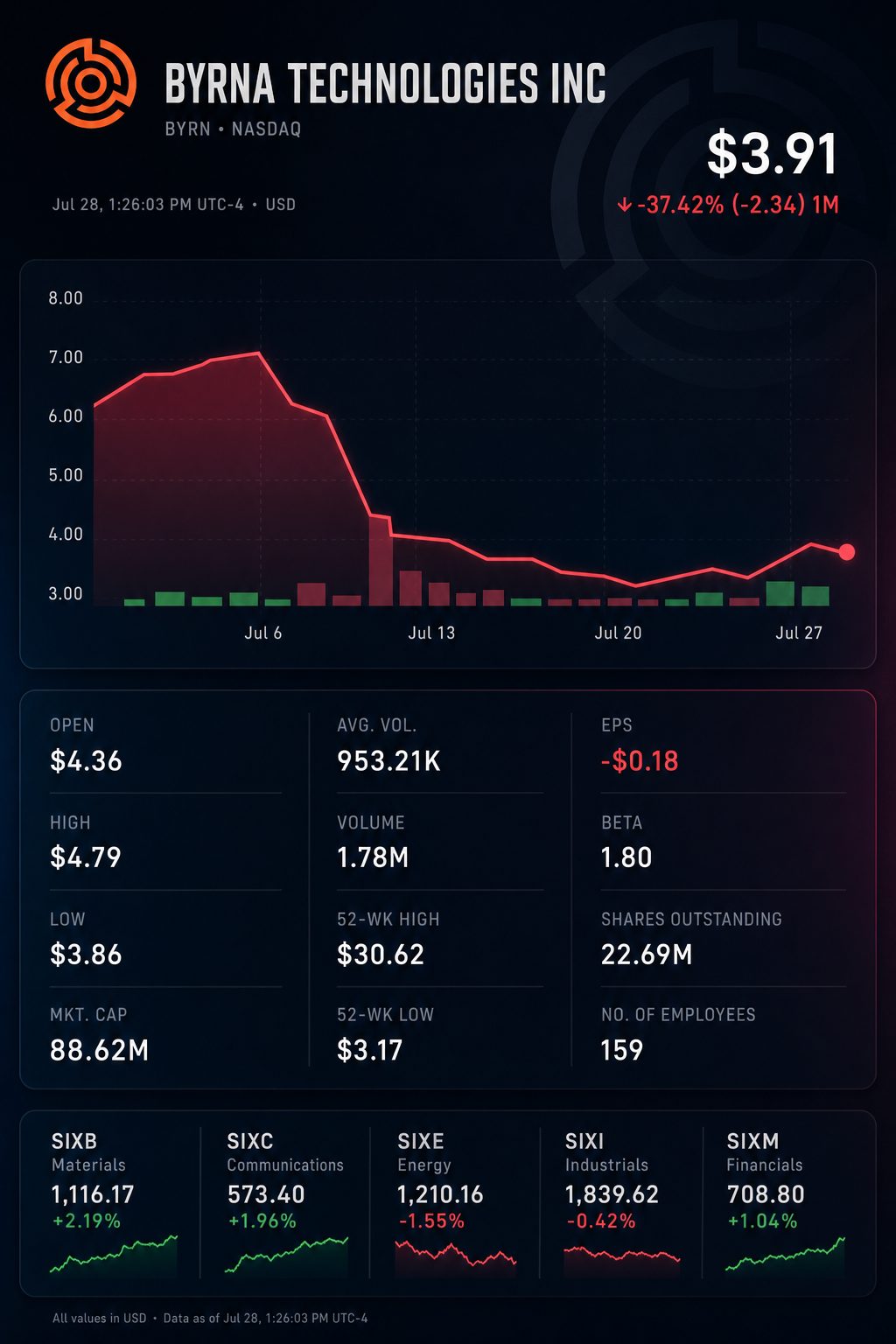
Byrna dropped 3.9% to $3.97, following a 16.7% jump on Monday.
As of June 30, BlackRock held 383,826 Byrna shares, representing a 68.9% decrease from its last reported holding.
Four company insiders have recently reported buying a combined 74,900 shares, which represents close to one-eleventh of the shares that BlackRock reduced from its position.
Shares of Byrna Technologies Inc. NASDAQ:BYRN dropped 3.9% to $3.97 on Tuesday afternoon, after gaining 16.7% in the prior session.
The shift happened alongside an updated ownership filing. BlackRock Inc. NYSE:BLK revealed a stake of 383,826 Byrna shares, representing 1.7%, as of June 30.
BlackRock had earlier reported holding 1.233 million shares, representing 5.4%. The change was 849,576 shares, or 68.9%.
The timing introduces a key detail. Byrna was deleted from the Russell 3000 by FTSE Russell following the close on June 26.
The overlap suggests that passive index rebalancing could partly explain BlackRock’s reduction. This remains an inference. BlackRock’s filing provided no reason.
Insiders provided a less prominent counter-signal. Four separate filings disclosed purchases totaling around 74,900 shares across July 22 and July 23.
The transactions amounted to approximately $260,000 at a weighted average price of about $3.48. This sum covers shares bought via an account reported by director Herbert Hughes.
Ownership signal
Reported shares
Quantified comparison
BlackRock position shift between reported dates
-849,576
Decreased by 68.9% between Oct. 24, 2024, and June 30, 2026
Four insider buys
About +74,900
Estimated $260,000 at an average of $3.48
Relative magnitude
—
BlackRock decrease was 11.3 times greater
The comparison uses different transaction periods. BlackRock disclosed positions on two separate dates, whereas the insider forms listed individual purchases.
Byrna ended Monday’s session at $4.13 as 1.55 million shares changed hands. The stock advanced 59 cents, up 16.7%.
The day’s trading range remained broad on Tuesday, as shares moved between $3.86 and $4.77. Volume hit 1.75 million by 12:42 p.m. EDT.
Byrna’s public float totals roughly 17.76 million shares. As of July 15, short interest stood at 2.1 million shares, equal to 11.85% of the float. This setup can intensify price surges and pullbacks.
The underlying environment continues to be unfavourable. Fiscal second-quarter revenue declined to $16.4 million, compared to $28.5 million in the same period last year.
Byrna posted a net loss of $10.1 million, with results reflecting a $5.9 million write-down of inventory and a $3.5 million impairment on equipment.
Gross margin fell to 11%. Excluding designated one-off charges, Byrna’s adjusted gross margin stayed close to 62%.
The data highlights demand and stock turnover as key elements of the investment rationale. CEO Conn Davis stated that “fiscal 2026 will not be a revenue-growth year” and described the quarter as having “reset the revenue baseline.” Byrna Technologies Inc.
As of May 31, inventory totaled $30.4 million, representing 1.9 times the amount of quarterly revenue and close to three times the combined value of cash and marketable securities.
Byrna’s $20 million credit facility had no outstanding borrowings at the end of the quarter. The company also met all requirements under its lending covenants.
Early company figures pointed to a possible bright spot. Around 30% of those in a try-before-you-buy test made purchases, and users of the product-finder tool converted at about double the average site rate.
Risks are still significant. Demand might remain weak, excess inventory could need further markdowns, and high short interest has the potential to increase volatility in the stock price.
Byrna was trading at $3.97, representing an increase of around 14% compared to insiders’ average acquisition price. Despite this, the stock was still down approximately 76% in 2026. Insiders have shown confidence, but soft sales and significant changes in ownership reduce the impact.
What is BYRN's current trading level, and how much price fluctuation is it experiencing?
BYRN was last seen at $3.97 as of 12:50 p.m. Eastern on July 28, down 3.9% from the prior session’s closing price of $4.13. During the session, shares moved between $3.86 and $4.77. Volume reached 1.75 million shares. At that level, the company’s market cap stood at roughly $90.1 million. All values are intraday and could shift by the session’s end.
What caused investors to be disappointed by fiscal second-quarter results?
Revenue declined 42.5% from the previous year to $16.4 million. Byrna reported a net loss of $10.1 million, or $0.44 per share. Adjusted EBITDA moved to a negative $605,000, reversing from a positive $4.3 million. Shares dropped 33.7% at the close on July 9, when results were announced. The quarter was pressured by weak demand and significant non-cash charges.
Does the reported 10.9% gross margin represent a sustained decline?
Gross margin fell sharply to 10.9%, down from 61.6% a year earlier. Inventory write-downs and equipment impairments in cost of goods reached $9.4 million. Those were partially offset by a $1.1 million tariff refund. Byrna’s adjusted gross margin was 61.8%, just above the prior year, as this figure excludes one-off charges. Despite this, adjusted EBITDA was still negative.
What is the extent of softness in direct-to-consumer and wholesale demand?
Direct-to-consumer revenue for the quarter declined 34.7% from a year earlier to $11.0 million, while wholesale revenue slid 53.8% to $5.4 million. Over six months, the declines were 20.7% and 9.4%, respectively. Company leadership attributed the results to weaker traffic, reduced order values, and underperforming site conversion rates. Retail partners continued to hold higher than normal inventory following previous stockpiling. The issue with reorders remains a critical factor for short-term improvement.
Does Byrna possess sufficient liquidity to handle the reset?
Byrna reported $10.4 million in cash and marketable securities as of May 31. Net cash used in operating activities reached $3.0 million for the first half. The company did not utilize any credit facility, preserving $20 million in available capacity, pending all contractual terms and restrictions. Inventory was recorded at $30.4 million, which is nearly triple the available liquid assets. Liquidity remains adequate, but focus shifts to converting inventory into cash.
How much does the HERO acquisition cost, and why is it significant?
Byrna will pay $625,000 in cash along with $625,000 in restricted stock. An additional performance royalty is linked to future HERO-related net sales. The acquired assets expand the company's range with more compact options and new consumer price levels. The deal was anticipated to close approximately 30 days after July 8. Byrna did not reveal expected revenue or profit impacts, making it challenging to assess short-term financial implications.
Do recent insider buys carry significance?
Disclosures for four insiders indicated around 75,000 recently acquired shares with a total value near $260,000 at reported prices. CEO Conn Davis acquired roughly 22,000 shares in the $3.46 to $3.51 range, while Chairman TJ Kennedy purchased 29,000 shares at about $3.53 each. Other transactions featured CFO Laurilee Kearnes and director Herbert Hughes, with part of Hughes’s stake held indirectly. The purchases may reflect insider confidence, though they do not demonstrate that demand has recovered.
Is a recovery in the second half possible for Byrna as a result of its turnaround initiatives?
Initial results from the program are promising but current data is still sparse. The trial initiative saw a conversion of approximately 30% among customers who received demonstration units. Users engaging with guided shopping converted at nearly double the rate of the overall website. Byrna recently named James White as head of retail and e-commerce operations. The company forecasts improvements in the second half, but management says it does not expect annual revenue growth in fiscal 2026.
Is BYRN considered inexpensive at its current price?
BYRN has a market capitalization close to $90 million and is valued at about 0.83 times its trailing sales. Based on reported figures, trailing revenue for the period ending in May reached around $108.9 million. However, annualizing the company's second-quarter revenue gives a figure of just $65.5 million—a rough metric, as management has forecast improvement for the second half. The company remains unprofitable on a trailing basis, rendering the price-to-earnings ratio irrelevant. Shares appear undervalued only if the company can achieve consistent sales and cash flow.
What are the key developments investors need to monitor in the week ahead?
The most immediate potential driver is verification of the HERO deal closing. Byrna had previously set a goal to finish the transaction around early August, pending standard closing conditions. Investors also seek proof that retail reorder rates and website conversion are on the upswing. Byrna’s news section has not posted a later operating update past July 28. Sentiment could shift based on new insider filings following recent acquisitions. In the absence of updated operating figures, volatility could stay unusually elevated.
Marcin Frąckiewicz is the founder and CEO of TS2 Space, a satellite communications company working with customers worldwide. His experience spans satellite communications, telecommunications and technology ventures. He graduated from the Warsaw School of Economics (SGH) and writes about space technology, artificial intelligence, stocks and the technology companies and industries he follows. Follow Marcin Frąckiewicz on Google News, Facebook or LinkedIn.
A figure above or below the 12.0 consensus could impact Treasury yields, the dollar, and cyclical stocks by influencing short-term growth outlooks.
#2
NAHB Housing Sentiment
A reading above or below 33 will influence expectations for housing demand, mortgage rate trends, and homebuilder stocks.
#3
Fabrinet After the Close
Investors are focusing on revenue, margins, and comments on datacom as key factors for companies involved in optical networking and AI infrastructure supply chains.