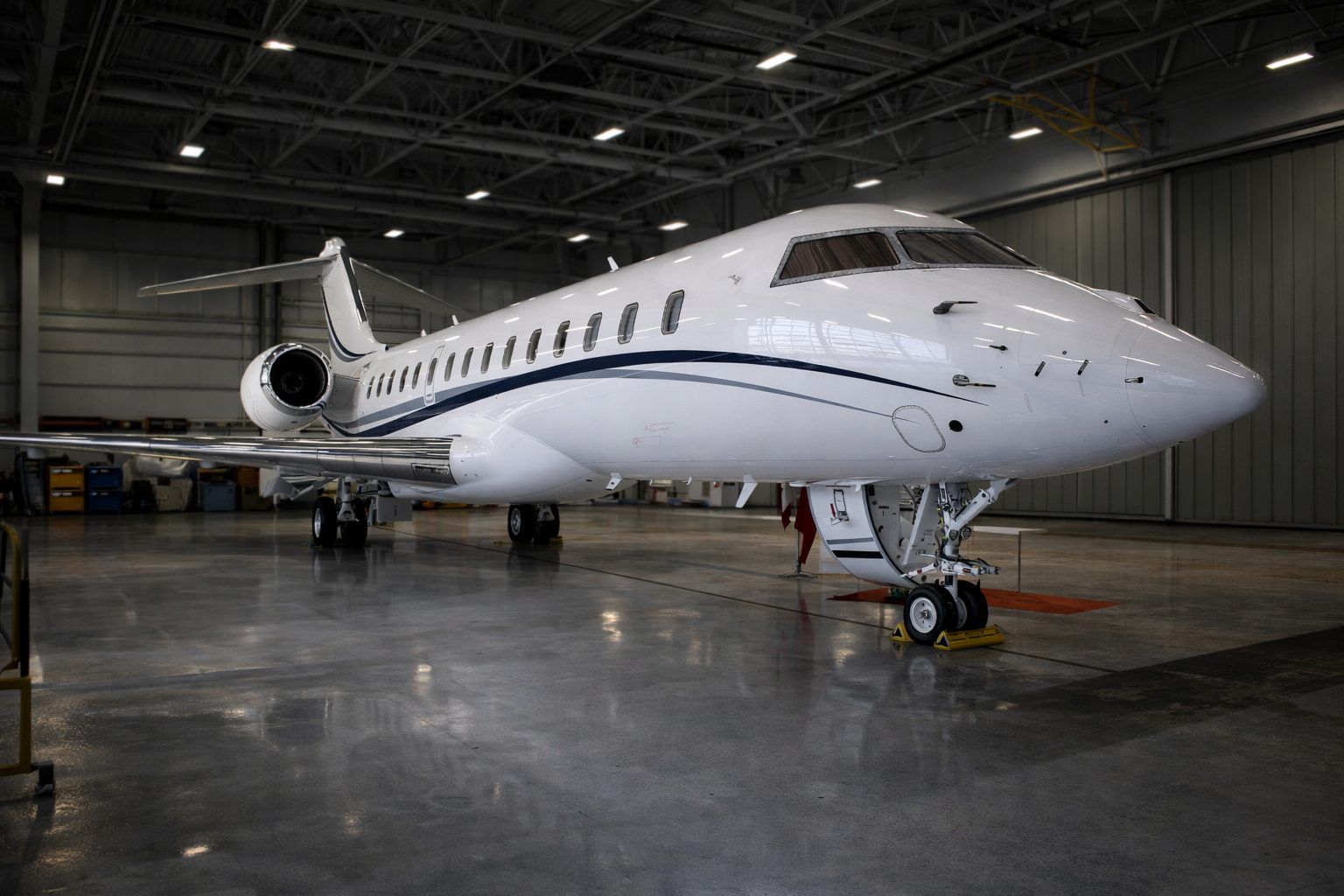

OTTAWA / MISSISSAUGA (Dec. 12, 2025) — Canada is moving to modernize a high-visibility but often overlooked slice of military airlift: the executive-style jets that ferry senior officials and can be rapidly reconfigured for urgent missions at home and abroad. The federal government announced Friday it has awarded Bombardier a contract to acquire six Canadian-built Global 6500 aircraft for the Royal Canadian Air Force (RCAF) under the Airlift Capability Project – Multi-role Flight Service.
The contract is estimated at about $753 million CAD, and includes more than the aircraft themselves — covering training for aircrew and maintenance personnel and military modifications required for the new multi-role fleet. The first delivery is expected by summer 2027, with initial operational capability targeted by the end of 2027, according to the government.
A direct replacement — and a fleet expansion
Canada’s current fleet of CC-144 Challenger aircraft has been in service for decades, and Ottawa says the new Global 6500s are meant to provide a modern replacement for the Challengers used for worldwide utility flights.
Importantly, the plan doesn’t just swap old planes for new ones. The government says the purchase replaces the remaining four Challenger aircraft, while the new acquisition totals six Global 6500s — effectively expanding the fleet while also upgrading capability.
Not just “VIP jets”: what the aircraft are expected to do
While Canadians most often notice these aircraft when they carry top officials — including the prime minister and Governor General, as The Canadian Press noted — the government is emphasizing a broader operational mandate.
Ottawa says the new Global 6500 fleet is intended to support missions such as:
- aeromedical evacuations,
- disaster relief,
- humanitarian aid, and
- national security operations.
That framing matters politically. The use of Challenger aircraft has “long been politically charged,” with opposition parties in past years frequently criticizing government travel on business jets as wasteful, according to the Canadian Press report. By foregrounding medevac, relief, and security missions, Ottawa is attempting to anchor the purchase in public-facing service — not just protocol and convenience. CityNews Halifax
Two price tags, one deal: $753M CAD vs. $400M (USD) order value
One point that jumped out in same-day coverage is the difference between the government’s contract estimate and Bombardier’s own valuation of the order.
- The Government of Canada put the estimated contract value at ~$753 million CAD.
- Bombardier, in a statement carried via GlobeNewswire distribution, said the order is valued at approximately $400 million USD, based on current list price plus the cost of military modifications.
Those figures aren’t necessarily contradictory: government contracts often include bundled items (training, support, integration work, program management) and reflect procurement-specific structures, while manufacturer “order value” language commonly references list pricing and defined scope elements from the company’s perspective. Canada+2MarketScreener+2
Built in Canada — and pitched as an industrial strategy win
Ottawa is also framing the purchase as a “buy Canadian” industrial play — especially at a time when defence procurement is being reorganized around domestic benefits.
The government says Bombardier will leverage its Canadian footprint and a supply chain of more than 60 Canadian suppliers, and it projects the contract will create over 900 direct and indirect jobs linked to aircraft manufacturing activities and the supply chain.
Bombardier’s Global 6500 aircraft are to be assembled in the Greater Toronto Area, with interior completion work in Greater Montreal, according to Bombardier’s release and Dow Jones coverage.
Bombardier also pointed to a PwC-commissioned analysis of its Global 6500 manufacturing footprint, citing $518.3 million in Canadian GDP, 3,747 full-time equivalent jobs, and $309.1 million in labour income supported in 2022 (a company-commissioned figure, not a government estimate).
A test case for Canada’s new Defence Investment Agency
Beyond aircraft, the contract has become a real-world early test for a major structural change in how Canada buys military equipment.
The government said this purchase is one of the initial procurements under the newly established Defence Investment Agency (DIA), which is intended to streamline and accelerate defence procurement and better align purchases with domestic industrial capacity.
Prime Minister Mark Carney announced the creation of the Defence Investment Agency on Oct. 2, 2025, arguing that defence procurement had become fragmented, slow, and overly complex — leaving the Canadian Armed Forces waiting too long for critical equipment. The Prime Minister’s Office said the DIA is designed to consolidate approvals, cut red tape, engage industry earlier, and better align Canada with allies that already operate dedicated procurement bodies.
In the days leading up to Friday’s aircraft announcement, reporting around the DIA also highlighted its first visible procurement work: a nearly $3 million contract awarded to MDA Space and Telesat to begin engineering and options analysis for an Arctic-focused satellite communications initiative, underscoring the agency’s push to move projects forward earlier in their lifecycle.
What’s still unknown: configuration, mission kits, basing, and long-term costs
Despite the high-profile nature of “VIP aircraft,” the multi-role concept leaves major questions that will matter to both taxpayers and operators:
- What specific mission configurations will the Global 6500s receive (and how modular will they be)?
- Where will they be based, and how will they be tasked between VIP transport and urgent operations?
- How will availability be managed so a relief mission isn’t competing with planned travel?
Public documentation on the project has historically been thin. In the National Defence Defence Capabilities Blueprint, the Airlift Capability Project – Multi-role Flight Service appears as a “Project New” entry with many elements still listed as “TBD”, and a broad funding range of $1 billion to $4.99 billion (a high-level planning figure rather than a contract price). Canada Forces Apps
Why this story is likely to keep running
Today’s announcement sits at the intersection of three trends that tend to sustain headlines:
- Military readiness and domestic response: fires, floods, evacuations, and medical transport needs keep “multi-role” aircraft in the public conversation — even when the platforms aren’t combat aircraft. Canada+1
- Procurement reform under scrutiny: the DIA was created specifically because Canadians have long complained about slow, costly defence buying. These early contracts will be treated as proof points.
- Politics of government air travel: the VIP association of these jets ensures opposition parties and watchdogs will examine usage, cost controls, and transparency — even if the aircraft are regularly used for medevac and disaster relief.
For Bombardier, the deal adds a domestically symbolic customer to a strategy it has been building for years: positioning long-range business jets as adaptable platforms for state and defence missions. For Ottawa, it’s an early, high-profile procurement that will either validate — or stress-test — the government’s promise to buy faster, buy smarter, and buy more in Canada.
Related articles: Canada