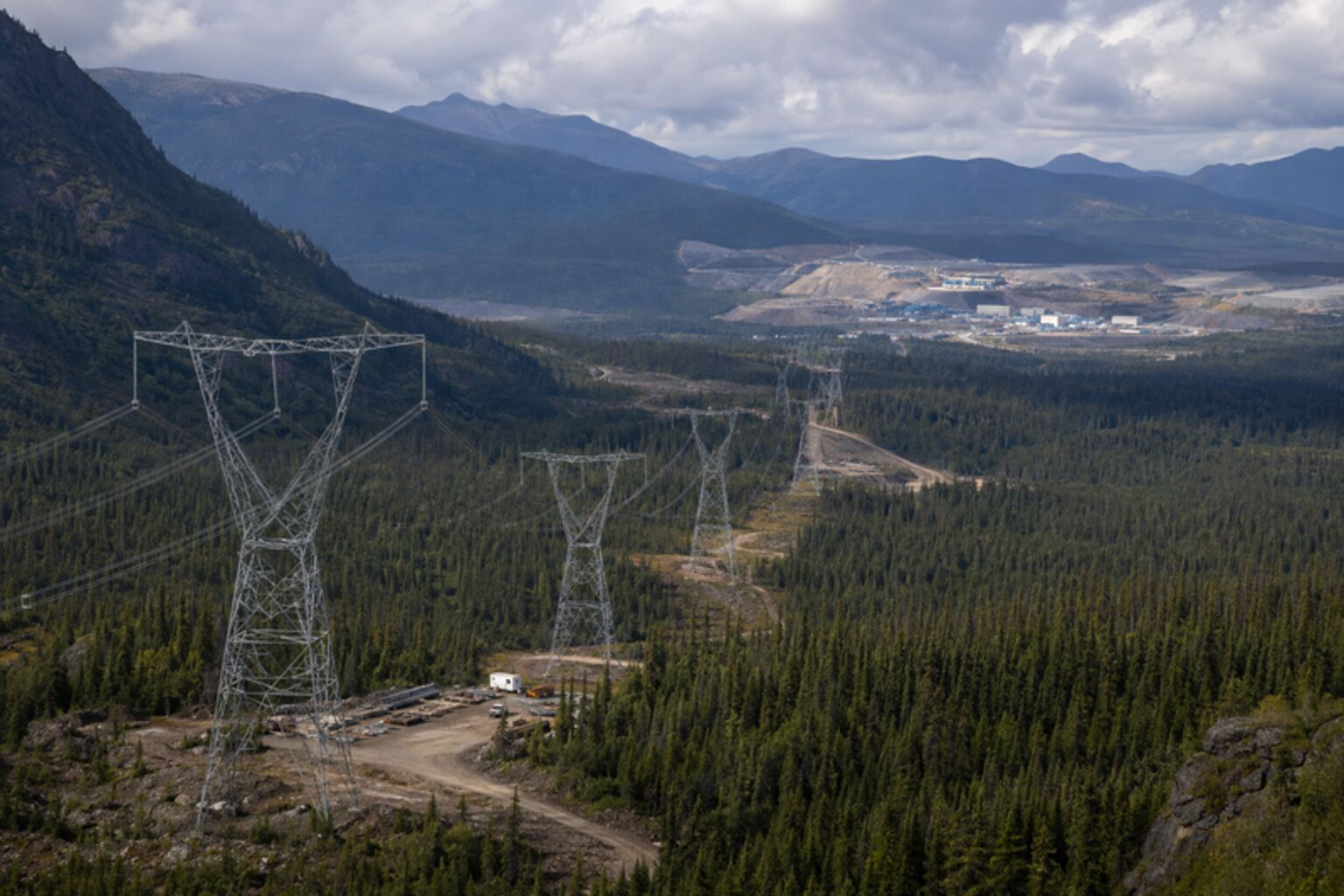

PRINCE GEORGE, British Columbia, September 5, 2026, 5:20 p.m. PDT — Canada has started building a new power artery into northern British Columbia. The miners waiting at the far end still face a four-year clock.
BC Hydro broke ground Thursday on the North Coast Transmission Line. Its latest service plan puts the preliminary cost of the first two phases at C$6 billion.
The stocks barely cheered. Four listed companies tied to Golden Triangle projects lost an equal-weighted 1.22% on Friday. Skeena Resources Limited (TSE:SKE) alone finished higher, by 0.13%.
The corridor basket stayed below its August 24 level
That muted tape makes sense. Phase 1 is scheduled to enter service around fall 2030. Phase 2 targets mid-2032.
Groundbreaking removes one infrastructure doubt. It does not finance a mine, settle its permits or guarantee a grid connection. Metal prices will move these shares many times before the first new electrons arrive.
C$3.9 billion meets a C$6 billion estimate
Canada and British Columbia have committed C$3.9 billion toward phases 1 and 2. That equals 65% of BC Hydro’s preliminary C$6 billion forecast.
The remaining C$2.1 billion is a comparison, rather than a final funding gap. Customer contributions, financing structure and the updated capital plan can change it. Phase 3 is outside the C$6 billion figure entirely.
Public commitments cover 65% of the preliminary estimate
A C$139.5 million Canada Infrastructure Bank loan funded early engineering, route clearing and consultation. Clearing began in July. Major line contracts are due to be awarded during 2027, according to BC Hydro’s procurement update.
The construction milestone is real. So is the duration risk. Delays and cost revisions compound differently when a project stretches across six construction seasons.
The route is 440 kilometres; delivery runs into 2032
Phase 1 clearing and access work moves from planning into construction.
Prince George to Glenannan is scheduled to enter service around fall.
Glenannan to Terrace targets mid-year service after a 2027 major start.
Which shares carry the exposure
The federal release names Golden Triangle critical-minerals development as a target. The line expands regional capacity; each mine still needs its own interconnection and investment decision.
Skeena owns Eskay Creek and expects initial production in 2027. Its project page says the mine will connect to nearby low-cost hydropower through the existing 287-kV Northwest Transmission Line.
Seabridge Gold Inc. (TSE:SEA; NYSE:SA) owns KSM. One of its stated 2026 goals is completing the Treaty Creek switching station for a BC Hydro power hookup.
Newmont Corporation NYSE:NEM operates Red Chris with a 70% stake. Imperial Metals Corporation (TSE:III) owns the other 30%. Newmont expects a final investment decision on the underground expansion later this year.
Four tickers, three projects, different sensitivities
Eskay Creek
Single-company development exposure. The project is already under construction and targets 2027 production.
KSM
Large undeveloped copper-gold resource. Seabridge seeks a major partner and advances its grid switching station.
30% of Red Chris
Imperial carries concentrated joint-venture exposure alongside its other British Columbia mines.
70% of Red Chris
Newmont operates the mine. Its global portfolio makes this corridor a smaller part of the share-price story.
Power was the common bottleneck
Demand from mines, LNG facilities and ports now exceeds the existing 500-kV line’s capacity. The new route should more than double available power between Prince George and Terrace.
Ottawa estimates the line could unlock C$10 billion in new activity and almost 10,000 jobs. Those are government projections. They depend on separate industrial projects actually proceeding.
Energy Minister Tim Hodgson said the line would “deliver the clean electricity needed to unlock B.C.’s world-class deposits.” His September 3 statement also tied it to new processing capacity.
Ownership adds another layer. First Nations may co-own as much as 50% of the new line. Negotiations remain active, and agreements are expected later this year.
Some terms are unresolved. Chief Robert Michell of Stellat’en First Nation said, “All our conditions to build haven’t been addressed by the Crown.” The comment appears in the province’s own release.
The next rerating needs company proof
The grid start changes the probability tree. It moves a regional expansion from policy language into physical work. Friday’s prices show that investors still separate infrastructure progress from mine economics.
Skeena’s nearer production date gives it the shortest operating clock. Seabridge still needs a partner. Red Chris awaits Newmont’s feasibility work and investment decision.
Risks remain substantial. The C$6 billion estimate is preliminary, Phase 3 has no included cost, and the schedule reaches 2032. Mine financing, permits, Indigenous agreements and weaker copper or gold prices could dilute the benefit.
Construction has begun. The market’s next question is sharper: which mine can turn a future power connection into cash flow first?