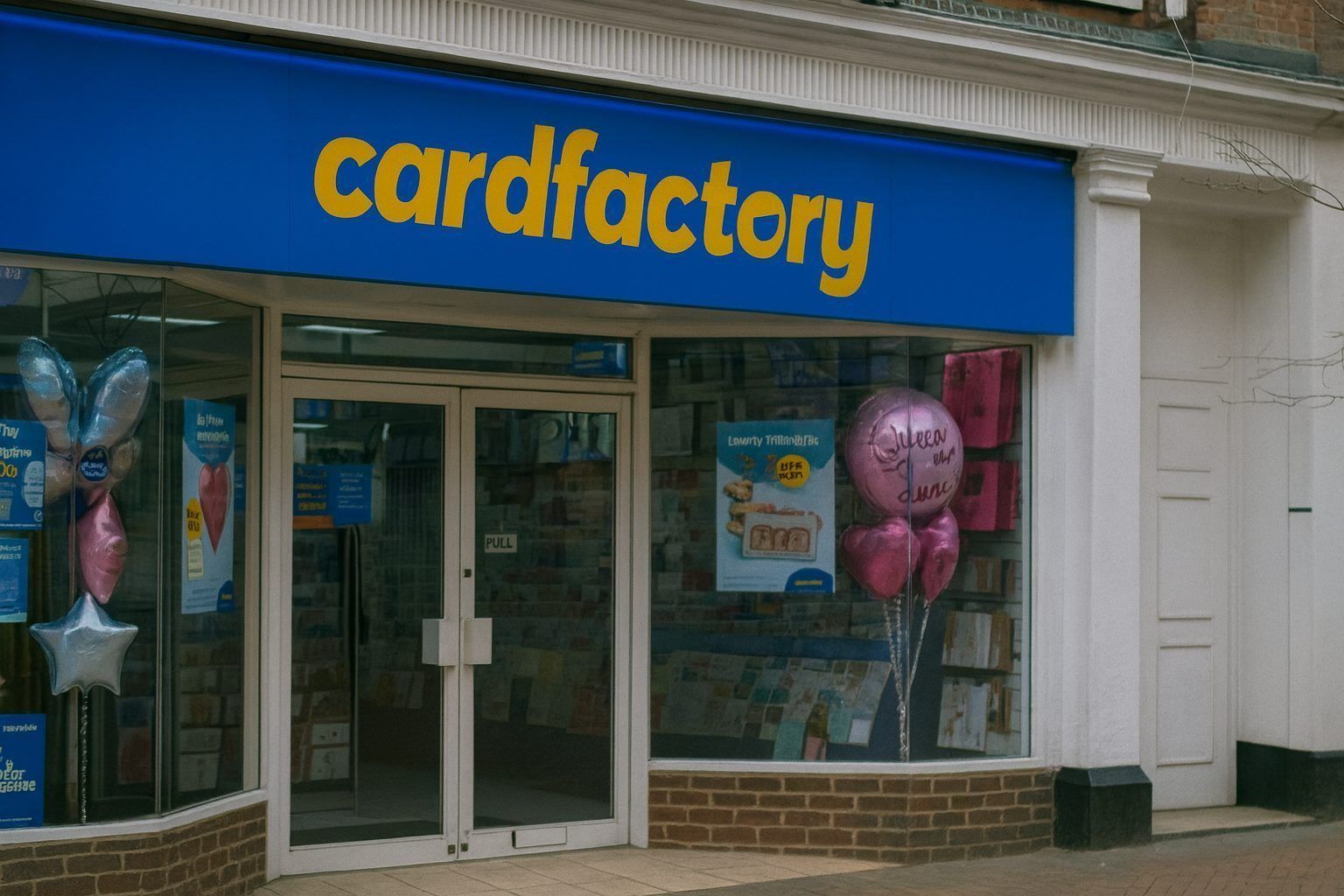

London | 12 December 2025 — Card Factory Plc shares suffered a sharp sell-off on Friday after the UK greetings card and gifting retailer issued a surprise profit warning heading into what it calls its “most important” trading period of the year. The company blamed weaker UK consumer confidence and “soft” high-street footfall, cutting its full‑year profit expectations for the financial year ending 31 January 2026. London South East+2Reuters+2
In morning trading, Card Factory stock slid from the prior close of 96.40p to around the low‑70s, at one point trading as low as 69.90p. The London Stock Exchange’s delayed quote showed shares around 71.30p, down roughly 26% on the day.
What happened to Card Factory shares today?
Card Factory’s update landed early Friday and immediately changed the tone around the stock. In its trading statement, the retailer said UK store sales have been running below its previous expectations as the squeeze on consumers has continued into December.
That downgrade was echoed across market coverage:
- Reuters reported the shares fell as much as 27% and hit a more than three‑year low, with analysts describing the magnitude of the warning as a surprise.
- The Guardian called it a “shock profit warning” during peak Christmas trading, noting the company does not expect to make up the lost sales in the remaining weeks of the financial year. The Guardian
- Investors’ Chronicle described a “festive sell‑off” after Card Factory blamed “soft high street footfall” and lowered profit guidance. Investors’ Chronicle
The new profit forecast: Card Factory cuts FY26 expectations to £55m–£60m
The key number investors are reacting to is Card Factory’s revised guidance for adjusted profit before tax (PBT):
- New FY26 adjusted PBT guidance:£55 million to £60 million (assuming current trading trends persist through the final seven weeks of the year) London South East+2Reuters+2
- FY25 adjusted PBT:£66.0 million London South East
Reuters framed the new outlook as a 9% to 16.6% decline versus last year.
Just as important is what that guidance replaced. Prior company messaging had pointed to mid‑to‑high single‑digit percentage growth in FY26 adjusted PBT from FY25 levels—implying something closer to ~£70m than today’s £55m–£60m range.
Management’s explanation: soft footfall and weaker UK store sales
Card Factory’s core message is that macro pressure has become too visible to ignore, particularly in the UK store estate. It said consumer pressures have impacted confidence and shopping behaviour, contributing to weaker high-street footfall, and that these conditions have persisted into the key festive period.
At the same time, the company pointed to several stabilisers:
- Republic of Ireland and North America are trading in line with expectations London South East+1
- Integration of Funky Pigeon remains on track London South East+1
- Progress continues on its productivity and efficiency initiative, “Simplify and Scale” London South East+1
Buyback headline: Card Factory was repurchasing shares just before the slump
One detail that stood out to traders on Friday: Card Factory also published a “Transaction in Own Shares” RNS.
The company disclosed it bought back 100,000 shares on 11 December 2025 at a volume-weighted average price of about 96.57p (with prices on the day in a 96.20p–97.40p range).
Those repurchases are part of a share repurchase programme announced earlier in the autumn. Card Factory said the programme began 30 October 2025 and will run until no later than 31 January 2026, with shares typically held in treasury to help satisfy employee share awards.
Why it matters for investors: buybacks can be a signal of confidence, but they can also be largely mechanical (for employee share plans). Either way, the optics are striking: the company was buying shares around the mid‑90s pence level shortly before the market repriced the business into the low‑70s on a profit warning.
Analyst reaction: “shock warning”, and doubts about recovering “lost” festive sales
Today’s sell-off isn’t just about the headline profit range—it’s also about timing. A profit warning in December, for a retailer heavily exposed to the season, tends to rattle confidence.
Key reactions reported on 12 December include:
- Panmure Liberum’s Wayne Brown called the update a “shock warning” that surprised “in scale,” and raised questions about whether Card Factory’s strategy shift toward celebration products may have increased its sensitivity to the economic cycle. Reuters
- Investec’s Kate Calvert said weak consumer spending and pre‑budget caution have hit footfall and sales, and that Card Factory does not feel it can recover the “lost” sales in the remainder of the year. The Guardian
- Stockopedia described the warning as a “hammer blow” to shareholders, highlighting how far the new guidance undershoots prior expectations and reiterating that high‑street card retailers remain economically sensitive. Stockopedia+1
The big reset: from growth hopes to a profit decline
A useful way to understand today’s downgrade is to compare it with where expectations stood only months ago.
September: profits down, but guidance held
In its half-year report (six months ended 31 July 2025), Card Factory reported:
- Revenue: £247.6m (up 5.9%)
- Adjusted PBT: £13.2m (down 9.0%)
- Net debt (excluding leases): £78.9m London South East
The same document also details the balance-sheet shape that equity investors tend to watch in a downturn, including total lease liabilities of £121.4m at 31 July 2025.
July: Funky Pigeon deal pitched as a digital accelerator
In July, Card Factory agreed to buy Funky Pigeon from WH Smith for £24m cash, describing it as an acceleration of its online and omnichannel strategy. The company said Funky Pigeon had generated roughly £32m revenue per year and around £5m EBITDA on average across the prior two financial years.
Card Factory also highlighted expected annual synergy benefits of more than £5m, and said the acquisition should be earnings enhancing in the year ending January 2027 (the first full year post-completion).
Against that backdrop, the December profit warning is a meaningful confidence hit: even if the long‑term digital plan remains intact, the near‑term earnings engine—the UK store base in peak season—has weakened materially.
Forecasts and price targets: where analysts stood as of 12 December 2025
After a sudden profit downgrade, investors typically look for one thing: How far do external forecasts and targets move next?
Here’s what widely-followed consensus pages were showing on 12 December (with an important caveat below).
Investing.com: average target around 163p, range 110p–225p
Investing.com’s analyst snapshot showed:
- 7 analysts
- Average 12‑month price target: ~162.86p
- Low / High targets:110p to 225p
- Consensus rating: “Strong Buy” (6 buy, 1 hold) Investing.com
MarketBeat: “Moderate Buy” with targets cited from Canaccord and Peel Hunt
MarketBeat’s same‑day note highlighted:
- Shares down sharply with volume spiking (tens of millions of shares traded)
- A “Moderate Buy” consensus and a mean target around 148.33p
- Broker notes referenced: Canaccord (185p) and Peel Hunt (110p) MarketBeat
Investors’ Chronicle forecast page: median target 160p
Investors’ Chronicle’s forecasts page listed:
- Median target:160p
- High / Low:185p / 110p (as displayed on the page) Investors Chronicle
Critical caveat: price targets may be stale after today’s guidance change
Many published targets reflect research written before a trading shock. A profit warning this late in the year typically triggers broker model updates (lower near-term earnings assumptions, sometimes lower targets), but those changes may take days to flow into consensus aggregators.
Stockopedia noted that an Edison Research note in October had suggested FY26 adjusted PBT of £70.7m—a very different starting point to today’s £55m–£60m guidance.
Independent small‑cap commentator Paul Scott also wrote that consensus numbers were not yet updating immediately, and sketched a scenario where the profit miss implies meaningfully lower EPS than previously forecast.
Why the macro backdrop matters: the high street is soft, and the economy is wobbling
Card Factory is highly exposed to discretionary shopping trips. That makes it sensitive not only to consumer confidence but to raw footfall—especially during seasonal peaks.
Reuters linked the warning to a broader weak retail backdrop and noted that official data showed the UK economy shrank unexpectedly over the three months to October.
The Guardian’s business live coverage on the same day also focused on weaker UK growth data and rising expectations for a Bank of England rate cut at the 18 December meeting—another signal that policymakers see the economy as fragile.
Structural headwinds: fewer letters, pricier stamps, shifting habits
Beyond the cyclical footfall problem, Card Factory sits inside a longer-term debate: are people sending fewer physical cards?
The Guardian pointed to UK postal trends, noting Royal Mail’s annual letter volumes have fallen dramatically over the last two decades and citing Ofcom expectations for further declines. It also highlighted sharp increases in the cost of stamps (including a first‑class stamp price rise to £1.70 earlier in 2025).
Card Factory’s strategy response has been to broaden from cards into gifts and “celebration essentials”, and to strengthen its online position via Funky Pigeon—moves that may matter more now that the store estate is showing weakness during peak season. London South East+1
What investors will watch next for Card Factory stock
With the stock repriced sharply in a single session, the next catalysts are likely to be operational:
- Christmas and January trading: The company’s guidance is explicitly conditional on current trends persisting into year-end, so any stabilisation—or further deterioration—matters disproportionately.
- Evidence that “Simplify and Scale” offsets cost inflation: Management continues to point to productivity and efficiency as a buffer against an inflation-impacted retail environment. London South East+1
- Funky Pigeon integration milestones: Investors will look for proof that the acquisition improves online competitiveness and creates synergy benefits on the path to FY27.
- Balance sheet and cash returns: The board reiterated buybacks and a progressive dividend approach, which will be scrutinised against the lower profit outlook.
Bottom line
Card Factory’s profit warning on 12 December 2025 is a classic high‑street shock: the company is still profitable and insists its long-term strategy is progressing, but the near-term earnings trajectory has shifted abruptly—right in the middle of peak trading.
Related articles: Financial Forecasts