No Signal? No Problem – Starlink’s Direct-to-Cell Satellites Are Eliminating Dead Zones

No Signal? No Problem – Starlink’s Direct-to-Cell Satellites Are Eliminating Dead Zones

August 2022: SpaceX and T-Mobile announced a partnership to provide direct-to-cell connectivity via Starlink satellites, with texting expected in 2023–24 and voice/data thereafter. January 2024: SpaceX achieved the first SMS directly via satellite, enabling a two-way text conversation between ordinary smartphones relayed entirely through space after the first batch of D2C-equipped satellites launched. Gen2 Starlink satellites carry the Direct-to-Cell payload, and the smaller V2 Mini satellites launched on Falcon 9 in 2023–24 were equipped to support these tests. By late 2024, more than 400 Starlink satellites had Direct-to-Cell capability, enabling voice calls, video calls, and IoT tests such as Cat-1

Starlink’s Sky Grab: How SpaceX Is Quietly Rewiring the Global Internet Game

Starlink’s Sky Grab: How SpaceX Is Quietly Rewiring the Global Internet Game

Starlink launched its first batch of 60 satellites in 2019, and by late 2024 the constellation numbered nearly 7,000 satellites in low-Earth orbit. In 2022 Starlink introduced laser inter-satellite links, enabling data to hop between satellites and extending coverage to oceans, polar regions, and remote locales. By mid-2023 Starlink declared global coverage aside from regulatory holdouts, with service reaching Arctic areas and mid-ocean shipping lanes. By early 2024 Starlink was legally available in about 70 countries. Starlink’s user base grew from 1 million by end-2022 to over 4.6 million by end-2024, with more than 5 million users expected by early
Inside Burundi’s Digital Struggle: The Truth About Internet Access and the Satellite Solution

Inside Burundi’s Digital Struggle: The Truth About Internet Access and the Satellite Solution

As of January 2025, Burundi had about 1.78 million internet users, roughly 12.5% of ~14 million people, leaving about 88–90% offline. About 99.6% of internet subscriptions are mobile broadband, while fixed broadband is virtually nonexistent with ~0.3% of homes wired and only about 3,000 fixed broadband subscriptions in 2023. 4G coverage reached about 32% of the population in 2023, 3G about 53%, while 2G covers around 97%, leaving many rural areas without true internet. The rural population accounts for about 84% of Burundians, and the government’s Universal Service Fund is rolling out 4G to 178 rural communities, aiming to reach
The Shocking Truth About Internet Access in Burkina Faso – From White Zones to Starlink Dreams

The Shocking Truth About Internet Access in Burkina Faso – From White Zones to Starlink Dreams

As of 2023, internet penetration in Burkina Faso is about 20%, with roughly 4.7 million active internet users in a 23 million population. By late 2023 there were about 17 million mobile internet subscriptions, offering ~77% potential coverage though many subscribers are not active. Fixed broadband remains extremely limited, with about 85,000 active fixed internet subscriptions in Q3 2023, up 140% from 2022. There is a pronounced urban–rural gap: 3G reaches about 64% of the country and 4G/LTE about 46%, 85% have basic mobile signal, 15% have no signal, 1,700 white zones were identified in 2022, of which only 183
Global Drone Market Outlook (2025–2030)

Global Drone Market Outlook (2025–2030)

In 2024, the total global drone market was about $73 billion, with forecasts to reach roughly $163–165 billion by 2030 at around a 14% CAGR. Some analyses forecast growth from about $30 billion in 2022 to $260.5 billion by 2030, implying a 27–39% annual growth rate. By 2030 the market’s major segments are projected to be: Consumer about $11.6B, Commercial about $55B, Military about $90B, Delivery about $10.5B, and Agricultural about $22.5B in annual revenue. DJI dominates the consumer drone market with an estimated 70–80% global share, over 90% in some sub-categories, led by Phantom and Mavic series as of
Everything You Need to Know About Internet Access in Bulgaria (Even the Satellites!)

Everything You Need to Know About Internet Access in Bulgaria (Even the Satellites!)

By 2021, about 65% of fixed broadband subscribers in Bulgaria were on fiber, with gigabit speeds available and Vivacom launching a 10 Gbps fiber service. 5G was launched commercially in 2020, with A1 Bulgaria and Vivacom turning on 5G in 2020 and by the end of 2022 around 70% of the population expected to have 5G coverage. Starlink entered Bulgaria in February 2022, and as of 2025 Neterra is an authorized Starlink reseller offering hardware and support, with typical speeds over 100 Mbps down and 40–60 ms latency at around €60 per month plus a €300 equipment kit. Vivacom holds
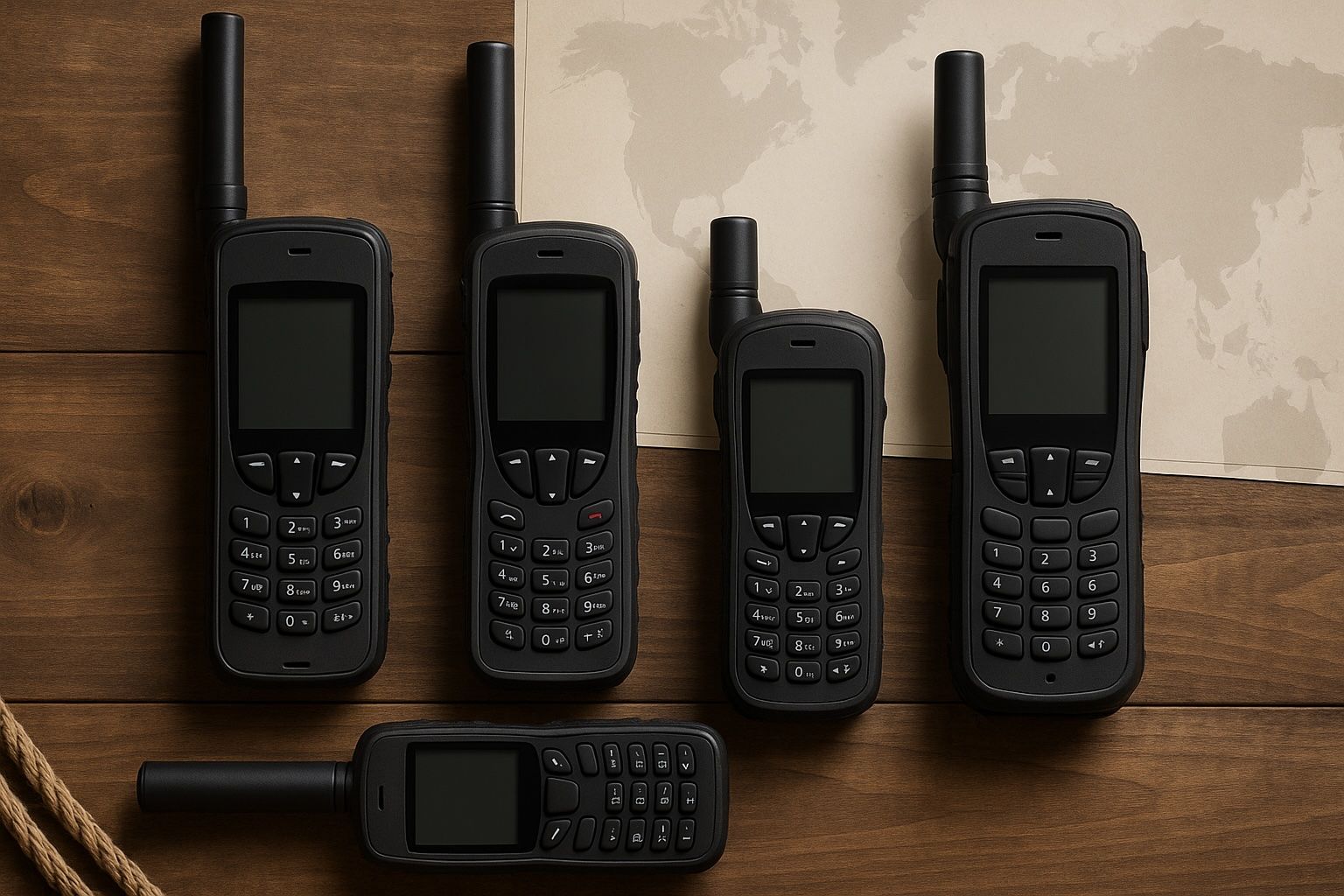
Satellite Phones: A Comprehensive Report

Satellite Phones: A Comprehensive Report

Iridium, a LEO network, started service in 1998 and operates 66 active cross-linked satellites, delivering near-global coverage, with the Iridium NEXT second-generation network launched in 2019. Globalstar uses 48 satellites (24 second-generation as of 2013), has no inter-satellite links and relies on ground gateways, and Apple’s Emergency SOS on iPhone 14 uses about 85% of Globalstar’s capacity for emergency texts. Inmarsat operates a GEO fleet of about 11 satellites, offers IsatPhone handheld services, the IsatPhone 2 provides ~8 hours of talk time and 160 hours of standby, and Inmarsat expanded with I-4/I-6 series after its 2023 acquisition by Viasat. Thuraya
2 June 2025
You Won’t Believe Brunei’s Internet: 5G Everywhere, 100 Mbps for All – Even Satellites Are Joining

You Won’t Believe Brunei’s Internet: 5G Everywhere, 100 Mbps for All – Even Satellites Are Joining

In 2019 Brunei created Unified National Networks (UNN), a wholesale network consolidating fixed, mobile, and submarine infrastructure for DST, imagine, and Progresif. In June 2023 Brunei officially launched nationwide 5G with about 90% of the population covered. A Fixed Broadband Uplift Program raised the baseline fixed broadband speed to 100 Mbps for all subscribers and tested 1 Gbps in a pilot. The three retail ISPs are Datastream Digital (DST), imagine, and Progresif, all reselling capacity via UNN. Brunei’s international connectivity is governed by three submarine cables—SEA-ME-WE3, the Asia-America Gateway (AAG), and the Southeast Asia-Japan Cable (SJC)—all under UNN. About 99%
2 June 2025
Botswana’s Digital Leap: How Satellites and Smartphones Are Redefining Internet Access in the Kalahari

Botswana’s Digital Leap: How Satellites and Smartphones Are Redefining Internet Access in the Kalahari

As of early 2024, about 2.09 million Batswana were internet users, representing roughly 77.3% of the population. Cellular penetration is around 185%, with mobile internet subscriptions at 2.93 million and fixed-line subscriptions at 164,000. Orange Botswana launched Africa’s first 5G network in 2022, initially covering about 30% of the population. SpaceX’s Starlink entered Botswana in August 2024 after BOCRA approved the license in May 2024, with Paratus Botswana becoming the first authorized Starlink reseller. BoFiNet operates the national fiber backbone and buys capacity from submarine cables like WACS and EASSy, becoming the largest provider of Botswana’s international bandwidth; as of
Bosnia’s Internet in 2025: Surprising Growth Amid Shocking Gaps in Connectivity

Bosnia’s Internet in 2025: Surprising Growth Amid Shocking Gaps in Connectivity

As of 2025, about 83% of Bosnia and Herzegovina’s population uses the Internet. 4G/LTE networks reach roughly 94% of the population, served by BH Telecom (BH Mobile), M:tel, and HT Eronet. 5G is not commercially deployed in 2025, with authorities predicting spectrum auctions may occur in 2025–2026 after regulatory delays. Fixed broadband shares (2023) are DSL around 50.1%, Cable about 29.8%, Fiber (FTTx) about 12.6%, Fixed Wireless about 7.2%, and Leased lines about 0.2%. FTTH fiber coverage reaches less than 10% of households, one of the lowest fiber coverage rates in Europe. Starlink is set to enter Bosnia in 2025,
Starlink Global Availability and Impact Report

Starlink Global Availability and Impact Report

Starlink is available in over 100 countries as of mid-2025, spanning North America, Europe, Asia, Africa, Oceania, and parts of South America. As of late 2024, Starlink had surpassed 4 million subscribers. Starlink offers five service types: Residential, Roam, Business (Priority), Maritime, and Aviation. Typical speeds range from about 50 Mbps to 150+ Mbps, with most users above 100 Mbps under good conditions, and latency around 20–50 ms. Monthly pricing ranges from about $90–$120 in well-connected markets, with discounts to roughly $30–$50 in developing regions. The United States was the first to receive Starlink, with public beta in mid-2020 and
2 June 2025
The Internet Frontier: How Bolivia Is Connecting from the Peaks to the Stars

The Internet Frontier: How Bolivia Is Connecting from the Peaks to the Stars

TKSat-1, launched in 2013 as a $300 million geostationary satellite with China’s help, enabled rural internet, backhaul for mobile towers, and community telecenters with latency around 600 ms. Plans for Túpac Katari 2 with substantially higher throughput were discussed, but a second satellite had not materialized by 2025. In August 2024 Bolivia banned unlicensed Starlink terminals, yet by early 2025 an estimated 10,000 Starlink kits were in use on the gray market, often roaming from Peru, with about $50/month and $500 equipment. The El Alto national data center opened in February 2025, a $52 million Tier III facility owned by

Stock Market Today

Go toTop