Browse Category

Satellite News 15 March 2025 - 4 June 2025

Military Satellite Services: Complete Guide to Secure Communications

Military Satellite Services: Complete Guide to Secure Communications

The United States operates the Advanced Extremely High Frequency (AEHF) constellation, delivering jam-resistant, global, protected military communications including nuclear command and control links. Navstar GPS is a 31-satellite global navigation system that provides precise positioning, navigation, and timing to guide munitions such as JDAM and to synchronize encrypted networks. Defense Support Program (DSP) and the Space-Based Infrared System (SBIRS) form…
Aviation Satellite Services: Benefits, Providers, and New Technologies

Aviation Satellite Services: Benefits, Providers, and New Technologies

By late 2022, more than 10,000 aircraft worldwide were equipped with in-flight connectivity, and about 65% of airlines planned further IFC investments in the next few years. Aireon’s space-based ADS-B payloads on Iridium NEXT have been operational since 2019, enabling global real-time tracking and supporting ICAO’s 15-minute GADSS position reporting standard. COSPAS-SARSAT, a global satellite distress system, relays 406 MHz…
Maritime Satellite Services: Complete Guide to Ship Connectivity & Communications

Maritime Satellite Services: Complete Guide to Ship Connectivity & Communications

L-band MSS terminals, such as Inmarsat FleetBroadband and Iridium Certus, provide global coverage with compact antennas but limited data throughput. Ku-band VSAT (12–18 GHz) has been the maritime workhorse, Ka-band HTS (26–40 GHz) offers higher capacity, while C-band deployments are restricted near shore due to interference and large dish requirements. GEO satellites offer broad coverage with about 600 ms latency,…
4 June 2025
Satellite Phones: A Comprehensive Report

Satellite Phones: A Comprehensive Report

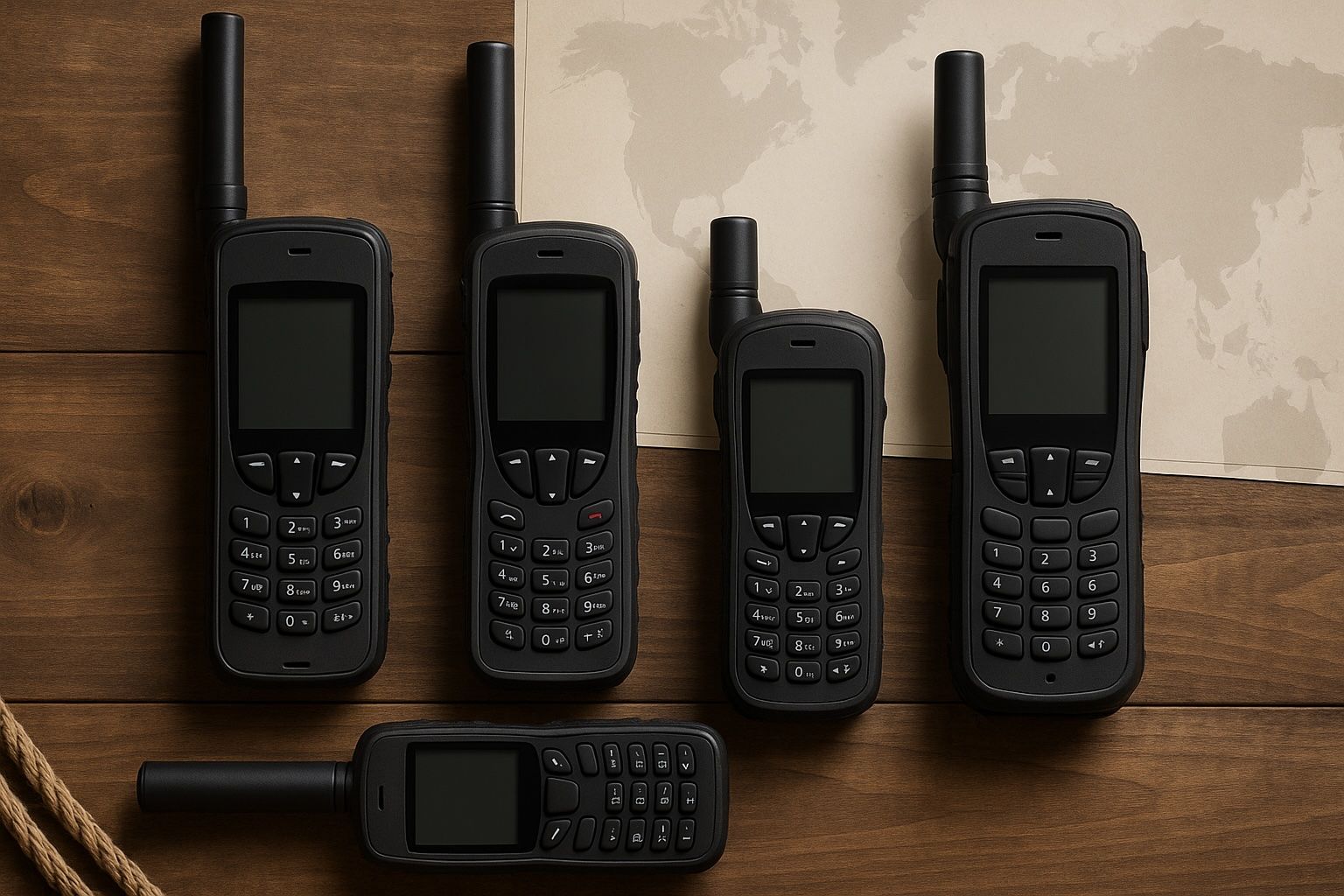
Iridium, a LEO network, started service in 1998 and operates 66 active cross-linked satellites, delivering near-global coverage, with the Iridium NEXT second-generation network launched in 2019. Globalstar uses 48 satellites (24 second-generation as of 2013), has no inter-satellite links and relies on ground gateways, and Apple’s Emergency SOS on iPhone 14 uses about 85% of Globalstar’s capacity for emergency texts.…
Starlink Global Availability and Impact Report

Starlink Global Availability and Impact Report

Starlink is available in over 100 countries as of mid-2025, spanning North America, Europe, Asia, Africa, Oceania, and parts of South America. As of late 2024, Starlink had surpassed 4 million subscribers. Starlink offers five service types: Residential, Roam, Business (Priority), Maritime, and Aviation. Typical speeds range from about 50 Mbps to 150+ Mbps, with most users above 100 Mbps…
2 June 2025
Inside OneWeb’s Global Internet Play: How This Satellite Network Is Quietly Disrupting Starlink’s Orbit

Inside OneWeb’s Global Internet Play: How This Satellite Network Is Quietly Disrupting Starlink’s Orbit

OneWeb’s first-generation constellation comprises 648 LEO satellites at about 1,200 km altitude, each ~150 kg, using Ku-band for user links and Ka-band for gateways, with 16 spot beams and no inter-satellite laser links, delivering up to 7.2 Gbps per satellite. By late 2021, OneWeb achieved partial service in high-latitude regions, focusing on the Arctic, Northern Europe, Greenland, and Alaska. On…
29 May 2025
Sky-Fi Revolution: How Starlink Is Reshaping Global Internet Access

Sky-Fi Revolution: How Starlink Is Reshaping Global Internet Access

Starlink is a SpaceX satellite internet constellation that began launching in 2019 to deliver broadband virtually anywhere on Earth. As of late 2024, SpaceX had launched over 7,000 Starlink satellites, with FCC authorization for about 12,000 and potential expansion beyond 30,000 in the future. Starlink satellites orbit at approximately 550 km altitude in multiple orbital shells, enabling lower latency than…
State of Internet Access in Argentina: Fiber, 5G, and Satellite in 2025

State of Internet Access in Argentina: Fiber, 5G, and Satellite in 2025

Argentina had about 40.6 million internet users and an internet penetration of 88% in early 2024, according to DataReportal. Fixed broadband subscriptions reached 11.9 million by end-2024, including about 4.8 million fiber subscriptions, up roughly 1 million that year. Fiber grew to represent about 41% of fixed broadband lines nationwide by late 2024, up from roughly 34% at end-2023. In…
29 May 2025
Inside Nicaragua’s Digital Frontier: The Truth About Internet Access and Satellite Connectivity

Inside Nicaragua’s Digital Frontier: The Truth About Internet Access and Satellite Connectivity

As of early 2025 Nicaragua had 8.71 million mobile connections, about 125% of the population, with more than 95% of lines capable of 3G/4G broadband. In January 2025, 4.47 million Nicaraguans used the internet, equal to 64.1% of the population. There were about 371,000 fixed broadband subscriptions in 2023, 5.43 per 100 people, with most lines in urban areas and…

Stock Market Today

  • Alphabet set to beat the market in 2026 but unlikely to replicate 2025 surge
    January 17, 2026, 3:21 PM EST. Alphabet, parent of Google, was a top performer in 2025 among the Magnificent Seven, a group of large tech names that surged last year. The unusually strong run may not repeat in 2026, but the stock could still beat the market. Key themes: Gemini, Alphabet's AI model, is winning enterprise adoption; Google Search remains a dominant cash cow, and AI-generated Overviews have helped keep traffic intact. Political risk from antitrust eased after a lighter penalty and no breakup was mandated, while Chrome and Android stay core to the business. A later monetization of AI could lift the multiple, though the near term remains uncertain. The stock hovered around $330 with a roughly $4 trillion market cap as of the latest session.
Go toTop