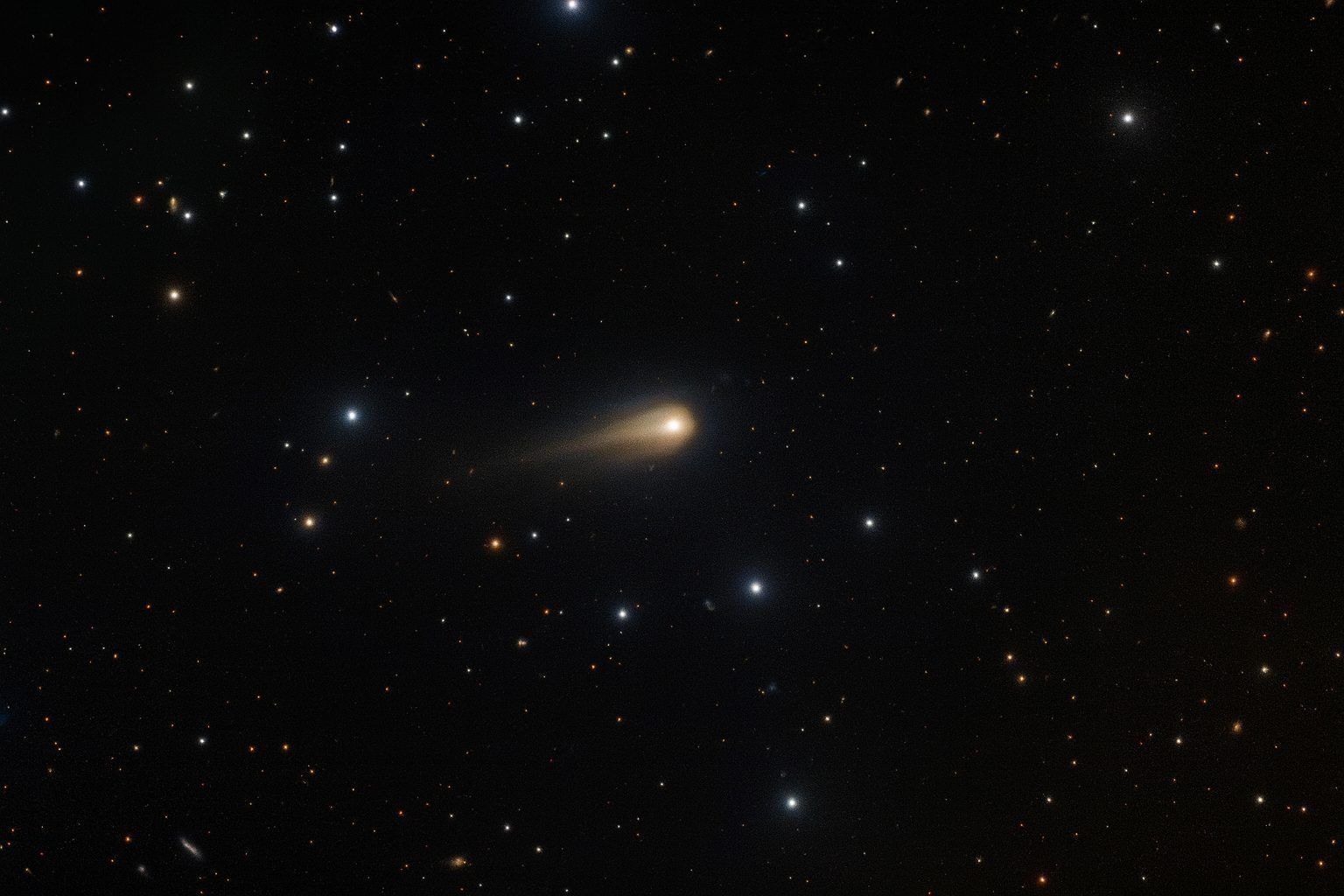
In the early hours of Friday, December 19, 2025, an icy visitor from beyond our Solar System swept through our cosmic neighborhood—not close enough to scare anyone, but close enough to thrill astronomers.
Comet 3I/ATLAS (also known by its formal designation C/2025 N1 (ATLAS)) reached its closest point to Earth at about 1:00 a.m. EST (06:00 GMT)—still a vast ~1.8 astronomical units away, or roughly 168 million miles (270 million kilometers). Space+2NASA Science+2
That distance is nearly twice the average Earth–Sun separation, which is exactly why scientists keep repeating the same reassuring line: there is no impact risk. NASA Science+2European Space Agency+2
So why all the attention? Because 3I/ATLAS is only the third confirmed interstellar object ever observed passing through our Solar System, following 1I/‘Oumuamua (2017) and 2I/Borisov (2019). NASA Science+1
What’s new today is the combination of (1) the flyby itself, (2) updated timing and viewing guidance, and (3) fresh reporting on what NASA and partner missions have captured—especially a rare ultraviolet perspective from Europa Clipper that was impossible to get from Earth for part of the comet’s journey. Space+2NASA Science+2
Today’s main moment: when 3I/ATLAS was closest to Earth
According to NASA/JPL orbital calculations referenced by Space.com, 3I/ATLAS hit minimum distance at 1:00 a.m. EST (06:00 GMT) on Dec. 19. Space
Space.com’s live coverage reported the comet had “just zoomed past Earth” around that time, noting that it will now continue outward through the Solar System, with a longer goodbye tour ahead. Space
Meanwhile, NASA’s official FAQ page emphasizes the key takeaway: even at “closest approach,” 3I/ATLAS remains extremely far away—around 170 million miles (270 million km), ~1.8 AU. NASA Science
Where is Comet 3I/ATLAS in the sky tonight?
If you’re stepping outside to try to see 3I/ATLAS on Dec. 19, here’s the practical reality:
- You won’t see it with the naked eye.
- Binoculars usually won’t cut it.
- A telescope (or a smart telescope) is your best shot. National Geographic+1
As of today, National Geographic reports the comet can be found in the constellation Leo, not far from Regulus (Leo’s brightest star). It may be easiest in the pre-dawn hours, depending on where you live and how high it gets above your horizon. National Geographic
NASA also notes that the comet is back to being observable again after being hidden near the Sun earlier this fall and that it can be observed in the pre-dawn sky and should remain observable until spring 2026 (fading as it goes). NASA Science
How to watch Comet 3I/ATLAS live online tonight
For many people, the best view won’t be through an eyepiece—it’ll be through a livestream.
The key update for Dec. 19: the livestream was delayed by rain
Space.com reports that the Virtual Telescope Project livestream (run by astronomer Gianluca Masi) was pushed back due to weather and is now expected to begin:
- 11:00 p.m. EST Friday, Dec. 19
- 04:00 UTC (GMT) Saturday, Dec. 20 (weather permitting) Space+1
The Virtual Telescope Project itself posted the same update, explicitly stating the event was rescheduled because of rainand confirming the 04:00 UTC on Dec. 20 start time. The Virtual Telescope Project 2.0
This timing matters because the comet’s closest approach has already happened—but it’s still observable, and tonight is still a prime “public attention” window while the flyby is fresh in everyone’s mind. Space+1
What makes 3I/ATLAS an “interstellar comet” (and why scientists are excited)
NASA’s explanation comes down to orbital math: 3I/ATLAS is on a hyperbolic trajectory, meaning it’s moving too fast to be permanently bound to the Sun. It isn’t looping around like typical Solar System comets—it’s passing through once, then leaving. NASA Science
ESA’s FAQ similarly frames the comet as an ancient traveler—billions of years old—and emphasizes that it is an active comet shedding material as it was warmed by the Sun. European Space Agency
That’s the deeper science appeal: comets preserve chemistry from where they formed. A comet that formed around another star is like a moving sample capsule—one we can only study remotely, and only briefly. NASA Science+1
New and notable science updates in today’s coverage
1) NASA’s Europa Clipper captured a rare ultraviolet view
One of the most talked-about mission updates around today’s flyby is that NASA’s Europa Clipper observed 3I/ATLAS on Nov. 6 from about 102 million miles (164 million kilometers) away, collecting roughly seven hours of data with its Europa Ultraviolet Spectrograph (Europa-UVS). NASA Science+1
NASA says this ultraviolet dataset will help researchers determine the composition and distribution of elements in the comet’s coma (the cloud of gas and dust surrounding the nucleus). NASA Science
Southwest Research Institute (SwRI), which leads the UVS instrument, highlighted why this was special: Clipper had a geometry that let it see the comet from a sunward/downstream perspective, helping bridge a period when Earth- and Mars-based observing was limited. SwRI reports UVS detected oxygen, hydrogen, and dust-related features, consistent with strong outgassing after the comet’s close approach to the Sun. Southwest Research Institute+1
A short quote from SwRI’s Europa-UVS principal investigator captures the tone of this “bonus science” moment: “this opportunity… was completely unexpected.” Southwest Research Institute
2) NASA’s Psyche mission helped refine the comet’s trajectory
NASA also reports that the Psyche spacecraft observed 3I/ATLAS for about eight hours on Sept. 8–9, when the comet was about 33 million miles (53 million km) from the spacecraft. Those observations, NASA says, helped astronomers refine the trajectory and added information about the comet’s faint coma. NASA Science
3) ESA says ExoMars data improved predictions—fast
ESA’s Planetary Defence Office responded to the discovery quickly and, in its FAQ, notes that data from ExoMars Trace Gas Orbiter collected in early October helped improve the comet’s predicted location by a factor of ten. European Space Agency
4) X-ray observations and multi-spacecraft coverage
ESA also notes that, in late November and early December, X-ray telescopes including XRISM and XMM-Newtonobserved a diffuse X-ray glow around the comet, calling 3I/ATLAS the first interstellar comet observed in X-ray light. European Space Agency+1
Taken together, today’s story isn’t just “a comet passed by.” It’s closer to: the Solar System briefly became a global, multi-agency observing campaign—telescopes on Earth, plus instruments spread across deep space, all collecting data before the object fades and departs. NASA Science+2European Space Agency+2
The “is it aliens?” question, and what NASA and ESA actually say
A wave of online speculation has followed 3I/ATLAS for months, partly because interstellar objects are rare and partly because the internet can’t resist a mystery.
But on the technical questions that matter—trajectory, activity, and “non-gravitational” behavior—NASA’s official position is clear:
- The comet’s properties are consistent with what scientists expect from a comet. NASA Science
- Any small trajectory changes are compatible with outgassing—gas released as ices heat and sublimate—causing slight “pushes.” NASA Science
ESA likewise describes 3I/ATLAS as an active comet showing dust plumes and gas release observed by major facilities, emphasizing observation—not alarm. European Space Agency
If you’re looking for the most grounded framing for today: 3I/ATLAS is weird because it’s foreign, fast, and fleeting—not because it’s artificial. NASA Science+1
What happens next: the comet’s exit route and future milestones
Although Dec. 19 is the “Earth headline” date, it isn’t the end of the comet’s Solar System story.
- NASA notes the comet’s closest approach to the Sun (perihelion) occurred around late October 2025, just outside Mars’ orbit. NASA Science+1
- NASA also indicates the comet is on course to venture past Jupiter in March 2026 on its way out. NASA Science
- AP reports it will come much closer to Jupiter in March, passing within about 33 million miles (53 million km), and cites NASA’s Paul Chodas saying it will be mid-2030s before it reaches interstellar space again—never to return. AP News
For skywatchers, the practical takeaway is simpler than the orbital mechanics: the comet won’t vanish overnight, but it will gradually fade as it recedes, which is why observatories and mission teams have been racing to collect as much data as possible right now. NASA Science+1
Bottom line for Dec. 19, 2025
Today’s 3I/ATLAS news can be summed up in three lines:
- Closest approach happened at ~06:00 GMT (1:00 a.m. EST) at ~1.8 AU—a safe but scientifically valuable flyby. Space+1
- You can’t see it with the naked eye, but telescope users may catch it near Leo/Regulus, and everyone else can follow livestream coverage. National Geographic+2NASA Science+2
- Spacecraft data is the real story: Europa Clipper, Psyche, ESA missions, and major observatories are building the most detailed portrait yet of an interstellar comet’s gases, dust, and behavior. Southwest Research Institute+3NASA Science…