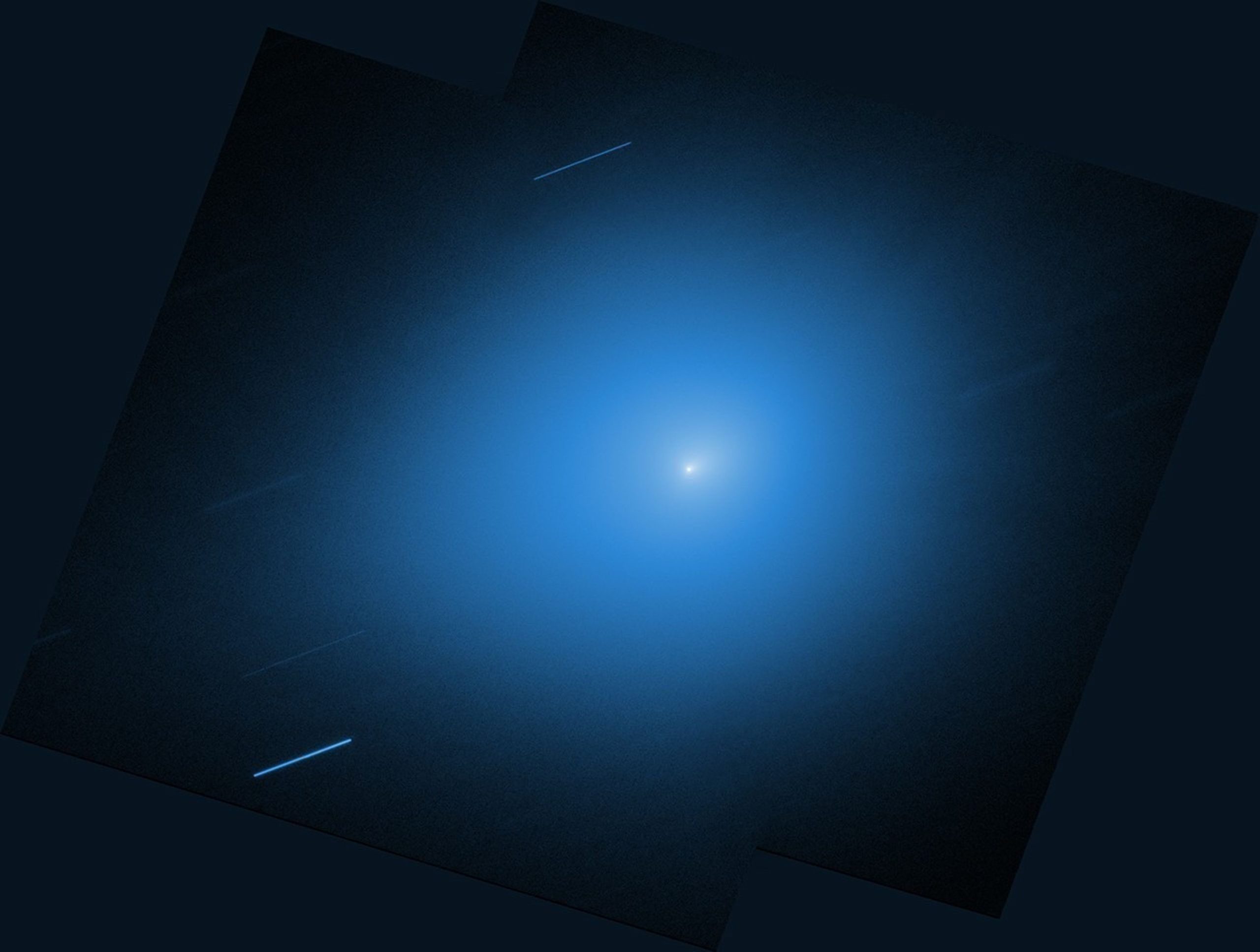
December 23, 2025 — Comet 3I/ATLAS, the third confirmed interstellar object ever seen passing through our solar system, is already on its way out. But the news cycle around it is still very much inbound.
In the days following 3I/ATLAS’ closest approach to Earth on Dec. 19, 2025, space agencies and research teams have been stitching together an unusually rich, multiwavelength “biography” of this visitor from another star system: NASA says it’s a normal (if rare) active comet, while ESA and Japan’s XRISM mission have revealed something never conclusively seen in an interstellar comet before—an X‑ray glow produced as the comet’s gases collide with the solar wind. European Space Agency+3NASA Science+3Europ…
Meanwhile, the internet’s favorite side quest—“is it alien tech?”—has not fully powered down. But the newest measurements and targeted searches are steadily tightening the story around physics, chemistry, and a whole lot of sunlight heating ice. NASA Science+2Reuters+2
The essential update: 3I/ATLAS has passed Earth safely — and it was never close
3I/ATLAS reached its closest distance to Earth on Dec. 19 at roughly 1.8 astronomical units—about 170 million miles (270 million kilometers)—nearly twice the Earth–Sun distance. It posed no danger to Earth, and ESA notes it was on the other side of the Sun during that closest approach. NASA Science+1
NASA’s latest fact sheet also emphasizes how fast the object is moving: when discovered, it was traveling around 137,000 mph (221,000 km/h), accelerating under the Sun’s gravity to roughly 153,000 mph (246,000 km/h) at perihelion. As it departs, it will eventually leave the solar system at essentially the same speed it arrived. NASA Science
Quick facts (what people are searching for right now)
- What is it? An interstellar comet—an icy body releasing gas and dust—designated “3I” because it’s the third confirmed interstellar object observed in our solar system. European Space Agency+1
- Who found it? The NASA-funded ATLAS survey telescope in Río Hurtado, Chile, reported it on July 1, 2025. NASA Science+1
- How big is it? Still uncertain; NASA cites Hubble-based estimates placing its nucleus diameter between about 1,400 feet (440 m) and 3.5 miles (5.6 km). NASA Science
- When did it pass the Sun? NASA says perihelion occurred Oct. 30, 2025, at about 130 million miles (~210 million km) from the Sun (just outside Mars’ orbit). NASA Science
- Can you still see it? NASA says it can be observed with small telescopes in the pre‑dawn sky, and should remain observable until spring 2026, though it is fading with distance. NASA Science
The biggest new science headline: 3I/ATLAS glows in X‑rays
If you want the most “2025 sentence” possible, here it is: an interstellar comet is interacting with the solar wind strongly enough to show up in X‑ray observations.
ESA reports that XRISM (a JAXA-led mission with NASA and ESA participation) watched 3I/ATLAS for about 17 hours between Nov. 26–28, 2025, capturing what ESA describes as the first interstellar comet imaged in X‑ray light. European Space Agency+1
Soon after, ESA’s XMM‑Newton followed up with a long observation (around 20 hours, per ESA materials) that produced a striking view of the comet’s low-energy X‑ray glow. That glow is expected when gas streaming from a comet’s coma collides with charged particles in the solar wind—a process well-known for solar system comets, but a major milestone for interstellar ones. ESA also notes X‑rays can be especially sensitive to gases such as hydrogen and nitrogen that are harder to see in optical and ultraviolet studies. European Space Agency+1
In other words: 3I/ATLAS isn’t just photogenic; it’s becoming a laboratory for how “foreign” comet chemistry behaves inside a very familiar heliosphere.
NASA’s Parker Solar Probe caught 3I/ATLAS when Earth couldn’t
One of the stranger twists in this comet’s coverage is that some of its best “spy photos” come from a spacecraft built to study the Sun, not comets.
NASA says the Parker Solar Probe observed 3I/ATLAS from Oct. 18 to Nov. 5, using its WISPR camera system. This window matters because the comet passed through a geometry where it was difficult or impossible to observe well from Earth-based perspectives. NASA describes Parker’s role as giving scientists a way to track the comet during a period when “it was out of view from Earth,” and notes the spacecraft was tens of millions of miles from the comet during the campaign. NASA Science+1
For researchers trying to reconstruct how the comet’s activity evolved around perihelion—how much it brightened, what its tail and jets did, whether its outgassing changed—those Parker observations help fill in missing chapters.
Europa Clipper’s ultraviolet look: “alien-hunting” hardware, very normal comet work
Another spacecraft cameo came from Europa Clipper, NASA’s mission headed for Jupiter’s ocean moon Europa. In a widely shared update, the spacecraft’s ultraviolet spectrograph observed the comet for hours and produced a composite UV image taken from roughly 102 million miles (164 million km) away (captured on Nov. 6, per reporting based on NASA material). The point is not “looking for aliens” in the comet—it’s that the same UV tools designed to analyze Europa can also help characterize the gases in the comet’s coma. Live Science
This also tees up the next major waypoint in the comet’s solar-system sprint: Jupiter.
The “radio signal” wasn’t a transmission — it was chemistry
A big misconception in the 3I/ATLAS discourse has been the phrase “radio signal.”
Yes, radio telescopes detected something. But reporting based on MeerKAT observations describes it as OH absorption at the 1665 MHz and 1667 MHz lines—consistent with hydroxyl (OH), a common product when water-related molecules are broken apart by sunlight and embedded in comet activity. In other words: not a message, not a beacon—a spectral fingerprint. WIRED
This matters because the strongest scientific case for any interstellar comet is not “mystery,” but comparative planet formation: if you can measure water-related chemistry, carbon compounds, and other volatiles from a body that formed around a different star, you’re doing a kind of exoplanet archaeology—without leaving home.
SETI results: Breakthrough Listen reports no technosignature detection
Because the “alien tech” meme got loud early, it triggered something useful: targeted, transparent checks.
The SETI Institute reports that Breakthrough Listen used the Allen Telescope Array to observe 3I/ATLAS in early July, searching across roughly 1–9 GHz frequencies, and found no evidence of a technosignature in that dataset. (They also describe radio-frequency interference patterns that can mimic signals—an important real-world reminder that the universe is noisy, and so are we.) SETI Institute
That doesn’t “prove a negative” in a cosmic sense, but it does what good science does: it narrows claims to what the data actually supports.
Why the “is it a spaceship?” debate persists — and what the latest data says
There are two overlapping realities around 3I/ATLAS:
- Scientifically, it’s a once-in-years opportunity to sample another star system’s leftovers—remotely, but with modern instruments ranging from optical to infrared to X‑ray. ESA explicitly frames interstellar comets as “true outsiders” carrying clues about planet formation elsewhere. European Space Agency
- Culturally, it’s a perfect conspiracy engine: unfamiliar object + huge speed + interstellar origin + complicated orbital math + a few visually weird tail/jet geometries.
NASA’s position is blunt: the comet’s color, speed, direction, and cometary features are consistent with expectations for an active comet, and the small deviations in its trajectory are compatible with ordinary outgassing—the subtle rocket-like push that occurs when sunlight heats ice and releases jets of gas and dust. NASA Science
At the same time, some commentary has pointed to unusual-looking features—particularly a prominent sunward structure sometimes described as an “anti-tail”—as a reason to keep watching. Coverage of Avi Loeb’s arguments notes he has placed the object at 4 out of 10 on his own “Loeb Scale,” and has suggested the March 2026 Jupiter passage could provide new tests of the comet’s behavior. Chron+1
This is where it’s worth being boringly precise: testable predictions are welcome, but extraordinary interpretations must clear an extraordinary evidence bar. At the moment, the most data-supported storyline remains “interstellar comet doing comet things,” now documented across more wavelengths than any previous interstellar visitor.
The next big date: 3I/ATLAS and Jupiter in March 2026
After brushing past Earth at a safe distance, 3I/ATLAS’ next headline moment will be its approach to Jupiter in March 2026, when it is expected to pass at about 33 million miles (53 million kilometers) from the planet, per AP reporting and NASA-linked coverage. AP News+1
This matters for two reasons:
- Gravitational environment: Jupiter’s immense gravity and magnetic environment create conditions where changes in outgassing, dust dynamics, or trajectory modeling can be scrutinized.
- Spacecraft opportunity: Discussions have included whether spacecraft near Jupiter (notably Juno) can contribute useful observations, depending on constraints and mission priorities. Chron+1
And then, the long goodbye: AP notes it may take until the mid‑2030s before the comet reaches interstellar space again—continuing a one-way journey that started in another star system and ends back between the stars. AP News
A quieter but important “today” development: the world is using 3I/ATLAS to rehearse future readiness
Not all of the 3I/ATLAS story is about pretty data and public fascination. Some of it is infrastructure—how humanity gets better at tracking fast, rare objects.
Live Science reports that the U.N.’s International Asteroid Warning Network (IAWN) is using 3I/ATLAS as part of a global observing campaign aimed at improving astrometry—the precision measurement of object positions—because comets can be tricky: their comas and changing brightness complicate pinpoint tracking. The campaign involves dozens of observatories and citizen scientists, with results expected to be published later. Live Science
That’s a very 21st-century kind of progress: even when an object is harmless, we treat it as a drill—because someday, one won’t be.
Bottom line on Comet 3I/ATLAS today
As of Dec. 23, 2025, Comet 3I/ATLAS is an interstellar visitor that has already made its safe Earth flyby, is being analyzed through an unusually broad suite of observations, and is delivering something rare: hard data about comet chemistry and physics from beyond our solar system, including landmark X‑ray detections. European Space Agency+3NASA Science+3Europ…
The most important upcoming milestone is its March 2026 pass near Jupiter, which will likely be the next moment when both professional and amateur observers can test new claims against new measurements. AP News+1