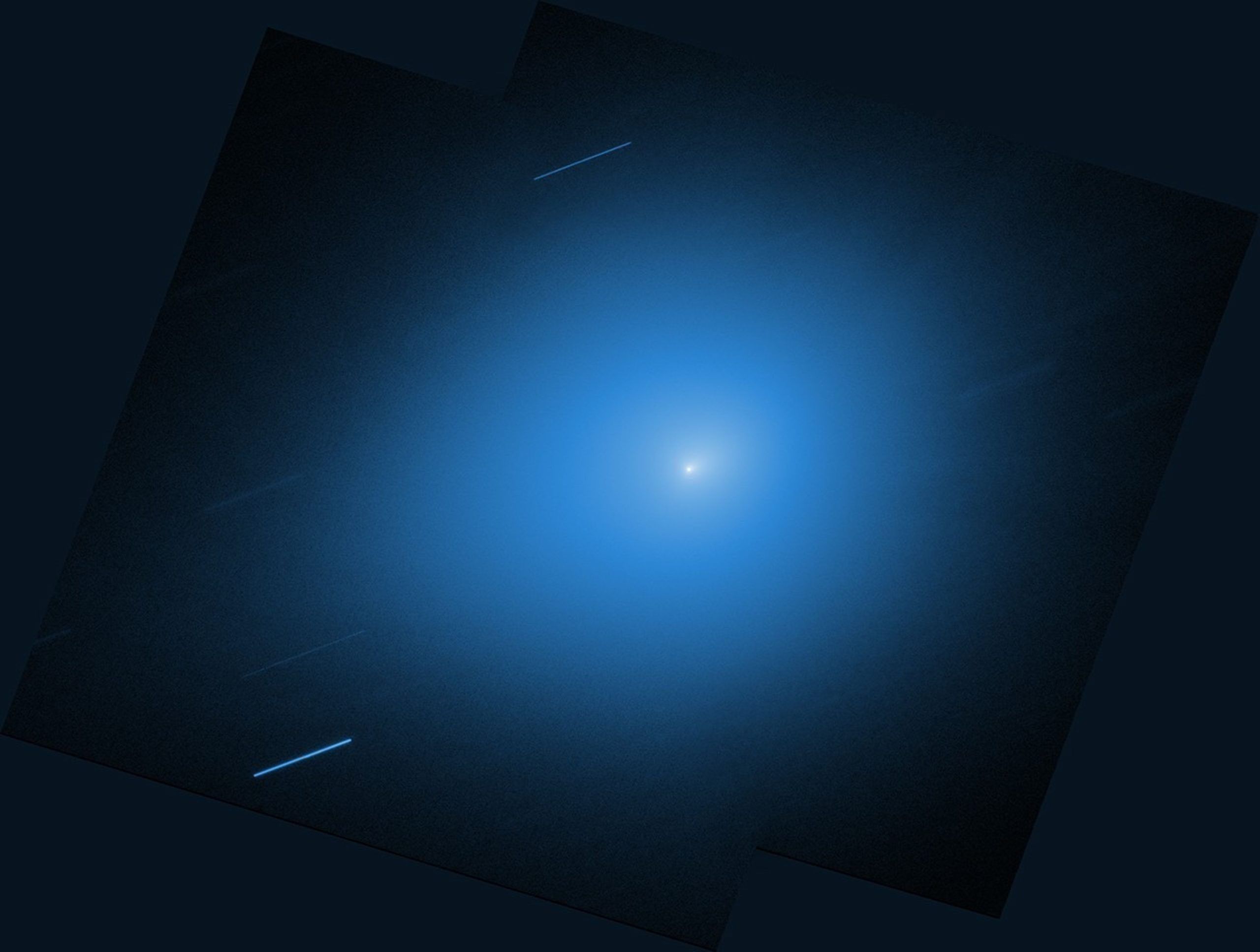

December 25, 2025 marks the strange, quiet “afterglow” phase of Comet 3I/ATLAS—the third confirmed interstellar object ever found passing through our solar system. The comet’s closest approach to Earth is already behind us (it passed at a safe distance), but the science story is still unfolding fast: Breakthrough Listen has now reported results from an ultra-sensitive “are you broadcasting?” radio search, while NASA and ESA continue to publish spacecraft observations that help pin down what this visitor is actually made of—and how it behaves when the Sun starts cooking it. SETI Institute
The quick recap: what is 3I/ATLAS, and why is everyone watching it?
3I/ATLAS was first reported on July 1, 2025 by the NASA-funded ATLAS survey telescope in Rio Hurtado, Chile. Its path is hyperbolic, meaning it’s not bound to the Sun—this is a one-time pass through our neighborhood, inbound from interstellar space and outbound back into the galaxy.
NASA says the comet posed no danger to Earth, and even at its closest it remained extremely far away—on the order of about 1.8 astronomical units (~170 million miles / ~270 million km) from Earth on Dec. 19, 2025. That “close approach” date matters because it’s when telescopes could get their best look with the least geometric disadvantage. NASA Science
What’s new today (Dec. 25, 2025): the “alien signal” check comes back empty
The most widely shared fresh update circulating today is the one that combines pop-cultural curiosity (“Is it an alien probe?”) with actual, rigorous instrumentation:
Breakthrough Listen observed 3I/ATLAS on Dec. 18, 2025—one day before closest approach—using the 100-meter Green Bank Telescope across 1–12 GHz. The team reports no credible detections of narrowband radio technosignatures, with the study explicitly describing a nondetection down to the ~100 milliwatt level for candidate signals.
That’s an absurd level of sensitivity in human terms: Breakthrough Listen and the SETI Institute note that at closest approach the search was sensitive to transmitter powers around 0.1 W (EIRP)—a “phone-on-a-table” kind of number, not a “galactic empire” number. SETI Institute
Just as important as the headline: the teams are being very direct about the interpretation. The paper states there is currently no evidence that interstellar objects are anything other than natural astrophysical objects, while also arguing that—because we’ve only seen a handful—checking is scientifically warranted.
“No signal” doesn’t mean “no science”: what the SETI teams actually did
A common misconception is that a SETI search is someone staring at a waterfall plot waiting for aliens to text “hi.” In reality, the Breakthrough Listen observations described:
- Multiple receiver bands spanning roughly 1.1–11.7 GHz
- An observing pattern that alternates on-target and off-target scans (to identify local interference)
- Automated searches for drifting narrowband signals (what you’d expect from a transmitter on a moving/rotating body) arXiv
The SETI Institute also summarizes other facilities used on 3I/ATLAS (including the Allen Telescope Array and MeerKAT) and reports no technosignatures detected across these campaigns so far.
There’s also a transparency move that’s worth highlighting: both the news coverage today and the SETI/Breakthrough Listen write-up point readers to publicly available data products (with specialist tools needed to analyze them). In other words: “Don’t trust us—go reproduce the analysis.” That’s the scientific method in its natural habitat. SETI Institute
Another “today” thread: a new attempt to estimate the comet’s true size
Also circulating with today’s update is discussion of a separate (still not peer-reviewed) analysis that uses non-gravitational acceleration—tiny trajectory changes caused by asymmetric outgassing—to estimate the nucleus size.
In plain English: when sunlight heats a comet, jets of gas and dust don’t always fire evenly in all directions. That can act like a weak, natural thruster. Modeling that effect can constrain how massive the nucleus must be.
Reporting on this, coverage today describes an estimate that places the nucleus at around ~1 km in diameter, with a range of roughly 820–1050 meters under specific assumptions.
NASA’s own public FAQ remains more conservative (and, frankly, appropriately cautious): as of Hubble observations as of Aug. 20, 2025, NASA says the nucleus diameter is not smaller than ~440 m and not larger than ~5.6 km—wide error bars driven by the difficulty of separating the nucleus from the bright coma.
Where is Comet 3I/ATLAS today, and can you still see it?
Today, 3I/ATLAS is outbound—moving away from the Sun and from Earth—so it’s fading rather than brightening. NASA emphasizes that it will not come close to Earth, and that it is now heading away on its exit trajectory.
The practical skywatching news: NASA says the comet is again observable from Earth after passing behind the Sun in October, with astrometric observations resuming Oct. 31, 2025. It can be observed in the pre-dawn sky and is expected to remain observable until spring 2026, even with a small telescope (expect “faint fuzz,” not a cinematic tail filling the sky). NASA Science
If you want the cleanest “where is it right now?” tracker NASA recommends its Eyes on the Solar System simulation for current position and path. NASA Science
How fast is it moving now?
NASA’s FAQ gives a crisp speed story:
- Around 137,000 mph (221,000 km/h) when discovered (inside Jupiter’s orbit)
- Speeding up to about 153,000 mph (246,000 km/h) at perihelion (closest to the Sun) due to solar gravity
- Now slowing down as expected as it departs, ultimately leaving at roughly the speed it entered NASA Science
NASA also notes that outgassing can cause small trajectory perturbations and that observed perturbations for 3I/ATLAS are small and compatible with ordinary cometary outgassing.
The spacecraft campaign: this comet got followed by an entire robotic civilization
One reason Comet 3I/ATLAS became such a major science story is that it wasn’t just “seen from Earth.” It was watched—sometimes opportunistically—by spacecraft scattered through the solar system.
Europa Clipper’s ultraviolet look (and why it’s a big deal)
NASA reports that Europa Clipper observed 3I/ATLAS on Nov. 6, 2025 from about 102 million miles (164 million km) away, over a seven-hour window using its Europa Ultraviolet Spectrograph (Europa-UVS). The goal: measure the composition and distribution of elements in the coma (the cloud of gas and dust surrounding the nucleus).
The neat bit of engineering poetry here is that Europa-UVS was built to study Europa—but the team repurposed it because the geometry lined up and the comet is a rare target that will never return.
Parker Solar Probe’s “from the inner solar system” viewpoint
NASA also reports that Parker Solar Probe observed 3I/ATLAS from Oct. 18 to Nov. 5, 2025 using its WISPR imager, capturing roughly 10 images per day while Parker was on its own solar flyby trajectory. NASA notes the images require careful processing (stray light, exposure differences), and that final calibrated products will help scientists study the comet during a period when it was hard to observe from Earth due to solar proximity.
NASA further notes other heliophysics missions that also saw the comet, including PUNCH, STEREO, and SOHO.
ESA’s X-ray storyline: the comet glows in a way your eyes can’t see
ESA has been releasing a steady stream of updates and imagery around 3I/ATLAS, including X-ray observations that are particularly useful because they probe gases that can be difficult to capture at optical wavelengths.
XMM-Newton (Dec. 3, 2025): 20 hours of X-ray observation
ESA reports that XMM-Newton observed 3I/ATLAS on Dec. 3 for around 20 hours, when the comet was about 282–285 million km from the spacecraft. ESA explains the comet’s X-ray glow as the result of gas streaming from the comet interacting with the solar wind, producing X-rays.
ESA also notes a key scientific advantage: X-ray observations are uniquely sensitive to gases like hydrogen (H₂) and nitrogen (N₂)—species that are close to invisible to many optical/UV instruments.
XRISM (Nov. 26–28, 2025): first interstellar comet imaged in X-rays
ESA reports that XRISM observed 3I/ATLAS for 17 hours between Nov. 26–28, 2025, capturing X-rays from a region roughly 400,000 km around the nucleus and noting signs of carbon, nitrogen, and oxygen in the data. ESA explicitly frames this as a milestone: 3I/ATLAS is the first interstellar comet to have been imaged in X-ray light.
ESA’s broader roundup emphasizes that 3I/ATLAS has been observed by an international fleet—ground telescopes plus major space observatories and interplanetary missions (including Mars Express, ExoMars TGO, and JUICE among others).
A weird behavioral twist: wobbling jets in a rare sun-facing “anti-tail”
Not all the news is about composition. Some of it is about behavior—specifically, how 3I/ATLAS vents material and how its rotation reveals itself in the structure of its coma and tail.
A recent report highlights research finding that jet structures in a sun-facing anti-tail (rare compared to the usual tail that points away from the Sun) were wobbling roughly every 7 hours and 45 minutes. The work connects this to a nucleus rotation period around 15 hours and 30 minutes, based on observations across 37 nights between July 2 and Sept. 5, 2025.
The big scientific punchline: anti-tails and wobbling jets have been seen in solar system comets, but this appears to be the first time such outgassing behavior has been characterized in an interstellar comet—a rare chance to study “comet physics” in material that formed around a different star. Space
So what does all of this mean, scientifically?
Interstellar objects are like geology samples that deliver themselves—except the lab is the entire planetary science community racing the clock before the sample leaves forever.
From NASA’s perspective, the core mission is straightforward: observe it as intensely as possible, across as many wavelengths and vantage points as possible, because objects like this are rare and fleeting.
From ESA’s perspective, the emphasis is similar: coordinate rapid response observations and use unusual capabilities (like X-rays) to constrain what 3I/ATLAS is made of and how it interacts with the solar wind.
And from the SETI side, today’s Breakthrough Listen result adds a clean, falsifiable data point: no narrowband radio emissions consistent with a transmitter have been detected in their most sensitive searches to date—useful not because it “debunks aliens” (science isn’t a vibe war), but because it strengthens the baseline assumption that these visitors are natural unless evidence indicates otherwise. arXiv
What happens next?
Even though the “closest approach” excitement has passed, 3I/ATLAS will remain a target as long as telescopes can still pick it up.
- NASA says it should remain observable in the pre-dawn sky with telescopes into spring 2026, and recommends tracking with Eyes on the Solar System.
- The Breakthrough Listen/SETI teams say they will continue observations as part of a broader strategy for future interstellar objects, with public data products already available.
- And according to a widely syndicated space-news report, the comet is expected to make a much closer pass to Jupiter in March 2026 before continuing outward, with its final escape to interstellar space expected later (on the scale of years).
As of today—December 25, 2025—the best way to summarize Comet 3I/ATLAS is: it’s leaving, it’s natural, it’s still scientifically loud, and the “last word” on its composition, structure, and behavior will come from the slow, careful work of turning a global pile of telescope and spacecraft observations into coherent models.
A comet from another star system just gave us a drive-by lab experiment. The polite thing to do is learn everything we can before it disappears into the cosmic dark.