
Dec. 26, 2025 — Comet 3I/ATLAS is already on its way out of our neighborhood, but it’s still managing to surprise astronomers on the way to the cosmic exit ramp. Today’s coverage centers on a fresh scientific twist: researchers have identified wobbling jet structures inside an even rarer feature—an apparent tail that points toward the Sun, not away from it.
If you’ve been following the saga, this is the part where the universe reminds us it has a sense of humor: the comet is leaving, fading, and getting harder to observe from Earth—yet the data it already delivered are still yielding new physics, new debates, and new “wait, comets can do that?” moments. The Indian Express
What’s new on Dec. 26: the “wobbling jets” inside a Sun-facing anti-tail
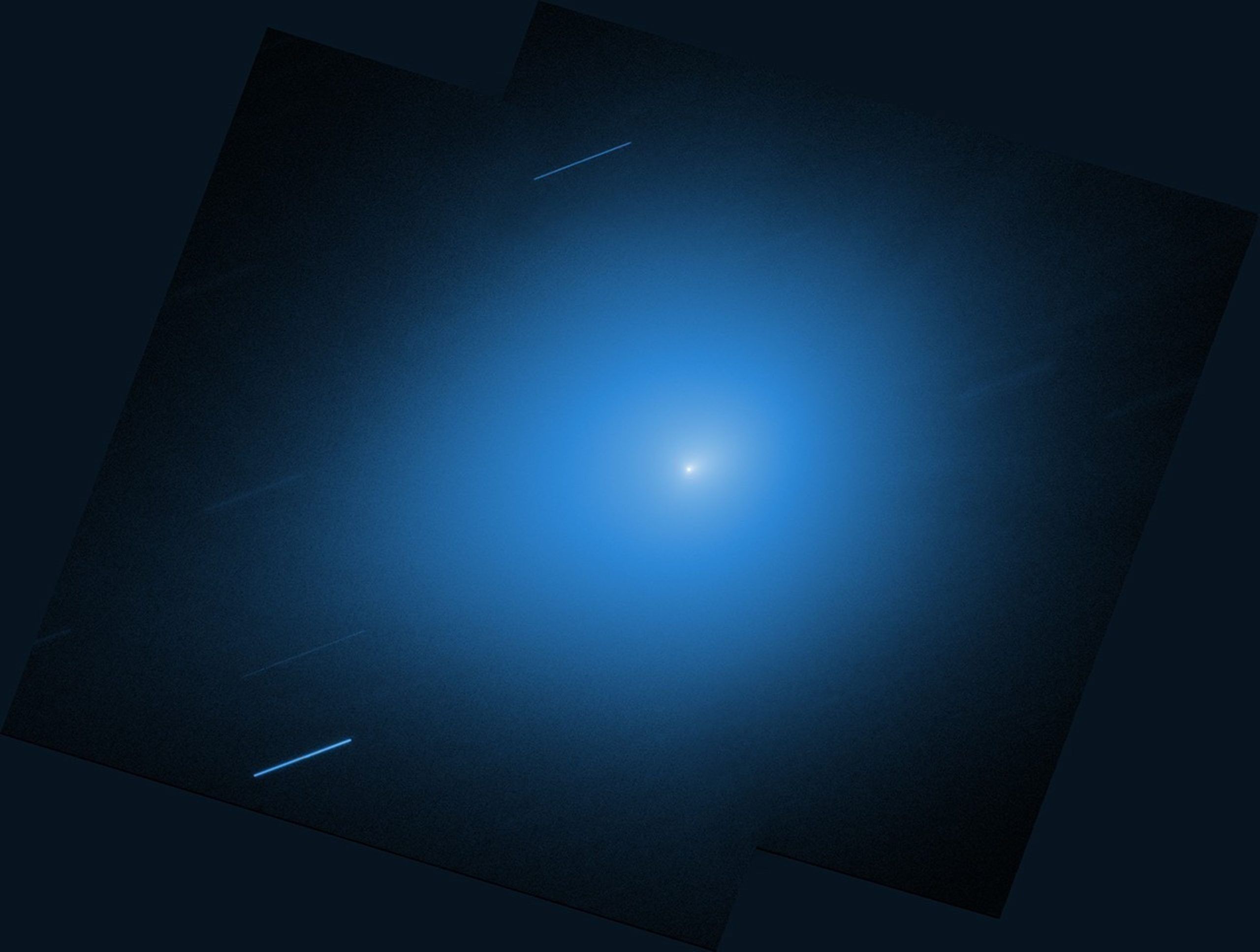
Most comets put on the classic show: a glowing coma (the fuzzy halo) and a tail that streams away from the Sun, pushed by sunlight and the solar wind. An “anti-tail,” by contrast, appears to point sunward—uncommon, often short-lived, and usually tricky to interpret. The Indian Express
Today’s reporting highlights that 3I/ATLAS didn’t just display an anti-tail—it displayed jet-like structures within that sun-facing feature that slowly shifted position in a regular, repeating wobble. In some observations, the sun-facing structure was described as extending up to roughly 620,000 miles (about 1 million kilometers), making it unusually prominent for a visitor that never came especially close to Earth.
The headline number that keeps popping up: the jets’ position angle modulates with a period of about 7.74 hours (often summarized as roughly “7 hours 45 minutes”). That periodic “wobble” is consistent with a jet source near a pole on a rotating nucleus, implying a nucleus rotation period of about 15.5 hours if a single dominant source is involved. arXiv
The key significance isn’t just that the comet has jets (many do), but that this is described as the first periodic jet-angle modulation detected in an interstellar comet—a rare opportunity to probe how a “fresh” body formed around another star behaves when our Sun starts cooking it. arXiv
Where is Comet 3I/ATLAS today? Location, distance, brightness on Dec. 26
Here’s the practical reality-check for anyone typing “Comet 3I/ATLAS today” into a search bar: it’s still out there, but it’s faint and getting fainter.
Ephemeris data for Dec. 26, 2025 place 3I/ATLAS at roughly:
- Magnitude: ~13.2 (a telescope target, not a naked-eye object)
- Distance from Earth (Δ): ~1.821 AU
- Distance from the Sun (r): ~2.498 AU
- Sky position: around RA 10h 11m, Dec +09° 53′ (with the comet tracked through the region of Leo in late December) Vanbuitenen
Magnitude ~13 is firmly in “you need real gear and decent sky conditions” territory. Think motorized tracking, careful star-hopping (or plate-solving smart telescopes), and the emotional resilience to accept that a dim fuzzball can still be scientifically priceless. Vanbuitenen
The flyby already happened: what Dec. 19 changed—and what it didn’t
3I/ATLAS made its closest approach to Earth on Dec. 19, 2025, passing at about 1.8 astronomical units—roughly 170 million miles (270 million kilometers) away. That’s “close” only by Solar System standards; in any everyday sense, it was never a threat and never a near-miss. NASA Science
The bigger deal about Dec. 19 was timing: it was a peak moment for coordinated observations, public interest, and (inevitably) online myth-making. Now, as of Dec. 26, the comet is headed outward on a hyperbolic path that means it won’t be coming back.
NASA’s Astronomy Picture of the Day entry dated Dec. 26, 2025 notes that 3I/ATLAS is moving outward on a hyperbolic trajectory at about 64 km/s relative to the Sun—fast enough that the Sun can’t keep it.
Why this interstellar comet matters (even while it’s leaving)
3I/ATLAS is not “just another comet.” It’s categorized as the third confirmed interstellar object observed passing through our solar system—following 1I/‘Oumuamua (2017) and 2I/Borisov (2019). And unlike ‘Oumuamua’s weird, ambiguous nature, 3I/ATLAS has behaved in many ways like a recognizable comet: nucleus, coma, dust and gas behavior—yet with enough quirks to keep researchers busy. NASA Science
Interstellar objects are valuable because they are, in a very literal sense, samples from elsewhere. You don’t need science fiction to find that astonishing: material assembled around another star system wandered the galaxy and, by dumb luck and gravity, became briefly observable to our instruments.
NASA has emphasized a “use every tool we have” approach—tracking 3I/ATLAS with multiple platforms to capture different phases of its journey, especially when ground-based telescopes can’t see it due to the comet’s apparent proximity to the Sun in our sky. NASA Science
One example: NASA’s Parker Solar Probe observed 3I/ATLAS from Oct. 18 to Nov. 5, 2025, capturing frequent images with its WISPR instrument during a period when the comet was difficult or impossible to observe from Earth-based viewpoints. Those images are still being processed and calibrated, but they extend the timeline of usable data through a critical part of the comet’s evolution.
2025’s “year of the comet” wrap-ups put 3I/ATLAS in the spotlight again
It’s not only researchers keeping 3I/ATLAS in the headlines. Year-end science coverage today is also framing 2025 as a standout year for comet-watchers—with 3I/ATLAS headlining alongside other notable comets that drew public attention.
A Dec. 26 recap points to 3I/ATLAS as the interstellar marquee object of the year, while also nodding to the chaos modern astronomy now has to navigate: real discovery, real data, gorgeous observations… and a parallel universe of rumors that spreads faster than any comet ever will.
What happens next: fading into 2026, with a Jupiter-era chapter ahead
From a skywatching perspective, the trend is simple: fading. As 3I/ATLAS increases its distance from both Earth and the Sun, it becomes less cooperative for amateur observation—still trackable with the right equipment, but no longer anywhere near the peak public attention window around the Dec. 19 flyby.
From a trajectory perspective, there’s still a meaningful upcoming waypoint: reports looking ahead to 2026 note that 3I/ATLAS continues fading into spring and is expected to pass near Jupiter in March 2026—another moment when geometry and proximity could matter for certain kinds of measurements (even if it remains far away in absolute terms).
The broader science story doesn’t end when the comet gets dim. The story shifts into papers, re-analyses, and model-building—because with rare objects like this, the data you already captured can keep producing discoveries long after the target becomes a smudge beyond reach. The newly reported jet wobble is a perfect example: the comet is leaving, but the evidence of its physics is arriving now.