
AI stocks are heading into the final trading stretch of 2025 with a familiar vibe: enormous ambition, enormous spending, and increasingly strategic moves that blur the line between “partnership,” “acqui-hire,” and “not-quite acquisition.”
On December 26, 2025, the AI-stock story isn’t just about one ticker popping on a headline. It’s about the whole ecosystem—chips, memory, power, regulation, and geopolitics—tightening into a single giant trade where one constraint (say, high-bandwidth memory or electricity) can ricochet through Nvidia, the cloud giants, and even consumer electronics.
Below is a full roundup of the major AI-stock headlines shaping today’s narrative, plus the themes investors are watching as the market closes the books on a year dominated—again—by AI.
The market backdrop: “Santa rally” energy meets AI capex reality checks
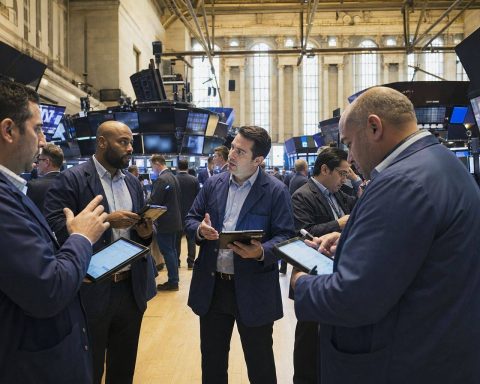
The setup into today’s session is unusually clean: U.S. equities went into Christmas with strength, and AI-linked names rebounded after a bout of valuation and spending anxiety. On Dec. 24, the Dow and S&P 500 closed at record highs in holiday-shortened trading, with the Nasdaq also higher; Micron stood out with another leg up as investors leaned back into the AI supply chain.
That matters for AI stocks because the market’s big argument right now isn’t “Is AI real?” It’s “When do we see the payback?” Reuters’ year-end outlook framing has been consistent: 2026 performance hinges on a mix of corporate earnings strength, the Fed path, and whether AI spending translates into durable profits rather than permanent cost inflation. Reuters
In other words: the AI trade is alive, but it’s no longer a straight-line hype machine. It’s a spending contest with quarterly scorekeeping.
Nvidia and Groq: a licensing deal that looks like an acqui-hire
The biggest AI-stock headline still echoing into Dec. 26 is Nvidia (NVDA) striking a non-exclusive licensing deal with AI chip startup Groq—and simultaneously bringing over key Groq leadership (including CEO/founder Jonathan Ross and President Sunny Madra) along with additional staff, while Groq stays independent. Groq’s CFO Simon Edwards is taking over as CEO, and Groq’s cloud business is not part of the deal.
Why the market cares (even in thin post-holiday volume):
- Inference is the next battlefield. Training giant models made Nvidia a kingmaker; serving those models cheaply and fast at scale is where customers increasingly obsess.
- This deal is a signal that Nvidia takes alternative architectures seriously. Groq’s pitch has been high-speed, low-latency inference hardware—exactly the “make chatbots feel instant” problem.
- It shows how “soft M&A” is evolving. Instead of buying a company outright (and inviting antitrust headaches), a company can license tech and hire the people who built it—getting much of the strategic value without the headline “acquisition.” Reuters
There was also recent market chatter about Nvidia exploring a much larger transaction structure around Groq; today’s reality is more precise: license + talent + ongoing independence.
What this means for AI-chip competitors: It reinforces the idea that the AI-chip market is splitting into sub-wars—training, inference, networking, memory, and power efficiency—with different winners possible in each. Even if Nvidia remains the platform default, it’s signaling it will borrow the best ideas anywhere.
The AI supply chain’s “quiet king”: memory—and the security fight around HBM
If GPUs are the celebrity athletes of the AI boom, memory is the oxygen. And on Dec. 26, Reuters dropped a reminder that the memory race is now so central to AI that it’s tangled up with national security.
South Korean prosecutors indicted 10 people over alleged leaks of memory chip manufacturing technology to China’s ChangXin Memory Technologies (CXMT)—a case authorities say helped set the stage for China’s development of HBM (high-bandwidth memory), a critical component for AI computing. The report describes alleged transfer of proprietary DRAM process steps and further technology acquisition through supply chains, with prosecutors estimating the damage in the tens of trillions of won.
This matters for AI stocks in two big ways:
- HBM is a choke point. AI accelerators increasingly live or die by memory bandwidth and packaging.
- Geopolitics is now part of the bill of materials. Export rules, alleged IP leakage, and industrial policy can change capacity, pricing power, and competitive timelines—especially for memory-heavy AI buildouts.
And the ripple effects aren’t theoretical. Reuters has also reported how AI-driven demand for memory chips is pressuring other industries, including gaming consoles, because chipmakers prioritize higher-margin data center demand—raising the risk of price increases elsewhere in electronics.
So yes, Micron (MU), SK Hynix, Samsung, and memory-adjacent suppliers remain part of the “AI stocks” conversation—not as side characters, but as structural enablers.
India becomes the next AI infrastructure hotspot—with real-world constraints
One of the most consequential Dec. 26 stories for AI stocks isn’t a Silicon Valley product launch. It’s geography.
The Washington Post reports that Amazon, Microsoft, and Google have pledged a combined $67.5 billion in investments in India since October, with about 80% of those commitments coming this month—much aimed at building massive data centers to support AI workloads.
Key details shaping how markets read this:
- Microsoft’s $17.5 billion India investment (announced Dec. 9) includes a major data center complex in Hyderabad targeted to go live in mid-2026.
- Google’s plan includes $15 billion in India between 2026 and 2030, including a 1-gigawatt-scale data center project in Visakhapatnam, according to local government records cited in the report.
- The Post also highlights the tension underneath the boom: data centers strain power and water, and local backlash can emerge quickly when subsidies and resource usage collide with communities already under pressure.
For AI stocks, this “India buildout” theme ties directly into:
- cloud revenue narratives (Microsoft, Google/Alphabet, Amazon),
- AI infrastructure supply chains (chips, networking, cooling),
- and the emerging “power scarcity premium” (the market increasingly values access to electricity and land like it used to value access to GPUs).
It’s also strategically important: India is both a massive user market and a talent hub. The Post notes India will host an international AI summit in February, and that OpenAI and Anthropic have opened offices in India this year.
China’s “hard tech” capital injection: chips, quantum, and AI adoption
While U.S. tech giants expand globally, China is pushing its own lever: state-guided capital and industrial policy.
Reuters reports that China on Friday (Dec. 26) launched three venture capital funds to invest in “hard technology,” with each fund expected to be larger than 50 billion yuan, targeting areas including integrated circuits, quantum technology, biomedicine, and brain-computer interfaces, among others. Reuters
On the same day, Reuters also reported that China pledged to double down on upgrading its manufacturing base and promised capital to fund technological breakthroughs. The industry ministry specifically said it will expand efforts to help smaller firms adopt artificial intelligence, while fostering “intelligent agents” and AI-native companies in key industries. Reuters
For AI stocks, this matters even if you never buy a China-listed share, because it influences:
- competition in semiconductors and memory,
- demand for AI hardware (inside China and globally),
- and the long-run “two technology blocs” dynamic that shapes export rules and supply chains.
In plain English: capital is becoming a weaponized input in the AI race, not just a financial metric.
Platform AI faces regulatory friction: Meta and WhatsApp
AI distribution is as important as AI capability—and regulators know it.
Reuters reports that Italy’s antitrust watchdog ordered Meta to halt a WhatsApp policy that would block rival AI chatbots, amid an antitrust probe (Meta has disputed the order and indicated it would appeal).
For Meta (META) as an AI stock, this is a reminder that the “default assistant inside the world’s most-used messaging apps” is not just a product decision—it’s potentially a competition and regulatory issue, especially in Europe.
The unsexy but decisive AI theme: power infrastructure is now an “AI stock” catalyst
A year ago, AI-stock debates were mostly “models, GPUs, and cloud revenue.” In late 2025, the debate has expanded to: Where does the electricity come from?
Reuters reported earlier this week that Alphabet (GOOGL) agreed to buy clean energy developer Intersect for $4.75 billion (cash plus assumed debt), explicitly positioning the move in the context of Big Tech needing computing and power capacity for AI. Intersect projects representing about 10.8 gigawatts are expected to be online or in development by 2028, Reuters said.
The Associated Press also framed the Intersect deal around powering AI’s data center growth.
This is why investors increasingly treat “AI stocks” as a stacked supply chain:
- chips (compute),
- memory (bandwidth),
- networking (movement),
- power + cooling (physics),
- and regulation (permission).
Software AI names: index changes and “agentic” momentum
Not all AI stock action is in megacap semis.
One of the cleaner near-term catalysts in AI software has been index inclusion: UiPath (PATH) jumped after news it will join the S&P MidCap 400, a change that can drive forced buying by index-tracking funds.
It’s not the same kind of “headline gravity” as Nvidia, but it highlights a steady pattern: as markets try to broaden the AI trade beyond a handful of giants, automation and enterprise AI platforms get re-rated when they show operational traction—or when the plumbing of passive investing turns on.
What investors are watching next
Even with today’s news flow, the next phase for AI stocks into early 2026 keeps circling the same high-stakes questions:
- Capex credibility: Are hyperscalers and AI infrastructure players still confident in ROI, or do they quietly slow builds? Reuters
- Inference economics: Do new approaches (specialized inference chips, licensing deals, model efficiency gains) materially reduce cost-per-query—or just shift who gets paid? Reuters
- HBM and memory availability: The memory side of AI remains both a growth engine and a geopolitical flashpoint.
- Power constraints: Energy and data-center infrastructure are now “earnings-relevant” for the biggest AI names. Reuters
- Regulatory drift: Messaging platforms, app ecosystems, and AI assistants are colliding with competition law, especially outside the U.S.
The bottom line for AI stocks today
On Dec. 26, 2025, the AI-stock narrative is expanding. It’s no longer just “who has the best model” or “who sells the most GPUs.” It’s who can secure the entire chain—compute, memory, power, talent, and distribution—while navigating a world where governments increasingly treat AI as strategic infrastructure.
Nvidia’s Groq deal is the day’s cleanest “AI stocks” headline, but the deeper signal is that the AI boom is maturing into a global industrial buildout—one where countries, utilities, regulators, and supply chains matter as much as code.
Related articles: NASDAQ:NVDA