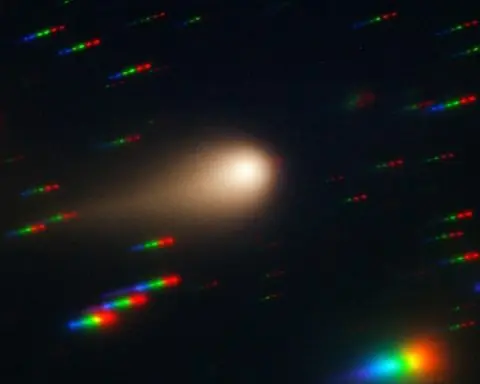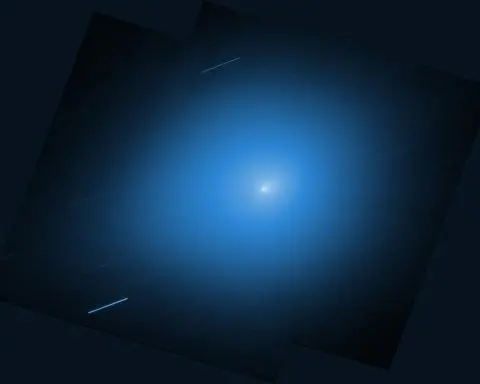
December 24, 2025 — Comet 3I/ATLAS (also cataloged as C/2025 N1 (ATLAS)) is already past its closest point to Earth, fading and drifting outward again — but the science and the headlines are accelerating, not slowing down. Today’s developments include a newly released Breakthrough Listen radio search that reports no sign of artificial transmissions, fresh discussion about the comet’s cyanide chemistry, and continued analysis of the comet’s rare sunward-facing “anti-tail” and wobbling jet behavior. NASA Science+3arXiv+3The Economic Times+3
Where is Comet 3I/ATLAS today?
As of December 24, 2025, ephemeris trackers place 3I/ATLAS at roughly 1.81 AU from Earth and 2.44 AU from the Sun, with an estimated brightness around magnitude ~13 — firmly in “telescope-and-patience” territory rather than naked-eye viewing. astro.vanbuitenen.nl
Sky-position services also list the comet in the neighborhood of Leo today, meaning it’s best hunted when the sky is fully dark and the comet is well above the horizon — and with expectations calibrated: this is a faint, fast-moving scientific target, not a big holiday showpiece. The Sky Live+1
NASA continues to emphasize the bottom line for everyone not currently running an observatory: there is no danger to Earth. Even at closest approach, 3I/ATLAS remained about 1.8 AU (270 million km / 170 million miles) away. NASA Science
Today’s biggest new science headline: Breakthrough Listen reports no radio technosignatures
The most “straight-from-the-lab” update dated December 24, 2025 comes from a new Breakthrough Listen report on arXiv: a technosignature search aimed at 3I/ATLAS using the 100-meter Robert C. Byrd Green Bank Telescope across 1–12 GHz. The observations were taken on December 18, 2025, about a day before the comet’s closest approach to Earth. arXiv
Their result: no credible detections of narrowband radio signals attributable to the comet. The paper reports that their search rules out isotropic continuous-wave transmitters above ~0.1 W (100 mW) at the comet’s distance during observations — a surprisingly low threshold, roughly “sub-cell-phone power,” assuming the signal is sent equally in all directions. arXiv
Two details here matter for readers watching the internet try to turn a comet into a plot twist:
- This does not “prove” the comet is natural (you can always invent a more complicated hypothesis), but it does put real, quantified constraints on one specific kind of radio emission.
- The authors explicitly note that, based on what we know so far, 3I/ATLAS shows mostly typical cometary characteristics, and there’s no evidence that interstellar objects are anything other than natural bodies — while still arguing that careful checks are worthwhile because we’ve only seen three such objects to date. arXiv
A separate public-facing Breakthrough Listen page also describes the same Green Bank Telescope strategy (observing less than 24 hours before closest approach, using L/S/C/X receivers spanning 1–12 GHz). seti.berkeley.edu
The cyanide question making rounds today: what’s real, what’s hype?
One of the louder “today” storylines (especially in viral rewrites) is the claim that 3I/ATLAS left behind poisonous cyanide or that Earth could be affected by its plume. Reporting today points to detections of hydrogen cyanide (HCN) and methanol (CH₃OH) in observations of the comet and then leaps — with varying levels of caution — into alarm or speculation. The Economic Times+1
Here’s what holds up under the harsh light of physics:
- Yes, cyanide-bearing molecules can be present in comets. Hydrogen cyanide is a known component detected in cometary comae in prior research, and it’s been measured in well-studied comets (including work published through major scientific outlets). AGU Publications+1
- Yes, specific teams reported CH₃OH and HCN in 3I/ATLAS using ALMA’s Atacama Compact Array at multiple dates before perihelion (late August through early October for methanol; mid-September for HCN, per the published abstract). arXiv
- No, that does not imply Earth is being “rained on” by cyanide from 3I/ATLAS. The comet was extremely far away at closest approach (again: ~1.8 AU), and NASA states it posed no hazard. At those distances, any gas or dust is dispersed in the solar environment and does not behave like a targeted delivery system to Earth. NASA Science
In other words: “contains cyanide chemistry” is a legitimate scientific sentence; “Earth is getting cyanide dumped on it” is not supported by the geometry or the distances involved.
The weird tail that points toward the Sun: today’s best explanation is still “comet doing comet things — but in a new accent”
3I/ATLAS became famous in part because images showed a dramatic sunward-pointing feature — often described as an anti-tail. This is visually counterintuitive because most people learn that comet tails point away from the Sun.
The key update driving a lot of today’s renewed interest: a detailed analysis posted to arXiv reports the detection of a faint high-latitude jet in the inner coma, measured across multiple nights, with a periodic wobble in its position angle. The authors interpret this as a jet undergoing precessional motion around the projected spin axis — and describe it as the first periodic jet-angle modulation detected in an interstellar comet. ar5iv+1
The headline numbers from that work:
- Jet position-angle modulation periodicity: ~7.74 ± 0.35 hours
- Implied nucleus rotation period (if the jet is from a single near-polar active region): ~15.48 ± 0.70 hours
- A photometric time-series estimate discussed alongside it: ~16.79 ± 0.23 hours ar5iv
Space.com’s coverage of the same research frames it in plain language: observers tracked the comet over dozens of nights with the Two-meter Twin Telescope at Teide Observatory and found a jet that “wobbles,” likely tied to rotation and the geometry of active vents. Space+1
This is exactly why scientists get excited about interstellar comets: they’re not just icy snowballs — they’re icy snowballs that were built in a different planetary system, baked by different radiation environments, and then tossed into the galaxy like cosmic message bottles.
NASA’s instrument swarm: how 3I/ATLAS is being tracked (and why “we missed it” is the wrong story)
NASA describes 3I/ATLAS as a multi-mission observing effort — a kind of ad-hoc “science flash mob” where spacecraft and telescopes grab data whenever geometry allows. NASA’s 3I/ATLAS resources highlight work involving assets such as Hubble, JWST, and multiple heliophysics/solar observatories, and reiterate that the comet’s observed perturbations are small and compatible with outgassing. NASA Science
One particularly neat datapoint (because it sounds like science fiction but is, in fact, engineering): Parker Solar Probe imaged 3I/ATLAS with its wide-field imager WISPR over an extended stretch from Oct. 18 to Nov. 5, 2025, collecting on the order of ~10 images per day while the spacecraft was outbound from a close solar flyby. NASA Science
That kind of vantage matters because ground-based observing gets wrecked when a comet is too near the Sun in the sky — while solar observatories can sometimes keep watching.
What happens next for 3I/ATLAS?
From here, the story becomes a slow fade — scientifically rich, visually subtle.
- The comet is now outbound and expected to remain observable (with appropriate telescopes) into spring 2026 according to NASA’s FAQ guidance. NASA Science+1
- NASA’s public materials also note the comet’s trajectory includes a pass out toward Jupiter’s realm in March 2026 as it exits the inner solar system. NASA Science
- Meanwhile, the “future of this field” angle is growing: recent coverage has focused on how hard it is to intercept a fast interstellar object after discovery — and why agencies and mission designers are increasingly discussing pre-planned interceptors and rapid-response strategies for the next 1I/2I/3I-style visitor. Live Science
The clean takeaway for December 24, 2025
Today’s news about Comet 3I/ATLAS isn’t that it’s a threat — it’s that it’s a rare laboratory sample from another star system, and the data are getting sharper:
- A Breakthrough Listen report dated Dec. 24, 2025 finds no radio technosignatures in a sensitive Green Bank Telescope search. arXiv
- Chemistry discussions (including cyanide) are real science, but not real danger — and NASA continues to emphasize the comet’s safe distance. NASA Science+1
- Jet/anti-tail analyses are turning a visual oddity into measurable nucleus physics, including an apparent ~15.5-hour rotation timescale inferred from a wobbling jet. ar5iv+1