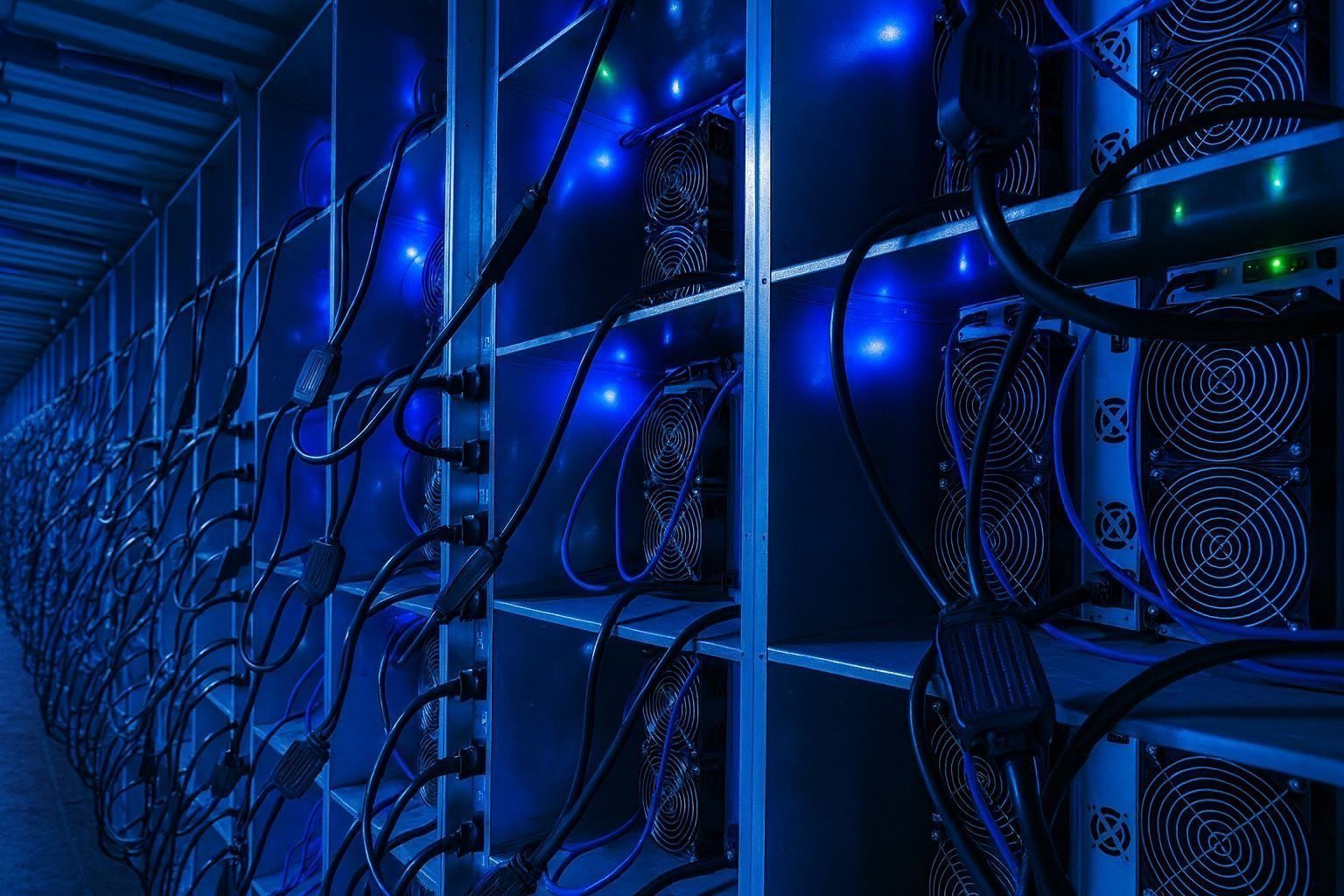
Dec. 14, 2025 — For years, the crypto-mining story has been told as a race: more machines, cheaper power, bigger facilities, higher hashrate. This week (Dec. 8–14), the story shifted into something sharper—and more consequential for the future of proof-of-work.
Bitcoin mining is still a global-scale industrial business. But multiple signals—from hardware launches and miner financials to grid-policy debates and Wall Street positioning—suggest the industry is entering a new phase: mining as an optional workload, competing directly with AI data centers for power, real estate, capital, and public tolerance.
Below is what mattered most in crypto mining this week, why it matters, and what to watch next.
The week in one sentence: mining economics got tighter, and AI got louder
Two separate themes dominated the week:
- Mining revenue per unit of compute (“hashprice”) pushed toward historic lows, forcing operators to underclock rigs, pause expansions, and rethink capex. Bloomberg+2TheMinerMag+2
- AI and high-performance computing (HPC) continued pulling miners toward data-center hosting, because AI contracts offer steadier cash flows than block rewards—and because the same “powered shell” that runs ASICs can sometimes be repurposed for GPUs. WIRED+2Bloomberg+2
The result: crypto mining isn’t disappearing—it’s reorganizing.
Where Bitcoin mining stands right now: hashrate, difficulty, and a looming reset
If you want a quick read on mining pressure, start with three metrics:
1) Hashrate: still enormous, but showing whiplash
- Hashrate Index reported that network hashrate fell 4.0% week-over-week, with the 7-day SMA dropping from 1,098 EH/s to 1,054 EH/s (30-day SMA at 1,078 EH/s). Hashrate Index
- CoinWarz pegged the current hashrate at ~1.020 ZH/s (zetta-hashes per second) with difficulty at 148.20T around block height ~927,853. CoinWarz
- YCharts (sourced from Blockchain.com) showed daily hashrate swinging from ~1.098B TH/s (Dec 8) to ~957.41M TH/s (Dec 9), then up again above 1.15B TH/s (Dec 10), settling at ~1.053B TH/s on Dec 13. YCharts
These sharp moves aren’t “sentiment.” They often reflect operational choices: curtailment during expensive power windows, underclocking to chase efficiency, or temporary outages.
2) Difficulty: easing modestly—because it has to
Difficulty is the network’s self-correction mechanism. When miners drop off, difficulty eventually falls, making it easier for those who remain.
- CoinWarz listed current difficulty at 148.20T (Dec 14). CoinWarz
- The difficulty history on CoinWarz shows a step-down during the week—from ~149.30T on Dec 8–9 to ~148.20T by Dec 11–14. CoinWarz
- Hashrate Index had already noted the prior adjustment (Nov 26) and projected a small decrease for the next retarget (expected around Dec 10). Hashrate Index
Translation: the protocol is doing what it’s designed to do—absorbing pain by rebalancing competition. But difficulty relief helps most when BTC price and fees cooperate.
3) Next difficulty forecast: late December could tighten again
CoinWarz estimated the next difficulty adjustment for Dec 24, 2025, projecting a move up to ~152.00T (+2.56%) if blocks continue coming in faster than 10 minutes on average. CoinWarz
That matters because miners don’t budget on today’s margin—they budget on the margin after the next retarget and after the next fleet shipment hits the floor.
“Hashprice” hit the headlines—and it’s squeezing everyone
Hashprice is the shorthand miners use for revenue earned per unit of hashrate (often quoted in $/PH/day). It collapses the whole business model into one number: price, fees, difficulty, and luck.
This week’s coverage repeatedly returned to the same point: hashprice has sunk toward record lows.
- Bloomberg reported that the downturn pushed “a slew” of miners close to unprofitability, and pointed to Hashrate Index data showing hashprice touching a record low—while TheMinerMag data suggested median total costs were still above revenue for many public miners. Bloomberg
- TheMinerMag’s MicroBT hardware coverage put hashprice around ~$35 per PH/s/day, “near all-time lows,” alongside a sustained network hashrate above 1 ZH/s. TheMinerMag
When hashprice gets that low, miners respond in predictable ways:
- Underclock and optimize (lower power draw, better J/TH effective efficiency)
- Curtail when power prices spike
- Delay capex (and renegotiate machine deliveries)
- Look for non-mining revenue (hosting, HPC, AI)
- Consolidate (sell sites, merge, raise converts, or exit)
This is why the most important mining story of the week wasn’t a hashrate record. It was a business-model pivot.
The AI pivot is no longer a side quest—it’s becoming the main plan
The clearest narrative thread of Dec 8–14: miners are increasingly selling “power + buildings + cooling” to AI, because AI tenants can be more predictable than Bitcoin’s difficulty curve.
WIRED: miners built the template for AI data centers—now AI is taking it back
WIRED reported that Riot’s massive Corsicana site in Texas—once framed as a monument to Bitcoin mining—is being partly repurposed for AI/HPC, and argued that across the U.S. a similar pattern has spread among major public miners. WIRED
WIRED also cited CoinShares research indicating that miners have announced more than $43 billion worth of AI/HPC contracts in recent months. WIRED
A key tension WIRED highlighted: AI customers often demand near-perfect uptime, while many miners built their economics around being interruptible—turning off during grid stress in exchange for incentives or cheaper power structures. WIRED
That difference is not cosmetic. It dictates capex: redundancy, generators, power conditioning, network design, and operational discipline.
Bloomberg: the squeeze is forcing energy-hungry machines to scale back
Bloomberg framed the same shift as urgency: hashprice pressure driving miners to scale down and move toward alternative revenue. Bloomberg
S&P Global / Visible Alpha: diversification is now embedded in forecasts
S&P Global Market Intelligence (Visible Alpha) published a Dec. 9 research note on Bitfarms that captured the same industry logic: mining margins tightening + diversification into HPC. SP Global
It reported analysts cut Bitfarms’ 2025 outlook after a weak quarter—reducing revenue forecasts and projecting 2025 BTC production falling to 2,235 BTC (from 2,914 the prior year) as difficulty rises and capex is reined in. SP Global
In other words: even analyst models are now treating pure-play mining growth as constrained.
Wall Street is positioning for the “mining-to-AI” trade
A standout financial headline this week came from TheMinerMag:
Citadel disclosed a 5.5% passive stake in Core Scientific
TheMinerMag reported that Citadel Securities and affiliates disclosed a 5.5% passive stake in Core Scientific, totaling ~17.2 million shares, following another filing for a 5.4% passive stake in TeraWulf earlier the same week. TheMinerMag
Whatever you think of mining stocks, this is notable because it signals that large market-structure firms see liquidity, volatility, and opportunity in the sector—particularly as miners brand themselves less as “crypto” and more as digital infrastructure.
TheMinerMag explicitly tied the interest to miners’ broader shift toward AI-oriented compute infrastructure as hashprice falls. TheMinerMag
Hardware news: MicroBT launches the M70 series into a brutal market
If mining economics are weak, why launch new machines now?
Because for ASIC makers, downturns are when efficiency gains matter most—and when the next generation gets seeded into the fleets that survive.
MicroBT’s M70 series: efficiency down to 12.5 J/TH
On Dec. 8, TheMinerMag reported that MicroBT introduced its new WhatsMiner M70 generation in Abu Dhabi with:
- Three efficiency classes: 12.5 J/TH, 13.5 J/TH, 14.5 J/TH
- A wide range of models, including air- and liquid-cooled units
- Claimed performance from ~214 TH/s (lower-end air-cooled M70) up to over 1 PH/s in rack-mounted M79S variants (per company materials cited in the report) TheMinerMag
But the launch story wasn’t celebratory. It was defensive.
TheMinerMag noted the release lands while:
- hashprice sits near ~$35/PH/day,
- network hashrate remains above 1 ZH/s, and
- BTC price has been correcting—cooling ASIC demand and leaving manufacturers with elevated inventories and slower order cycles. TheMinerMag
MicroBT also leaned into themes that keep coming up in mining’s rebrand: off-grid solar integration, hybrid power models, and ecosystem partnerships. TheMinerMag
The takeaway: the arms race didn’t end; it moved from “more TH” to “more TH per watt, deployed more intelligently.”
Corporate mining update: Canaan highlights low power cost and growing hashrate
Not all mining news this week was about retreat. Some was about execution.
On Dec. 10, Investing News Network covered Canaan’s November mining update, reporting:
- 89 BTC mined in November (unaudited)
- Deployed hashrate 9.41 EH/s and operating hashrate 8.12 EH/s by month-end
- Average all-in power cost $0.043/kWh
- A crypto treasury of 1,730 BTC and 3,951 ETH, with the company stating it acquired 100 BTC during price dips
- Expected ~1 EH/s of capacity coming online by year-end 2025, with additional energization in Q1 2026 Investing News Network (INN)
Regardless of where you land on Canaan as a business, those numbers illustrate what “survival mode” looks like for operators who believe they can win on power cost and fleet management.
Texas remains the mining capital—and the policy pressure point
No region better captures the mining dilemma—economic development vs. grid strain—than Texas.
A new solar-linked mine shows the “behind-the-meter” playbook
On Dec. 12, the Midland Reporter-Telegram reported Sangha Renewables energized a 19.9 MW bitcoin mine in Ector County that operates behind-the-meter on a 150 MW solar farm, buying “the first” ~20 MW of output before it hits the grid. MRT+1
The article described the operation as highly interruptible—explicitly contrasting it with traditional data centers that require continuous uptime—and said TotalEnergies provides balancing and supplemental grid power during non-solar hours. MRT
This model is a recurring theme in mining’s effort to present itself as a grid feature, not a grid bug: monetize curtailed renewables, stabilize project cash flows, and shut off when economics don’t work.
But statewide scrutiny is rising as loads explode
Chron reported Dec. 12 that an investigation based on Texas PUC records found that in 2024, Texas crypto mines consumed more than 14.7 million MWh, exceeding the combined residential electricity use of San Antonio and El Paso, and representing roughly ~3% of Texas’ total power produced. Chron
Chron also pointed to Texas Senate Bill 6 (effective in 2025) giving ERCOT authority to order large users—including crypto mines—to shut down or switch to backup power during grid emergencies. Chron
Then came the bigger twist: AI is now the dominant “large load” narrative.
- TheMinerMag’s Miner Weekly cited ERCOT figures showing ~226 GW of new large-load interconnection requests in the pipeline (up from 63 GW at end of last year), with ~73% tied to data center developers building AI-scale campuses. TheMinerMag
- A separate Chron report also described ERCOT large-load requests surging above ~230 GW in 2025, with over 70% coming from data center developers, and noted new regulatory drafting for customers requesting 75 MW+. Chron
Mining’s political vulnerability increases when it’s no longer framed as the “new growth industry,” but as one contestant in a crowded competition for megawatts.
The power race goes national: AI data centers are reshaping energy plans
Two Reuters items this week helped frame the macro backdrop miners are operating inside:
- On Dec. 8, Reuters reported NextEra expanded a partnership with Google Cloud to scale data center infrastructure, describing plans for multiple gigawatt-scale data center campuses integrated with new generation/capacity, alongside clean energy contracts with Meta. Reuters
- On Dec. 9, Reuters reported Texas solar output overtaking coal, describing rapid solar capacity and output growth in ERCOT territory. Reuters
For miners, this matters in two opposite ways:
- Good news: more renewables can mean more periods of low or negative pricing, which miners can exploit (especially behind-the-meter).
- Bad news: AI’s willingness to sign long-term power + capacity deals can outbid miners for the best sites and contracts, especially if miners can’t guarantee uptime.
Bitcoin price forecasts changed—and miners feel it immediately
Mining is a commodity business. Your “product” is BTC, and your costs are mostly energy + financing + depreciation. That’s why BTC forecasts ripple through mining long before they show up in hashrate.
On Dec. 10, Business Insider reported that Standard Chartered’s Geoff Kendrick slashed the bank’s bitcoin price forecasts, including:
- ~$100,000 by end of 2025
- $150,000 by end of 2026 (down from an earlier $300,000 target) Business Insider
Whether you agree with the forecast isn’t the point. The point is what happens when a large bank publicly signals “less upside, slower cycle”:
- Equity investors become more selective with miners.
- Debt markets price in higher risk.
- Expansion plans get harder to justify.
- The industry leans even harder into HPC/AI narratives to defend valuations.
What to watch next: 5 indicators that will decide mining’s next quarter
As the week ends (Dec. 14), here are the signals most likely to drive the next wave of mining headlines:
- Hashprice direction
If it stays near the ~$35/PH/day zone reported this week, expect more underclocking, more curtailment, and more “AI pivot” announcements. TheMinerMag+1 - Late-December difficulty
CoinWarz projects the next retarget around Dec 24 with a possible increase. If that materializes without a BTC price rebound, margins tighten again. CoinWarz - AI hosting deal quality (not just size)
Multi-year contracts sound great—but uptime requirements and capex retrofits can quietly destroy economics if operators underestimate what hyperscalers demand. WIRED - Grid policy changes (especially ERCOT and other hotspot regions)
Texas is signaling more oversight for 75 MW+ loads, and the political patience for any “flexible load” may shrink as AI demand accelerates. TheMinerMag+2Chron+2 - Capital markets: stakes, converts, and consolidation
Citadel’s disclosed positions in Core Scientific (and earlier in TeraWulf) are a reminder that mining equities are increasingly traded as infrastructure proxies—especially when paired with HPC narratives. TheMinerMag
Bottom line: crypto mining is becoming “compute arbitrage”
This week made one thing clear: Bitcoin mining is no longer just about Bitcoin.
Mining firms are increasingly in the business of:
- arbitraging electricity markets,
- monetizing real estate and interconnection rights,
- managing fleets as flexible industrial loads, and
- pitching themselves as the fastest path to new AI capacity.
Some miners will survive as elite low-cost producers. Others will become AI landlords. Some will be acquired. And some will simply go dark—until difficulty drops enough to make the math work again.
That is how proof-of-work evolves: not by ideology, but by economics.