- 1-inch sensor leap: The Mini 5 Pro packs a 1-inch CMOS camera (50 MP) – a world-first in a drone this size – versus the Mini 4 Pro’s 1/1.3-inch sensor (48 MP), boosting low-light and detail performance .
- Video & gimbal upgrades: Mini 5 Pro can shoot up to 4K/60 HDR or 4K/120fps slow-mo with 10-bit color (D-Log M/HLG), edging out the Mini 4 Pro’s 4K/100fps limit . Its gimbal offers a wider 225° range for dynamic angles and true vertical shots, building on the Mini 4’s vertical shooting ability .
- Flight time & range: Expect ~36 min flight on Mini 5 Pro (standard battery) vs ~34 min on Mini 4 Pro, with optional “Plus” batteries pushing endurance to ~52 min vs 46 min (at the cost of heavier takeoff weight) dronedj.com techradar.com. The Mini 5 Pro’s O4+ link is rumored 25 km max range (vs ~20 km on Mini 4 Pro) – though line-of-sight rules will limit real use theverge.com theverge.com.
- Obstacle sensing: Both drones feature omnidirectional obstacle avoidance. The Mini 5 Pro adds a forward LiDAR sensor for better low-light avoidance (“Nightscape” sensing) and smarter ActiveTrack 360° tracking modes, whereas the Mini 4 Pro relies on vision sensors only dronedj.com dronedj.com.
- Sub-250g category: Both drones target the 249g class to skirt registration in many regions. Mini 4 Pro reliably stays under 250 g, but the Mini 5 Pro is advertised at 249.9 g ±4 g – meaning some units could tip the scale over the limit, nullifying the no-registration perk .
- Design & size: Physically, the two Minis are very similar – ultra-compact, folding drones that fit in a hand. The Mini 5 Pro’s camera module is larger for the 1” sensor, and it sports an extra LiDAR module, but otherwise retains the Mini 4 Pro’s “bug-eye” vision cameras on top and bottom auxiliary light techradar.com dronedj.com. Both weigh ~249 g (standard battery) and maintain that travel-friendly, no-license-needed profile.
- Pricing & availability:Mini 4 Pro launched at $759 (standard kit) and is widely available (often discounted), while the Mini 5 Pro is ~$769 equivalent – but not officially sold in the US due to DJI’s ongoing export woes . U.S. pilots can only import it via resellers (no warranty, higher cost), whereas elsewhere it’s available via DJI and retailers.
- New features: The Mini 5 Pro introduces perks like a 48mm “Medium Tele” digital zoom mode, more internal storage for footage, faster wireless transfers, and updated flight software (e.g. preset tracking modes for biking, improved Return-to-Home logic) dronedj.com dronedj.com. The Mini 4 Pro isn’t far behind – it debuted features like Waypoint autonomous flight paths, Cruise Control, and advanced APAS avoidance that set the standard for the Mini series petapixel.com techradar.com.
Overview: Pocket Drones with Pro Power
DJI’s Mini series proves that big things come in small packages. The Mini 4 Pro (released late 2023) and the newer Mini 5 Pro (2025) are ultra-light (<250g) camera drones loaded with high-end tech. Both cater to travelers, hobbyists, and creators who want pro-level features in a palm-sized quadcopter. As one reviewer noted, DJI “brought its A-game” with these Minis – they’re packed with capabilities previously reserved for larger drones dronedj.com. The Mini 5 Pro takes this further by achieving a milestone upgrade (a 1-inch sensor and enhanced sensing) on the Mini 4 Pro’s strong foundation. Below, we break down how these two mini marvels compare in detail.
Camera and Imaging
DJI Mini 5 Pro brings a major imaging upgrade: a 1-inch CMOS sensor (the first ever in a drone this small) versus the Mini 4 Pro’s still-respectable 1/1.3-inch sensor dronedj.com. In practice, the Mini 5’s larger sensor delivers better low-light performance, dynamic range, and detail. It can capture 50 MP still photos, slightly edging the Mini 4 Pro’s 48 MP photos in resolution dronedj.com techradar.com. As DroneDJ put it, the Mini 5 Pro’s 1-inch sensor is a “world-first” that lets you “capture 50-megapixel shots with incredible detail, even in low light” dronedj.com. Photographers can expect cleaner night shots (e.g. sunsets, city lights) and more latitude for editing from the Mini 5’s camera.
Both drones use fixed-aperture lenses (f/1.7 on Mini 4 Pro; the Mini 5 Pro’s aperture isn’t officially stated, but likely around f/1.7–f/2). Each offers RAW and JPEG photo capture and DJI’s HDR modes. The Mini 4 Pro already impressed reviewers with its image quality – producing excellent 12 MP binned shots in low light and detailed 48 MP shots in good light . Colors and dynamic range are surprisingly good for such small cameras, and both drones support 10-bit D-Log M profiles for more grading flexibility in post .
Video capabilities have also advanced. The Mini 4 Pro maxes out at 4K 60fps (with HDR) for normal video, and introduced a 4K 100fps slow-motion mode (or 1080p at 200fps) . The Mini 5 Pro one-ups this with 4K 60fps HDR as standard and a 4K 120fps slow-mo option for even smoother slow-motion footage . Both drones record in up to 10-bit color (D-Log M or HLG), which is great for editors who want to color grade footage. According to DJI, the Mini 5 Pro also achieves about 14 stops of dynamic range in HDR video – a slight improvement that helps in high-contrast scenes. In short, daytime video will look similar on both (sharp 4K, rich color), but the Mini 5’s footage holds up better for slow-motion and low-light scenes. It even has a new Night Mode for video to reduce noise, building on the Mini 4 Pro’s already solid night performance .
Another highlight is gimbal and shooting flexibility. Both drones have a 3-axis stabilized gimbal that can rotate for true vertical shooting (ideal for TikTok/Instagram content). The Mini 4 Pro introduced this easy portrait-mode camera rotation (no cropping needed) theverge.com, and the Mini 5 Pro retains it. In fact, the Mini 5’s gimbal has an expanded 225° tilt range, allowing more creative angles and even “roll” shots that mimic FPV-style moves dronedj.com. This means you can tilt the camera further upward or sideways on the Mini 5 Pro, whereas the Mini 4’s gimbal tilt was limited to 60° upward techradar.com. Both support DJI’s useful digital zoom (up to 2× in 4K, more in lower resolutions) for flexibility – the Mini 5 Pro even advertises a specialized 48mm medium-telephoto mode for tighter compositions without moving the drone dronedj.com. Overall, content creators will appreciate the Mini 5 Pro’s marginal edge in camera specs, but the Mini 4 Pro still holds its own as an excellent flying camera for its size techradar.com.
(Tech specs summary: Mini 4 Pro – 1/1.3″ sensor, 48MP stills, 4K/60 + 4K/100fps slow-mo; Mini 5 Pro – 1″ sensor, 50MP stills, 4K/60 HDR + 4K/120fps slow-mo, improved dynamic range and low-light.)
Flight Performance and Battery Life
Despite their tiny size, both Minis are competent performers in the air. The flight time has improved incrementally with the newer model. The Mini 4 Pro is rated for up to 34 minutes on the standard Intelligent Flight Battery (in ideal conditions) . Real-world, users see ~25 minutes before the low-battery Return-to-Home kicks in . DJI sells a higher-capacity Battery Plus (not in all regions) that gives the Mini 4 Pro up to 46 minutes aloft – at the cost of pushing weight beyond 250g (more on that later) .
The Mini 5 Pro pushes endurance a bit further: about 36 minutes on the standard pack, and up to 52 minutes with its optional Battery Plus . That standard battery endurance is only ~2 minutes more than the Mini 4, but crossing the 35+ minute mark means more leeway to capture shots without rushing. With the Plus battery, the Mini 5 Pro can hover close to an hour, an impressive feat for a palm-sized drone (though it will weigh significantly more and likely require registration). It’s worth noting these times assume gentle flying – wind, speed, and aggressive maneuvers will reduce actual flight times to the 20–30 minute range for both drones.
In terms of speed and maneuverability, both drones are similar. They have a top speed around 16–17 m/s (approx 35–38 mph) in Sport mode and can handle moderate winds, but being so light, they’re not as stable in strong gusts as larger drones. The Mini 4 Pro is “not suited to windy conditions,” as TechRadar cautions techradar.com – the Mini 5 Pro likely has similar wind limits (it reportedly has a slightly higher wind resistance, but still a sub-250g drone physics apply). Ascend/descend speeds are modest (5 m/s up/down on Mini 4), meaning they’re a bit “pokey” compared to bigger Air or Mavic drones theverge.com. Both use DJI’s latest flight controllers, so they benefit from precise GPS, GLONASS & Galileo positioning and stable hovering with downward vision sensors. The Mini 5 Pro allegedly improved internal components for flight stability, giving it a steadier hover even in tricky environments dronedj.com, but differences are minor – both are impressively stable for their size.
One area seeing a bump is transmission range and signal. The Mini 4 Pro introduced DJI’s O4 (OcuSync 4) video transmission, doubling range to up to 20 km (FCC) in ideal conditions . That was a big step from the Mini 3 Pro’s ~12 km max. In practical use, you’d rarely fly miles away (legal line-of-sight limits aside), but a stronger link means more reliable signal and HD live feed, even in congested areas. The Mini 5 Pro uses an enhanced O4/Ocusync 4+ system, with rumors of 25 km range in FCC mode . This edges it closer to flagship drones. Essentially, the Mini 5 Pro should maintain a rock-solid FPV feed at slightly longer distances or in difficult environments where the Mini 4 might start to drop bars. Both drones stream 1080p live view to the controller/phone, with the Mini 5 possibly supporting an even higher 60fps live feed. For most users, the effective range difference is moot – both fly far beyond what’s usually allowed – but the Mini 5 Pro gives a bit more headroom and possibly better penetration against interference. DJI also introduced QuickTransfer 2.0 on the Mini 5 Pro, allowing faster wireless offloading of photos/videos to your phone (with a new one-tap button to initiate transfers) . This is a nice quality-of-life upgrade for workflow; the Mini 4’s Wi-Fi transfer was already handy but could be slow for large 4K videos.
Obstacle Avoidance and Flight Features
One of the standout features of these drones is full omnidirectional obstacle sensing – a rarity in the sub-250g class. The Mini 4 Pro was the first DJI Mini to have vision sensors covering every direction (forward, backward, downward, and upward via angled fisheye cameras) theverge.com petapixel.com. This gave it a “sphere” of awareness to detect obstacles and avoid collisions. It uses four wide-angle vision cameras (front, back, and two up-angled on top corners) plus a downward 3D ToF/IR sensor for precise ground sensing techradar.com petapixel.com. As The Verge quipped, the Mini 4 Pro essentially has “bug eyes sticking out in every direction so it doesn’t hit things as much.” theverge.com In flight, this translates to features like Advanced Pilot Assistance System (APAS) that can automatically brake or bypass obstacles. TechRadar noted that with APAS on “Bypass/Nifty” mode, the Mini 4 Pro can even weave through trees or indoors, although caution is still needed techradar.com. The Mini 4’s omnidirectional vision was a game-changer for safety on a mini-drone, giving pilots much more confidence to fly in complex environments techradar.com.
The Mini 5 Pro builds on this by adding a novel sensor: forward-facing LiDAR. This laser-ranging sensor augments the vision system, particularly in low-light scenarios where the cameras might struggle dronedj.com dronedj.com. DJI calls the system “Nightscape Omnidirectional Obstacle Sensing,” meaning the Mini 5 can “see” obstacles even at dusk or in dim lighting via LiDAR dronedj.com. Practically, if you’re flying at sunset or in dark indoor spaces, the Mini 5 Pro should be better at detecting a wall or branch in its path compared to the purely camera-reliant Mini 4 Pro. Both drones have a bottom auxiliary LED that automatically lights up for landing in low light, but LiDAR takes it further by actively scanning forward. This makes the Mini 5 Pro’s avoidance system safer in challenging light conditions, though in daylight its avoidance should perform similarly to the Mini 4’s. DroneDJ notes the Mini 5’s omnidirectional system is “smarter than before,” and with LiDAR it can even memorize flight routes and navigate home if GPS is weak (e.g. flying out from a balcony and returning when signal is spotty) dronedj.com dronedj.com. This indicates improved Advanced Return-to-Home smarts, where the drone uses its sensors to plot a safe path back, not just a straight line.
Both models enable a suite of automatic flight modes that leverage these sensors. For example, ActiveTrack 360°: the drone can lock onto a subject and track it in any direction while avoiding obstacles. The Mini 4 Pro’s ActiveTrack was already reliable, and the Mini 5 Pro gets an updated version that can recognize different types of movement and auto-adjust its tracking strategy dronedj.com. New Mini 5 Pro tracking presets like “Standard” and “Cycling” mode optimize how the drone follows fast-moving or weaving subjects dronedj.com. In essence, the Mini 5 Pro should track a bike rider or runner with smoother framing and fewer hiccups. However, for typical use (hiking, boats, etc.), both drones offer similar intelligent tracking performance, circling or following subjects while deftly avoiding obstacles.
Other popular modes include MasterShots (the drone films a sequence of cinematic moves around a subject automatically) and QuickShots (pre-set moves like dronie, helix, rocket, etc.). The Mini 4 Pro introduced these and even allowed some Waypoint missions – you can program GPS waypoints and have the drone fly a route, which was new for the Mini series . The Mini 5 Pro of course carries all these forward. In fact, out of the box the Mini 5 had some of these features disabled until a first firmware update unlocked them – for example, its debut firmware enabled MasterShots and the 48mm zoom mode that early reviewers expected . Once updated, the Mini 5 Pro has the full array of DJI’s intelligent flight features ready to go.
To summarize: both Minis are class-leading in obstacle avoidance and autonomous flight, but the Mini 5 Pro is even more robust thanks to LiDAR and some software tweaks. Unless you frequently fly at night or push the limits of tracking, the difference may not be huge – as DroneDJ notes, if you’re not regularly flying in dark environments, “the LiDAR boost in the Mini 5 Pro won’t feel critical.” dronedj.com The Mini 4 Pro already gives a lot of peace of mind with its vision system, and is regarded as one of the safest ultra-light drones you can get. But for the absolute cutting-edge in mini drone obstacle sensing, the Mini 5 Pro takes the crown.
Design and Build Quality
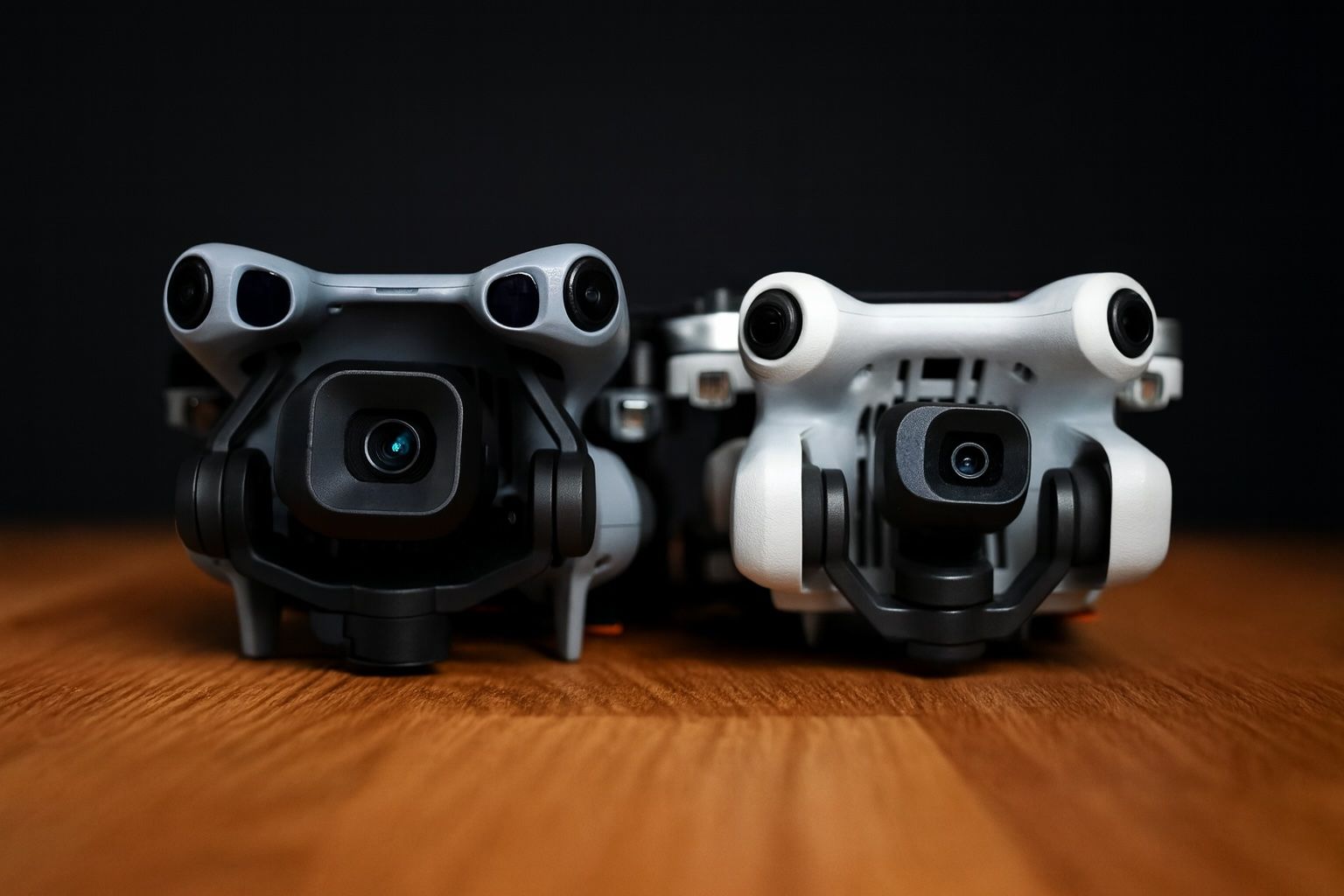
DJI Mini 5 Pro (left) vs DJI Mini 4 Pro (right). Both maintain an ultra-compact folding design with front, rear, and upward vision sensors (“bug-eye” cameras). The Mini 5 Pro’s camera gimbal is larger to accommodate the 1-inch sensor, and it adds a small LiDAR module above the gimbal for improved obstacle detection.
At a glance, Mini 5 Pro and Mini 4 Pro look nearly identical – DJI didn’t radically change the successful Mini formula. Both are palm-sized, foldable drones that weigh under 250 grams takeoff. They share the same silhouette: a rounded body with four folding arms and propellers, and a front-mounted 3-axis camera gimbal. In fact, the Mini 5 Pro’s dimensions are within millimeters of the Mini 4 Pro. The portable form factor is a huge selling point of this series – as PetaPixel’s reviewer noted, at under 250g these drones “easily fit into a single lens slot in most camera bags”, yet pack features that rival larger drones petapixel.com petapixel.com.
On close inspection, a few design tweaks emerge. The Mini 5 Pro’s camera housing is larger, reflecting the bigger 1″ sensor and possibly improved cooling for the image processor. The gimbal can rotate further (as mentioned), but externally it’s similar, with a sturdy dampened mount to stabilize footage. Just above the camera, the Mini 5 Pro integrates a LiDAR emitter (a small sensor window) which the Mini 4 Pro lacks dronedj.com. Meanwhile, the vision sensors are placed similarly: both have dual front “eyes,” dual rear sensors, and dual upward/angled sensors on the top-front of the drone’s shell (giving that insect-like appearance). The Mini 4 Pro introduced those top sensors (absent on Mini 3), and the Mini 5 Pro carries them too techradar.com. Both drones also feature a downward auxiliary light for landing and two downward vision sensors for terrain following and precision hovering.
In terms of build, they use lightweight plastics to hit the sub-250g target, but feel solidly put together. The Mini 4 Pro’s design was praised as extremely similar to the prior Mini 3 Pro, with the only obvious change being the extra obstacle cameras on top techradar.com. The Mini 5 Pro doesn’t deviate much either – if anything, DJI refined small things like arm thickness or vent placements for better cooling and aerodynamics. There are reports the Mini 5’s arms are slightly thicker/stronger (possibly to support the tiny increase in weight and new internals) dronedj.com, but visually it’s not very noticeable. Both drones have a sleek gray finish and aerodynamic body that’s “remarkably similar” across generations techradar.com techradar.com.
Importantly, weight is almost unchanged: around 249 grams with the standard battery in each case. DJI meticulously balances design choices to keep these under the 250g mark. The Mini 4 Pro successfully stays under that line with a bit of margin, even with props and a microSD card. The Mini 5 Pro is technically under 250g too – DJI lists “Approx. 249.9 g” – but as we’ll detail next, that leaves virtually zero margin for manufacturing variance dronedj.com. From a design standpoint, achieving a 1-inch sensor and LiDAR without tipping the scale over 250g is an impressive feat of engineering by DJI. Materials and durability remain similar; due to the low weight, these drones are actually quite resilient to minor bumps (less momentum in crashes), though any hard crash can still break arms or gimbals. Both come with gimbal protectors and propeller holders for safe transport.
Finally, the controllers: The Mini 4 Pro launched with the new DJI RC 2 (with built-in screen) and RC-N2 (standard phone controller) as options . The Mini 5 Pro is compatible with those same new controllers (in fact, it requires the O4-capable controllers – older DJI RC from Mini 3 won’t work). Physically the controllers are identical between the two drone models, so no design differences there. The RC 2 offers O4 transmission and a crisp built-in display, while the cheaper RC-N2 uses your smartphone – a choice of convenience vs cost.
Pricing and Availability
When it comes to cost and where you can buy them, the Mini 4 Pro currently has the edge – mainly because the Mini 5 Pro’s availability is limited in some regions. DJI Mini 4 Pro hit the market in September 2023 starting at $759 USD for the standard kit with the RC-N2 controller techradar.com. The version with the DJI RC 2 (screen remote) was $959, and a Fly More Combo (with extra batteries, bag, hub) ran about $1,099 techradar.com techradar.com. Now in 2025, the Mini 4 Pro often sees discounts and bundle deals. It’s not uncommon to find it on sale – DroneDJ notes the Mini 4 Pro “often sees price drops and bundle promotions,” delivering a lot of value as it gets a bit older dronedj.com. Being an established model, it’s widely available through the DJI Store, Amazon, and retailers worldwide. Importantly, it’s officially sold in North America, Europe, and most regions, so buyers get full warranty support and local customer service.
The Mini 5 Pro, launched in September 2025, came with a slight price bump but a big caveat – no US domestic release. DJI set the Mini 5 Pro’s base price around $769 (with the RC-N3, a similar controller that’s backward compatible) in markets like Europe and Asia dronedj.com. The Fly More combos are priced comparably to the Mini 4’s launch: about $929 for the bundle with the standard controller, and over $1,000 for the bundle with the RC 2 screen and extra batteries dronedj.com dronedj.com. For customers in supported regions (Europe, Asia, etc.), you can order it from DJI or local dealers normally. However, DJI chose not to list the Mini 5 Pro in the US due to “local conditions and evolving industry environment” – widely read as ongoing geopolitical trade issues and US government scrutiny of DJI dronedj.com. This mirrors what happened with the DJI Mavic 4 Pro earlier in 2025, which also skipped an official U.S. launch dronedj.com.
For American drone enthusiasts, this is a frustrating scenario: the Mini 5 Pro is arguably the most advanced mini drone, yet you “can’t have [it] in the US” through normal channels dronedj.com. That said, it’s not impossible to get one – units have appeared via gray-market importers on Amazon and eBay, typically at a markup dronedj.com. If a U.S. pilot imports a Mini 5 Pro, they should be aware of the downsides: no official warranty (DJI ties service to region of sale), potential FCC compliance questions (it’s unclear if the firmware differs), and difficulty obtaining spare parts or support dronedj.com dronedj.com. Essentially, U.S. buyers have to go the extra mile and assume some risk if they want the Mini 5 Pro. DJI’s decision is a big factor in the value equation – as Ishveena Singh of DroneDJ points out, for many U.S. pilots it’s “too much uncertainty for a $769 drone” with no warranty or support dronedj.com.
Meanwhile, the Mini 4 Pro is fully available in the US (and everywhere else), making it a safer choice if you live stateside. It’s also more affordable now than ever. By 2025, one could find the Mini 4 Pro in kit or combo packages frequently on sale under its MSRP, whereas the Mini 5 Pro, being new and scarce, commands full price or higher. In Europe and other regions where both are sold, the price difference is relatively small – around €799 vs €829, etc., depending on taxes – so it really comes down to whether the new features are worth it. In those markets, the Mini 4 Pro might drop further in price as it’s replaced at the top of the mini lineup.
Availability summary: Mini 4 Pro – easy to buy worldwide, cheaper, plenty of accessories and parts readily found. Mini 5 Pro – not officially in North America (as of late 2025), but available in other regions; early adopters in the US have to import. DJI has not announced if the Mini 5 Pro will eventually come to the U.S. (perhaps if political winds change), but they’ve shown a pattern of holding back some products from the U.S. lately. So, if you’re in the U.S., factor in the hassle of import or opt for the Mini 4 Pro which you can get with full peace of mind and support .
Regulatory Considerations: Sub-250g Benefits
One of the biggest appeals of both Mini drones is their classification in the sub-250 gram category. This is not just an arbitrary number – 250 g is a critical cutoff in many countries’ drone laws. In the US, drones under 250 g flown recreationally do not need to be registered with the FAA, and have more lenient rules (for instance, you don’t need to take the TRUST test to fly them recreationally) . Similarly, in Canada and much of the EU, <250 g drones enjoy simpler licensing requirements and can sometimes be flown in areas off-limits to heavier drones (with fewer bureaucratic hoops).
DJI explicitly targets this class: the Mini 4 Pro and Mini 5 Pro are marketed at ~249 grams takeoff weight. In practice, the Mini 4 Pro stays safely under 250g with its standard battery. Even adding small accessories, most Mini 4 units weigh ~243–247 g, giving a slight buffer. The Mini 5 Pro, however, pushes right to the edge: DJI lists “Approx. 249.9 g” and even acknowledges a manufacturing tolerance of ±4 g on that weight dronedj.com. That means some Mini 5 Pro units could weigh 252–254 g out of the box. If you happen to get a slightly “heavy” unit and you fly in the US, you’d technically be required to register that drone (which is only $5 and quick to do, but it’s a legal step one might hope to avoid). More importantly, crossing 250g means it no longer qualifies for certain exceptions – for instance, in the U.S. a sub-250g drone doesn’t require Remote ID broadcast when flown recreationally, but at ≥250g it does. There is no tolerance in FAA rules – 250.0 g and above is treated differently dronexl.co dronexl.co. By contrast, Europe’s drone regulations actually allow a bit of leeway (they built in up to ~3% tolerance for manufacturing variance) dronexl.co. So a Mini 5 Pro in Europe can be considered a C0 class drone as long as it’s labeled under 250g, even if it’s a gram or two over in reality – but a Mini 5 Pro in the U.S. that’s over 250 would break the letter of FAA rules dronexl.co dronexl.co.
For the Mini 4 Pro, this wasn’t a big issue: it has a proven track record of staying under the limit with the standard pack . With the Mini 5 Pro, early users and reviewers have indeed been weighing their units to see if they pass the test. Most fall around 249–250 g without accessories. If you swap in the Intelligent Flight Battery Plus on either drone, you will exceed 250 g (the Plus battery alone adds ~40–50 g). DJI doesn’t even sell the Plus battery in EU markets because it would void the C0 classification there . In the US, you can use the Plus battery on a Mini, but then you must register the drone since it’s no longer sub-250. Essentially, think of the Plus battery as an optional upgrade that sacrifices the under-250g advantage for extra flight time.
From a regulatory standpoint, if flying legally and hassle-free is your goal, both drones deliver when used in their sub-250g configs. You avoid registration in many jurisdictions and can enjoy more permissive operations (for example, Canada lets <250g drones fly in more places with less certification). DJI even touts that “no need for training or exams in most countries” due to the weight – appealing for beginners who don’t want red tape petapixel.com. However, with the Mini 5 Pro you’ll want to double-check your unit’s weight and be mindful of any local rules about that threshold. If it’s a close call, spending $5 to register might be wiser than risking non-compliance. In Europe, both drones can be flown in the A1 (C0) Open category with minimal requirements (just the basic online test) since they’re under 250g and even have class labeling (the Mini 4 Pro was labeled C0, and the Mini 5 Pro should be as well).
One more consideration: Remote ID. In the US, as of September 2023, drones need to broadcast Remote ID unless they’re <250g and not used for commercial flights. The Mini 4 Pro, being sold in the US, came with Remote ID broadcast enabled via firmware. The Mini 5 Pro, since it’s not officially in the US, likely doesn’t include a RID module or it may be disabled. If an imported Mini 5 is flown in the US, technically it should comply with RID if registered – a grey area if the firmware wasn’t built for it. This is a niche concern, but worth noting for commercial operators.
In summary, both drones are championed as hobbyist-friendly, regulation-light aircraft. The Mini 4 Pro has a clear track record of meeting the sub-250g promise. The Mini 5 Pro attempts the same, but pushes the envelope so much that pilots need to be aware of the fine print. DroneXL aptly notes that under FAA rules, “there’s no manufacturing variance allowance” – 250g is an absolute line, so “trust your scale, not marketing materials,” when in doubt dronexl.co dronexl.co. For most casual users, as long as you use the standard battery and maybe avoid payloads, the Mini 5 Pro should operate in the under-250g class just like the Mini 4 Pro does.
The DJI Drone Roadmap: What’s Next?
DJI hasn’t slowed down its release cadence – new drones are constantly in development. For those wondering about upcoming models, there are a few credible leaks and trends to consider:
- DJI Air 4: The DJI Air 3 (released mid-2023) brought dual cameras to the mid-tier; now rumors suggest an Air 4 is on the horizon, likely in late 2025. In fact, a leaked prototype dubbed “Air 4” surfaced earlier this year, indicating DJI is already working on it dronedj.com dronedj.com. Leaked photos showed a design similar to the Mini 4 Pro/Mavic 4, with three upward sensors on top of the body and no rear sensors, possibly to simplify design and reduce weight dronedj.com dronedj.com. The Air 4 is expected to stick to the sub-1kg category but offer improvements like maybe a dual 1-inch sensor system, better flight time (some speculate over 50 min), and updated OcuSync. DroneDJ noted that by late 2025 the Air 3 will be ~2.5 years old, so a refresh makes sense dronedj.com. If the leaks hold true, the Air 4 could merge some design cues from the new Mavic 4 Pro (more on that next) – potentially dropping rear obstacle cameras and using top-mounted ones instead for rear coverage dronedj.com. We’ll likely see an Air 4 announcement once DJI navigates the current trade issues, hopefully by end of 2025 or early 2026.
- Mavic 4 Pro: This is DJI’s new flagship prosumer drone (successor to the Mavic 3 series). It launched in 2025 with cutting-edge features (reportedly a triple-camera system, etc.), but notably skipped the U.S. market just like the Mini 5 Pro . The Mavic 4 Pro was released internationally around May 2025 and is arguably the most versatile drone DJI has made, with a 360° rotating gimbal and advanced imaging. Why mention it here? Because its absence in the U.S. shows the pattern that also affected the Mini 5 Pro. Enthusiasts in the U.S. have had to import the Mavic 4 Pro via third parties , similar to the Mini 5 situation. If this trend continues, upcoming DJI drones might face staggered releases depending on geopolitical factors. For buyers, this means keeping an eye on news: a product might launch in Europe/Asia first and only trickle into North America unofficially.
- Mini 5 Pro successors: Since the Mini 5 Pro just released in 2025, a true “Mini 6” or similar is likely at least a year away (DJI’s cycle for Mini series has been ~15–18 months historically). We might see a DJI Mini 5 (non-Pro) or SE model if DJI follows the pattern of the Mini 2/3 generations (they often released a lower-cost variant after the Pro). However, for the Mini 4 generation, DJI interestingly did not issue a “Mini 4” non-Pro – they jumped straight to the Mini 4 Pro and kept selling the older Mini 3 as the budget option reddit.com. It’s possible DJI will do the same here: the Mini 5 Pro stands as the tech showcase, while the Mini 4 Pro (or Mini 3) continues as a cheaper alternative. If a Mini 5 “SE” or similar appears, it might come in 2026, perhaps stripping out obstacle sensors to hit a lower price (pure speculation for now).
- Other DJI releases: In the rumor mill, aside from drone aircraft, DJI has new cameras and gadgets (e.g. an “Osmo Nano” action cam and “Osmo 360” camera were hinted in FCC filings) theverge.com theverge.com. For drone-specific news, there’s also talk of a future Avata 3 FPV cinewhoop and even something called DJI Neo 2 (a follow-up to a toy drone) per leaked images theverge.com. These aren’t directly related to the Mini series, but show DJI’s pipeline is full.
In short, DJI’s drone lineup in late 2025 has the Mini 4 Pro, Mini 5 Pro, Air 3 (and possibly Air 3S variant), Mavic 3 Pro, Mavic 4 Pro, Avata FPV, etc. We know the Mini 5 Pro is the top dog of the ultra-light category right now. The next things to watch for are an Air 4 (for mid-tier pilots wanting more wind resistance and dual cameras) and eventually the next-gen Mini (be it a Mini 5 non-Pro or Mini 6) in 2026. If you’re on the fence, consider that the Mini 5 Pro will likely remain DJI’s most advanced mini through 2026; any “Mini 6” would probably not arrive until at least late 2026 given the current release rhythm. And of course, availability will depend on how geopolitical issues evolve – a factor nobody can perfectly predict.
Conclusion and Buyer’s Recommendation
So, which drone should you choose? Both the DJI Mini 4 Pro and Mini 5 Pro are outstanding feats – “the Mini 4 Pro is undoubtedly the best sub-250 g drone available [in its time],” as TechRadar put it techradar.com techradar.com, and the Mini 5 Pro pushes the envelope even further. The right choice depends on your needs, location, and budget:
- If you’re in North America (or anywhere the Mini 5 Pro isn’t officially sold): The DJI Mini 4 Pro is the safer bet. It’s readily available, well-supported, and still one of the most capable small drones you can buy. You get nearly the same 4K video quality, excellent obstacle avoidance, and you stay legal under 250g with zero fuss dronedj.com. For most recreational fliers and even semi-pro content creators, the Mini 4 Pro offers “all the quality, safety, and convenience you need, with none of the risk.” dronedj.com dronedj.com It’s also more affordable – especially with current deals – and you won’t be dealing with warranty or parts issues. In essence, the Mini 4 Pro is a proven, high-value choice that will continue to get the job done for the next couple of years.
- If you’re an experienced pilot or professional creator outside the US (or willing to import) who demands the best mini-drone tech: The DJI Mini 5 Pro might be worth it. It gives you that slight edge in camera performance (crucial for low-light or high dynamic range scenes), a bit more flight time, and the absolute latest in tracking and avoidance tech. It’s the drone for those who always chase the cutting edge – the “ultimate pocket-sized camera companion” if you will dronedj.com dronedj.com. Just go in with eyes open: you’re paying a premium for incremental upgrades, and if you’re in a region without official support, you’ll be your own tech support. The Mini 5 Pro makes the most sense for enthusiast filmmakers and drone geeks who will utilize its new features (like 4K120 or LiDAR night flying) and who don’t mind tinkering or taking a bit of risk.
- If you prioritize regulatory freedom: Both drones qualify as <250g, but the Mini 4 Pro has a more comfortable margin. If avoiding registration and compliance steps is vital, the Mini 4 gives more peace of mind that it will stay underweight no matter what (as long as you don’t slap heavy accessories on it). The Mini 5’s weight is right at the knife-edge – fine for most, but possibly requiring a scale check and registration if unlucky dronedj.com. For a casual flyer who just wants hassle-free fun, the Mini 4 Pro is the “safer sub-250g bet” dronedj.com.
- Budget and value: As of 2025, the Mini 4 Pro often can be found for less money, and it’s still a current model. The Mini 5 Pro commands full price. If you’re stretching your budget, you might get more bang for buck with a discounted Mini 4 Pro plus maybe some extra batteries or accessories, rather than a grey-market Mini 5 Pro at a markup.
In conclusion, you really can’t go wrong with the Mini 4 Pro – it remains a top-tier drone in its class and will meet the needs of most users from travelers to bloggers. The Mini 5 Pro is a technical triumph and undoubtedly the better drone on paper, but its marginal improvements come with the baggage of limited availability. As one expert summed up: “The Mini 5 Pro is a technical achievement, but its absence from the US market makes it a frustrating ‘what if’… Meanwhile, the Mini 4 Pro remains impressively capable and legally simple.” dronedj.com dronedj.com For Americans especially, the Mini 4 Pro is the immediate recommendation – you can buy it today, fly it anywhere under 250g rules, and get spectacular results. If you’re an early adopter hungry for the latest features and you live where the Mini 5 Pro is sold (or are willing to import), then by all means, the Mini 5 Pro will serve you excellently – just know you’re on the cutting edge, with the pros and cons that entails.
Bottom line: Grab a Mini 4 Pro now and enjoy the skies, or spring for the Mini 5 Pro if you truly need that 1-inch sensor and are prepared to deal with its quirks. Both are “mini to the max” drones that prove you no longer need a heavy, cumbersome UAV to get cinematic shots from the air dji.com techradar.com. Happy flying!
Sources: DJI, DroneDJ, TechRadar, The Verge, DroneXL, PetaPixel, DPReview.