NEW YORK, May 27, 2026, 17:05 EDT
- DraftKings rose 5.3% to $25.07, reversing Tuesday’s 5.2% drop.
- CFTC records show Railbird Exchange, owned by DraftKings, certified six sports event-contract templates.
- The upside case is tied to prediction markets; the risk is tax pressure and an unsettled legal fight.
DraftKings Inc. shares rose 5.3% on Wednesday, bouncing from the prior session’s slide as investors weighed fresh signs that the sports-betting company is pushing deeper into federally regulated prediction markets.
The stock was at $25.07 in late trading, up $1.26 from Tuesday’s close. It opened at $23.85, traded as high as $25.32 and drew volume of about 11.8 million shares, while FanDuel parent Flutter Entertainment rose 2.0%. The Invesco QQQ Trust, a proxy for large Nasdaq technology shares, slipped 0.1%.
Why it matters now: DraftKings is trying to turn prediction markets — yes-or-no contracts that pay out based on whether an event happens — from a threat into a growth line. The company’s core sportsbook business is still tied to state-by-state gambling rules, but event contracts trade under federal derivatives rules.
The Commodity Futures Trading Commission’s product page showed Railbird Exchange, listed as REX, certified six event-contract products on May 22, including GAMEWIN, GAMESPREAD and ENTITYSTAT. The CFTC lists them as binary options, meaning contracts with two possible outcomes.
Gambling Insider reported that DraftKings-owned Railbird’s filings marked the first public reference to the DKeX brand, DraftKings’ in-house exchange platform, and said the contracts were scheduled for initial listing on May 27. The products resemble familiar sportsbook formats, including game winners, spreads and player-stat contracts, but sit in a different regulatory bucket.
The rebound followed a rough Tuesday. DraftKings fell 5.21% to $23.81 in the previous session, its second straight decline, even as the Nasdaq Composite gained 1.19%, according to MarketWatch data.
The strategic argument is not new, but it is getting sharper. DraftKings acquired Railbird in October, saying the deal would support its entry into prediction markets through regulated event contracts. Chief Executive Jason Robins said at the time that Railbird’s team and platform, combined with DraftKings’ scale and brand, “positions us to win in this incremental space.” DraftKings
Analysts have split over whether that push is a drag or a new runway. Freedom Capital analyst Nick McKay initiated coverage last week with a Buy rating and a $30 price target, saying DraftKings was “positioned to win across sports” after moving into prediction markets to compete with Kalshi and others, TipRanks reported. TipRanks
The company also has a stronger earnings base than it did during earlier land-grab years. DraftKings reported first-quarter revenue of $1.646 billion, up 17% from a year earlier, and maintained 2026 revenue guidance of $6.5 billion to $6.9 billion. It also kept its adjusted EBITDA forecast, a profit measure before interest, tax, depreciation, amortization and some other costs, at $700 million to $900 million.
Robins said in the May results release that the “core business is strong,” while Chief Financial Officer Alan Ellingson said DraftKings was still looking to “grow revenue, expand profitability” and invest in higher-return opportunities. SEC
But the trade is not clean. WilmerHale lawyers wrote on Tuesday that federal versus state oversight of sports-focused prediction markets is still being litigated and could reach the U.S. Supreme Court. If courts or regulators curb sports event contracts, DraftKings’ DKeX strategy could lose much of its appeal.
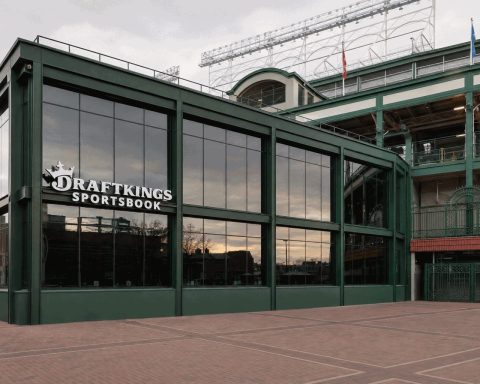
Tax is the other pressure point. Illinois bettors placed 27% fewer March Madness wagers from a year earlier after a new online wagering tax, Axios reported, and DraftKings has cited the state’s high tax structure in deciding to close its retail sportsbook outside Wrigley Field. Illinois taxes operators 25 cents on each of the first 20 million online wagers and 50 cents thereafter.
For now, the stock is trading like investors want the option value. The question is whether DraftKings can build a federally regulated prediction-market business fast enough to offset state tax pressure, legal noise and the cost of competing with fast-moving platforms already built around event trading.
Related articles: NASDAQ:DKNG