
Sydney, Dec. 25, 2025 — DroneShield Limited stock ASX:DRO heads into the Christmas break with a familiar mix of catalysts: fresh contract momentum, a public governance clean‑up, and investors trying to decide whether 2025’s chaos was a growth story with messy execution—or a warning label with great marketing.
The most recent price-sensitive update was a $6.2 million Asia-Pacific military contract, disclosed on 24 December 2025, with delivery and cash payment expected in 2026. Company Announcements In parallel, the company has rolled out board-level governance changes after a bruising period of insider selling and disclosure controversy, including a planned mandatory minimum shareholding policy for directors and senior management.
With the ASX closed for the holiday, DroneShield’s last trading session (24 Dec) saw the shares end around A$3.29, after an intraday range that touched roughly A$3.48 at the high. StockInvest (Prices vary slightly by data provider; the key point is that the stock bounced sharply from November’s drawdown but remains well below its 2025 peak.)
What’s the latest news moving DroneShield shares?
1) DroneShield’s new $6.2m Asia-Pacific contract pushes revenue into 2026
DroneShield told the market it has received a standalone $6.2 million order via an in-country reseller for an Asia-Pacific military end-customer, with delivery and payment expected in 2026.
Two details stood out for investors:
- The reseller is described as a wholly owned subsidiary of a multi‑billion‑dollar, publicly listed global customer, and is contractually required to distribute solutions to a major Asia‑Pacific military government department.
- The solutions include selected third‑party hardware designed to interoperate with DroneShield’s command-and-control platform DroneSentry‑C2.
This matters because it suggests DroneShield isn’t only selling “boxed” hardware—it’s increasingly positioning itself as the software and systems layer that can integrate multiple sensors/effectors, which is where stickier, higher-margin value can live over time.
2) The earlier $49.6m European military contract sets up a Q1 2026 delivery window
Just days before the governance headlines, DroneShield announced a much larger $49.6 million European order via an in‑region reseller, contractually required to distribute to a European military end customer.
According to the company, the contract covers handheld counter‑drone systems, accessories, and software updates, with a “significant portion” of hardware already on the shelf and deliveries and cash payments expected to be completed in Q1 2026. DroneShield
That combination—inventory already available plus near-dated payments—helps explain why the stock can rally hard on contract flow: the market isn’t just hearing “pipeline,” it’s hearing “cash conversion soon.”
Governance reset: why DroneShield changed its rules (and why investors care)
DroneShield’s December governance changes are not cosmetic. They are a direct response to a confidence shock that hit the stock after management share sales and disclosure errors became public.
In an ASX announcement dated 22 December 2025, DroneShield said an independent review (overseen by independent directors and conducted by Herbert Smith Freehills Kramer) led the board to take “immediate action.” ASX Announcements
Key steps include:
- Establishing a mandatory minimum shareholding policy (MSP):
- Each director is expected to hold ordinary shares worth their annual base fee within 3 years.
- The CEO is expected to hold ordinary shares worth 200% of annual salary within 12 months.
- Updating the company’s Securities Trading Policy and Continuous Disclosure Policy to align with what markets expect of an ASX200 company.
- Searching for an additional independent non‑executive director with ASX200 experience within 12 months.
- A review of director and executive remuneration (with an update expected in the February 2026 remuneration report).
- Process upgrades around announcement verification; and, after ERP implementation concludes in January 2026, an external adviser will review financial reporting processes and internal controls.
Reuters described the reforms as coming after DroneShield disclosed that top executives sold a combined A$70 million of shares over a short period, triggering a sharp sell-off and forcing a governance review.
The backdrop: a high-growth stock that tripped over trust
DroneShield’s 2025 story has two competing plotlines:
- Demand tailwinds: drones are now cheap, ubiquitous, and tactically meaningful—so counter‑drone (counter‑UAS) capability is becoming a default line item for militaries and critical infrastructure.
- Credibility headwinds: governance and disclosure errors can erase investor confidence faster than any competitor can.
A particularly damaging episode occurred in November, when DroneShield issued a corrective ASX notice withdrawing an earlier announcement: it clarified that “November Contracts” totalling $7.6 million for U.S. government delivery were not new orders, but reissued orders due to regulatory updates, and that the contracts were inadvertently marked as new due to an administrative error. Company Announcements
Reuters also reported broader investor concern after executive share sales, the disclosure error, and leadership instability—highlighting how quickly a “market darling” narrative can unravel when incentives and controls look shaky. Reuters
Financial snapshot: the numbers that made DroneShield a market favourite
DroneShield’s fundamentals are the reason this remains a widely watched stock, despite the governance drama.
In its Quarterly Report for the period ending 30 September 2025, DroneShield reported an “exceptionally strong quarter” with record metrics, including: Company Announcements
- Revenue: A$92.9 million (3Q 2025), up sharply from the prior-year comparable quarter.
- Cash receipts: A$77.4 million for the quarter.
- Committed revenues year-to-date 2025: A$193.1 million, compared with A$57 million for all of 2024 (as presented in the report).
- SaaS revenue: A$3.5 million for 3Q 2025 (also highlighted as strategically important as drone technology evolves).
Those figures explain why many investors still treat governance repairs as “fixable,” while viewing the demand environment as structurally positive.
Other recent contracts that feed the 2026 outlook
If you’re trying to model 2026 (even loosely), it’s not just about the December headlines.
- On 3 November 2025, DroneShield announced a $25.3 million Latin American contract, with deliveries expected through calendar Q4 2025 and Q1 2026, and cash payment expected across the same window.
- On 25 November 2025, DroneShield announced a $5.2 million European military follow‑on contract, and noted that its order announcement threshold for 2026 will increase to $20 million (from the current $5 million), unless there’s a specific rationale to announce a smaller order.
That last point is easy to miss but important: investors may see fewer small contract headlines in 2026 even if underlying order flow continues—because the company is signalling it plans to raise the bar for what it flags to the market as a standalone contract announcement.
What does DroneShield actually sell?
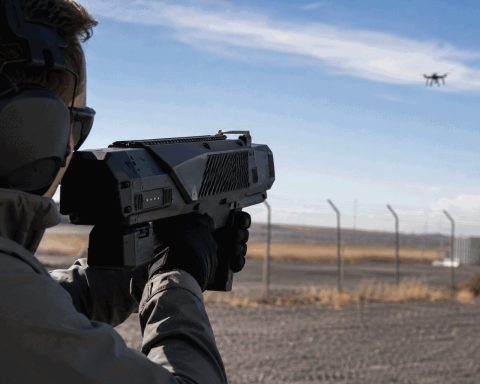
DroneShield positions itself as a counter‑UAS specialist offering AI-powered hardware and software to detect, track, and defeat unmanned aerial threats. DroneShield In practice, its recent contract language shows it sells:
- Handheld counter‑drone systems (hardware),
- Software updates and command-and-control tooling (software),
- And increasingly, integrated solutions that can connect DroneShield software with third‑party hardware.
That integration story matters because counter‑drone is a classic “systems problem”: detection, identification, tracking, mitigation, and reporting all have to work together, often in messy RF environments with fast-evolving threats.
DroneShield stock forecasts: analyst price targets and what they imply for 2026
Forecasts are not facts (markets love humbling forecasters), but investors still track them because they shape institutional positioning and headline narratives.
Here’s what prominent consensus aggregators were showing in late December:
- Investing.com’s consensus estimates imply upside based on analysts’ average price target, and also list the stock’s 52‑week range (roughly A$0.585 to A$6.705).
- TradingView’s analyst range for ASX:DRO shows estimates spanning roughly A$4.40 (low) to A$5.00 (high).
- A widely cited broker note from Bell Potter retained a Buy view while trimming the price target to A$4.40 (down from A$5.30), according to Australian market wrap reporting.
The big takeaway: even bullish targets are implicitly saying the stock must earn its way higher through execution—deliveries, cash receipts, repeat orders, and governance stabilization—rather than pure multiple expansion.
What to watch next: the 2026 catalysts that actually matter
DroneShield’s near-term story is unusually “calendar‑driven.” Several events and windows could swing sentiment quickly:
- Delivery and cash receipt timing
- The $49.6m European contract is expected to be delivered and paid in Q1 2026.
- The $6.2m Asia-Pacific contract and its cash receipt are expected in 2026.
- The $25.3m LATAM contract spans deliveries/payments through Q1 2026.
- Governance follow-through
Policies are promises until implemented. Investors will be watching for:
- Finalised updates to trading and continuous disclosure policies, and any market communication around controls.
- Progress on appointing an additional independent director with ASX200 experience.
- Reporting credibility and internal controls
The board has flagged a post‑ERP external review of reporting processes and internal controls after ERP implementation completes in January 2026. ASX Announcements
Given the earlier disclosure correction on “new vs reissued” U.S. contracts, investors are likely to treat process upgrades as a material driver of valuation, not just compliance housekeeping. Company Announcements
The risk side of the ledger (because stocks are allergic to one‑sided narratives)
DroneShield’s opportunity is obvious; so are the risks:
- Lumpy revenue and contract concentration: Large defence orders can be episodic, politically influenced, and timing-sensitive (especially around delivery milestones and procurement cycles).
- Governance discount: Even after reforms, markets may keep a higher risk premium until the company demonstrates clean execution and consistent disclosure practices.
- Volatility and valuation sensitivity: With a wide 52-week trading range, small changes in sentiment can produce outsized price moves.
Bottom line
As of 25 December 2025, DroneShield Limited stock is being pulled by two strong forces: real-world demand for counter‑drone capability (validated by multiple contracts with delivery/cash extending into 2026) and an investor base that now insists on trust and controls after insider-selling backlash and disclosure errors.
Related articles: ASX:DRO