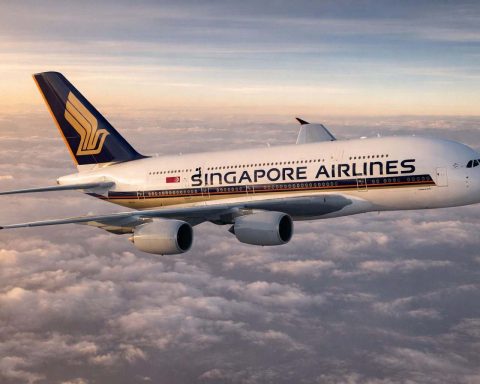

SINGAPORE (25 December 2025) — Singapore Airlines Ltd. stock (SGX: C6L) is heading into year-end with a familiar mix of tailwinds and turbulence: resilient passenger demand and shareholder returns on one side, and profit pressure from intensifying competition and losses at associate Air India on the other.
With Singapore’s market shut today for Christmas Day, investors are taking stock of where Singapore Airlines shares left off — and what the next catalysts could be once trading resumes.
Singapore Airlines share price today: Where C6L stands into the holiday break
Singapore Airlines shares last closed at S$6.40 on 24 December 2025, with trading volumes typical of a shortened, holiday-thinned week.
Because 25 December is a Singapore public holiday — and the Singapore Exchange is closed — there is no fresh on-exchange price print today, making 24 December’s close the key reference point for investors assessing momentum.
The most important operating datapoint right now: November traffic stayed firm
The market’s near-term narrative has been shaped by Singapore Airlines Group’s latest monthly operating data (a major read-through for demand, pricing power, and capacity discipline).
For November 2025, Singapore Airlines Group reported:
- Passenger traffic up 2.6% year-on-year, ahead of a 2.2% rise in passenger capacity
- Group passenger load factor at 87.3% (up 0.3 percentage points)
- A combined 3.5 million passengers carried (up 6.0%)
- Cargo and mail carried up 12.4%, with cargo load factor improving to 60.2% Singapore Airlines
Those figures reinforce an important point for the Singapore Airlines stock story: demand is still healthy — but the “easy money” phase of post-pandemic pricing is behind the sector, so investors increasingly care about yields (average fares) and cost control, not just full planes.
Earnings reality check: Operating profit held up, but net profit fell sharply
Singapore Airlines’ most recent major financial update (its first half FY2025/26 results for the six months ended 30 September 2025) explains why the stock can look steady on the surface while analyst optimism remains restrained.
From the company’s results materials:
- Total revenue:S$9.675 billion (first-half record)
- Operating profit:S$802.9 million (slightly higher year-on-year)
- Profit attributable to owners:S$238.5 million, down sharply versus the year-ago period SGX Links
Management’s messaging was essentially: core operations remained robust, but non-operating items and associate results dragged net profit — with Air India’s contribution a major swing factor.
Reuters’ coverage of the same results also highlighted cost pressures and the Air India impact, noting that the associate’s losses weighed on the group’s bottom line as competition intensified across key markets.
Dividend and capital return: Why income-focused investors are paying attention
If there’s one reason Singapore Airlines stock has found support into year-end, it’s that the company has been explicit about returning capital — not just through “ordinary” dividends, but through a structured special-dividend plan.
Key confirmed dividend details:
- Interim dividend:5 cents per share
- Interim special dividend:3 cents per share
- Ex-date:5 December 2025
- Payment date:23 December 2025 Singapore Airlines
In its first-half results release, Singapore Airlines also set out a special dividend package targeting 10 cents per share annually over three financial years, with the first 3-cent tranche already paid and a further tranche (linked to FY2025/26) subject to shareholder approval at the AGM in 2026.
For investors, that package does two things:
- Creates a clearer income runway (useful in volatile airline cycles).
- Raises the “valuation floor” debate — because even if earnings are choppy, cash returns can keep the stock from de-rating too aggressively unless the operating outlook deteriorates.
Analyst forecasts: Why many targets cluster around the current price
Despite the dividend story and stable traffic, sell-side expectations remain relatively conservative — and the consensus price targets circulating as of 25 December 2025 generally imply limited upside from where the stock last traded.
Several widely followed consensus snapshots show:
- Yahoo Finance lists a 1-year target estimate around S$6.17, with targets spanning roughly S$5.25 to S$7.00.
- Investing.com’s consensus (based on a similar analyst count) also pegs the average target near S$6.17, with the high/low estimates in the same ballpark.
- SG-focused aggregator data shows targets (from multiple research institutions) ranging about S$6.03 to S$6.40 as of 25 December 2025, placing the median slightly below the last traded price.
- MarketScreener’s broker feed reflects a year in which several houses adjusted targets and, at points, shifted to more cautious stances (including “sell/reduce” calls from some brokers). MarketScreener
The “why” behind this tight target clustering is straightforward:
- Passenger demand looks resilient, but pricing power is under pressure as capacity normalises and competition intensifies.
- The Air India stake is strategically compelling, but in the near term it can behave like an earnings “gravity well” if losses persist.
- Airlines remain highly exposed to fuel, foreign exchange, labour, and operational constraints, which makes analysts hesitant to model a smooth earnings path.
Sector backdrop into 2026: Record travel, but the cost cycle still bites
Air travel demand around Christmas 2025 is expected to be exceptionally strong globally, according to industry data cited by the Financial Times — an encouraging macro tailwind for airlines going into 2026.
But airlines are also wrestling with structural cost issues. IATA’s December 2025 industry outlook flags persistent pressure from non-fuel costs, including labour and maintenance, in part due to delayed aircraft deliveries and aging fleets.
For a premium network carrier like Singapore Airlines, that backdrop matters because the investment case often hinges on the airline’s ability to defend margins via product positioning and network strength — not by being the lowest-cost operator.
A Singapore-specific 2026 issue investors may be underpricing: the SAF levy
One of the more tangible policy developments that could shape ticket economics is Singapore’s move toward sustainable aviation fuel (SAF) adoption.
The Civil Aviation Authority of Singapore (CAAS) has announced a Sustainable Aviation Fuel Levy that will apply to tickets and services sold from 1 April 2026, for flights departing from 1 October 2026. The levy varies by destination band and cabin class (with published examples ranging from S$1 for short-haul economy to higher levels for long-haul and premium cabins).
This isn’t automatically “bad” for Singapore Airlines stock — airlines can often pass such costs through — but it is a real variable for demand elasticity and fare competitiveness, especially on price-sensitive routes.
Fleet and supply chain watch: Boeing 777-9 timing and delivery risk
Aircraft delivery schedules remain one of aviation’s quiet but powerful profit drivers: delays constrain growth plans, while on-time deliveries can increase capacity into competitive markets (sometimes too quickly).
On that front, Reuters reported that Singapore Airlines’ CEO said the carrier does not expect a major impact from the delay in Boeing 777-9 deliveries, citing flexibility in fleet planning.
Investors will still be watching how the group manages fleet renewal and capacity growth — because capacity decisions ultimately flow through to unit revenues, yields, and load factors.
Next major catalysts for Singapore Airlines stock
For investors tracking near-term catalysts, Singapore Airlines has already published its key upcoming reporting dates:
- 24 February 2026: FY2025/26 Third Quarter Business Update
- 14 May 2026: FY2025/26 Fourth Quarter and Full Year Results Singapore Airlines
Between now and then, monthly operating statistics (like the November release) can move expectations — particularly if they show meaningful shifts in load factors, cargo performance, or route-region mix.
Bottom line: What the market is pricing into C6L right now
At around S$6.40 (last close), Singapore Airlines stock appears priced as a steady, dividend-supported large-cap with limited near-term rerating potential — unless one of three things changes materially:
- Yields stabilise or improve, signalling competition is rationalising.
- Air India losses narrow, reducing drag on group profitability.
- The market assigns higher value to the multi-year capital return plan, treating it as a durable shareholder-return framework rather than a one-off distribution.
For now, the dominant “holiday week” setup is a classic airline paradox: full planes and rising traffic can coexist with softer profits when costs and competition are moving targets. Singapore Airlines has the brand and balance sheet to navigate that paradox — but analysts are making it clear they want to see the earnings follow-through before upgrading the story.
Related articles: SGX:C6L