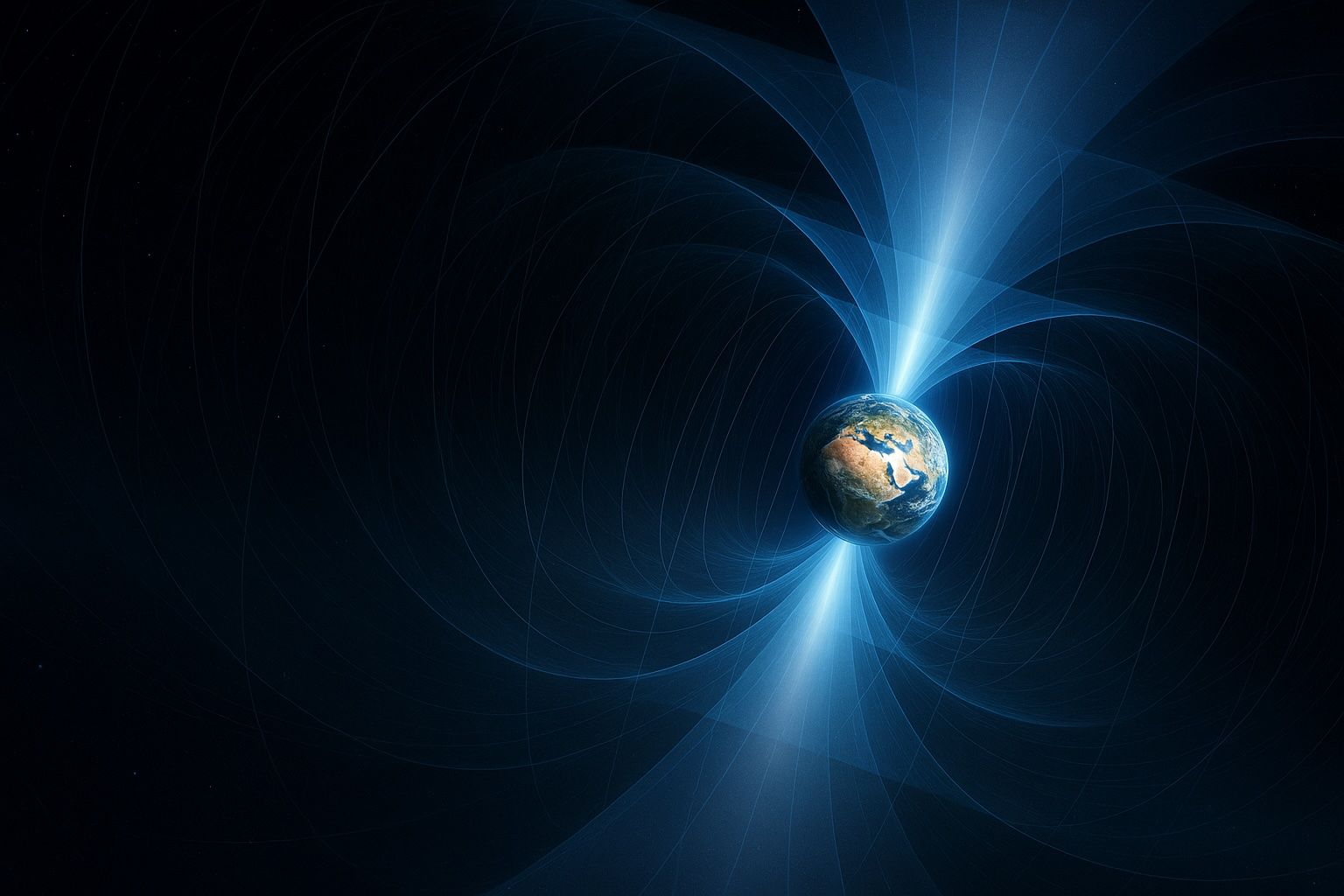
New satellite data overturns a decades‑old assumption about the magnetosphere’s electric polarity, while ESA’s Swarm mission maps a fast‑changing weak region over the South Atlantic that matters for satellites—not people.
Published: November 12, 2025
The big picture
Two complementary breakthroughs are reshaping scientists’ view of near‑Earth space:
- A polarity flip near the equator. New satellite observations and computer models show that the magnetosphere’s large‑scale electric polarity—long thought to be uniform from pole to equator—reverses sign around the equator. The finding helps explain how energy moves through Earth’s magnetic “bubble” during geomagnetic storms. ScienceDaily
- A growing weak spot over the South Atlantic. Eleven years of measurements from the European Space Agency’s Swarm satellites reveal that the South Atlantic Anomaly (SAA)—a region where Earth’s magnetic field is unusually weak—has expanded by an area nearly half the size of continental Europe and is developing a secondary lobe toward Africa. That evolution increases radiation exposure for spacecraft that pass overhead. European Space Agency
A surprising flip near Earth’s equator
For decades, textbooks described a dawn‑to‑dusk electric field threading the magnetosphere, with the “morning side” positively charged and the “evening side” negative. A team from Kyoto, Nagoya and Kyushu Universities has now shown the opposite near the equator: morning is negative, evening is positive (the poles still match the original picture). The team reproduced the effect with magnetohydrodynamic simulations, concluding the motion of plasma along magnetic field lines sets up the reversed charges. The work, published in JGR: Space Physics, reframes how scientists think about electric forces that steer storms in near‑Earth space. ScienceDaily
Why it matters: Electric fields guide charged particles and shape the radiation environment around Earth. Understanding where and how that field changes sign improves forecasts of storm‑time disturbances that can disrupt satellites and communications. ScienceDaily
The South Atlantic Anomaly is changing shape—and spreading east
ESA’s Swarm constellation, in orbit since 2013, has produced the longest continuous record of precise magnetic measurements from space. Using that record, researchers report the SAA has widened steadily since 2014 and is weakening faster southwest of Africa, indicating the anomaly is not a single block but a complex, evolving feature. The behavior is linked to “reverse flux patches” at the boundary between Earth’s molten outer core and the mantle—zones where magnetic field lines unexpectedly dive back into the core instead of emerging from it. European Space Agency
Additional context from independent reporting: Over the past decade the SAA has sprouted a lobe toward Africa, and inside its boundaries the effective “altitude” of the magnetic field dips much lower than average—exposing satellites to more energetic particles as they pass overhead. Live Science
Elsewhere, the field is shifting in contrasting ways: since Swarm began, the strong‑field region over Canada has shrunk (by an area roughly the size of India) while the Siberian strong‑field region has grown (by an area comparable to Greenland), a pattern tied to the north magnetic pole’s migration toward Siberia. European Space Agency
What this means for satellites, astronauts and daily life
- Space hardware: A weaker magnetic field above the SAA lets more high‑energy particles reach low‑Earth orbit. That raises the risk of single‑event upsets and intermittent instrument glitches. NASA has long tracked the SAA’s slow “split” into two lobes and notes that missions sometimes power down sensitive systems when transiting the region. Instruments mounted externally on the International Space Station see occasional “blips,” but astronauts remain safe inside the station’s shielding. NASA
- People on the ground: Despite breathless headlines, the SAA is not a hazard to life at Earth’s surface. It is a space‑safety and engineering challenge, not a public‑health one. NASA Science
No, this isn’t a “giant hole”—and it’s not a sign of an imminent pole flip
Some articles have described a “giant hole” in Earth’s magnetic field. Scientists are clear: the SAA is a region of reduced magnetic intensity, not an actual hole. It has been known since the 19th century and reflects the natural, uneven way the geodynamo operates. European Space Agency
As for magnetic reversal fears, authoritative agencies say the current changes do not indicate Earth’s poles are about to flip. Polarity reversals take hundreds to thousands of years, and there is no evidence one is imminent. A 2025 study led by European researchers also argues the SAA is probably not a precursor to a reversal. NASA Science+2USGS+2
A third global field adds to the story
In related progress, NASA in 2024 reported the first direct detection of a planet‑wide ambipolar electric field—a weak, global field that helps lift ions from Earth’s upper atmosphere into space and drives the polar wind. Scientists had predicted it for more than 60 years. This “third global field,” alongside gravity and magnetism, adds another lever shaping our near‑Earth environment. NASA Science
What to watch next
- More Swarm science: ESA says the satellites remain healthy and could continue delivering high‑quality magnetic records beyond 2030, improving models that mission planners use to harden spacecraft against radiation and to update navigation standards. European Space Agency
- Space‑weather readiness: Better mapping of the SAA and improved understanding of the magnetosphere’s reversed equatorial polarity should feed into storm‑time forecasts, satellite design and operational playbooks (for example, scheduling data‑intensive activities outside the anomaly). ScienceDaily+1
Bottom line
The latest research is not a doomsday signal. Instead, it paints a more nuanced, dynamic portrait of Earth’s magnetic environment:
- Near the equator, the magnetosphere’s large‑scale electric polarity can flip sign, driven by plasma motion. ScienceDaily
- Over the South Atlantic, the field’s weak spot is widening and changing shape, a challenge for spacecraft that engineers can and do manage. European Space Agency+1
- There is no evidence of an imminent pole reversal, and no threat to people on the ground. NASA Science+1
Understanding these changes—rather than fearing them—is what keeps satellites safer and science moving forward.