
- Strong Q3 Results: Lilly’s Q3 2025 revenue jumped 54% year-on-year to $17.6 billion, driven by its blockbuster GLP-1 diabetes and weight-loss drugs prnewswire.com. Adjusted earnings per share came in at $7.02, far above analysts’ ~$5.69 estimate reuters.com.
- Raised Guidance: On Oct. 30, Lilly raised its full-year sales forecast to $61–63.5 billion and its EPS outlook to $23.00–$23.70 reuters.com, topping Wall Street’s expectations. This beat-and-raise earned praise from analysts, with J.P. Morgan calling it a “dispels some GLP-1 market concerns” performance reuters.com.
- Stock Reaction: LLY stock has climbed this fall. After trading around the low-$700s in late September, shares spiked over 9% and briefly hit the mid-$830s on Oct. 1 ts2.tech. Ahead of the earnings, LLY was trading in the low-$800s (around $820 on Oct. 28–29 investing.com). News of the blowout quarter sent shares up another 5% premarket on Oct. 30 reuters.com.
- Weight-Loss Drug Leadership: Lilly’s new GLP-1 “incretin” drugs (which mimic natural hormones to lower blood sugar and appetite reuters.com) are selling like hotcakes. The Q3 sales of its weight-loss drug Zepbound reached $3.6 billion (versus $3.23B expected), and diabetes drug Mounjaro hit $6.5B (well above the $5.73B forecast) reuters.com. Lilly now commands roughly 57% of U.S. GLP-1 prescriptions (versus ~43% for rival Novo Nordisk) ts2.tech. The overall market for obesity/GLP-1 drugs could hit about $150 billion by 2030 reuters.com, and Lilly is poised to capture much of that growth.
- Pipeline & Approvals: Lilly’s pipeline is booming. In September it won EU approval for its Alzheimer’s antibody Kisunla and got an FDA nod for its new breast cancer pill Inluriyo (imlunestrant) ts2.tech prnewswire.com. The company also reported positive late-stage data on its oral obesity pill orforglipron (plans to file globally by year-end) prnewswire.com. These developments add to Lilly’s blockbuster line-up.
- Largest Healthcare Market Cap: With a market value north of $720 billion ca.investing.com, Lilly is now the world’s largest healthcare company by market cap reuters.com. Its massive size and growth have made it a favorite among investors in the drug sector.
- Bullish Analyst Outlook: Wall Street remains bullish. About 16 analysts cover Lilly with a “Strong Buy” consensus, and the average 12-month price target is roughly $970 (implying ~19% upside) stockanalysis.com. Major banks are even more optimistic: Morgan Stanley’s target is ~$1,023 and JPMorgan’s is ~$1,050 stockanalysis.com stockanalysis.com. BMO Capital recently upgraded Lilly’s target to $930 (from $840), citing surging incretin drug demand ca.investing.com.
- Strategic Acquisitions: Lilly has been aggressive on M&A to fuel future growth. In 2025 it paid up to $1.3B for Verve Therapeutics (gene editing programs for heart disease) fiercebiotech.com and up to $1B for SiteOne Therapeutics (non-opioid pain drugs) fiercebiotech.com. It also acquired Scorpion Therapeutics’ oncology program (up to $2.5B) and announced a deal to buy Adverum Biotechnologies (gene therapy for vision loss) for up to $262M biospace.com biospace.com. These deals deepen Lilly’s pipeline beyond diabetes.
- AI & Research Partnerships: Lilly is investing in innovation. In May 2025 it announced a $250M, 8-year partnership with Purdue University to co-develop AI-driven drug discovery and manufacturing processes axios.com. It is also striking biotech partnerships that use AI. For example, Lilly licensed an AI-discovered antibody for ALS (amyotrophic lateral sclerosis), committing up to $415M to development medcitynews.com. These moves underscore Lilly’s push into high-tech R&D.
- Global Expansion: The company is expanding overseas. Recently Lilly signed a deal with India’s Cipla allowing Cipla to market Lilly’s GLP-1 obesity drug (tirzepatide) under the brand “Yurpeak” in India reuters.com. This kind of licensing deal helps Lilly reach new markets while focusing on its core development.
- Valuation & Risks: Despite strong growth, Lilly’s valuation is very high (trading around 40–50 times earnings ts2.tech). Investors note potential risks. President Trump has proposed capping GLP-1 drug prices (recently vowing to cut Ozempic’s cost to ~$150/month), and Lilly’s stock fell about 4% when the news broke ts2.tech ts2.tech. There’s concern that broader price controls could hit Lilly’s sales. Other factors include stiff competition (e.g. from Novo Nordisk) and the fact that only a small fraction of patients use GLP-1s so far. Still, Lilly’s leadership in this fast-growing field gives it room for continued gains.
October Stock Moves and Market Reaction
Eli Lilly’s stock has moved sharply in recent weeks. After languishing around the mid-$700s in late September, the stock soared in early October. Between Sept. 29 and Oct. 1 it jumped over 9%, briefly touching the low $830s ts2.tech. Analysts noted this jump was fueled by a “perfect storm” of good news: better-than-expected trial results and anticipation of strong earnings. Trading volume was heavy, and by Oct. 23 shares were holding near $818 ts2.tech, about 6% higher on the year (roughly in line with the health-care index).
The stock then saw a mid-month wobble. On Oct. 16 President Trump announced plans to cut the cost of GLP-1 weight-loss drugs like Wegovy (Novo Nordisk’s drug) to around $150 per month ts2.tech. Investors feared this could extend to all GLP-1 medications, including Lilly’s Mounjaro and Zepbound. LLY shares fell roughly 4% on that day ts2.tech, dipping into the high-$700s. This episode highlighted a new risk: while demand for Lilly’s obesity and diabetes drugs is exploding, potential drug-price legislation or negotiations could affect profitability.
By the Oct. 30 Q3 earnings release, LLY was in the low $800s. After reporting blowout results and higher guidance, shares jumped about 5% in pre-market trading reuters.com. This reaction underlines investor enthusiasm that Lilly’s top-line growth remains intact despite any pricing pressures.
Strong Third-Quarter Earnings
On Oct. 30 Lilly announced blockbuster Q3 results. Revenue was $17.60 billion, a 54% increase from a year ago prnewswire.com. The surge was driven by a 62% rise in volume of its key products (mostly Mounjaro and Zepbound), only partly offset by lower net prices. In fact, Lilly noted a roughly 10% decrease in realized prices, largely due to payer rebates, but this was more than made up by surging prescriptions. The gross margin remained very high (about 83% of sales), reflecting the premium nature of its drugs.
On the bottom line, Lilly earned $7.02 per share (non-GAAP) in Q3, which was much higher than the $5.69 Wall Street expected reuters.com. The adjusted EPS (excluding one-time charges) jumped from $1.18 a year ago to $7.02, underscoring the leap in profitability. Management cited strong “incretin portfolio” demand for these results. CEO Dave Ricks said Lilly “delivered another strong quarter” and highlighted both pipeline advances (like advancing the oral obesity pill orforglipron into later trials) and manufacturing expansion (new plants in Virginia and Texas) prnewswire.com.
Impressively, Lilly raised its 2025 guidance again. It now expects $23.00–$23.70 in EPS on $61–$63.5 billion revenue reuters.com. Prior guidance had been $60–62B and $21.75–23.00 EPS, so this was a material bump. Wall Street had been expecting about $22.18 EPS for 2025, so the new range is well above that consensus. Investors cheered the forecast-raising, seeing it as confirmation that the appetite for Lilly’s drugs remains unabated. (For context, Lilly’s Q2 2025 revenue was $15.56B ts2.tech with EPS $6.31, meaning even Q3 beat that earlier boom.)
Blockbuster Weight-Loss and Diabetes Drugs
Lilly’s headline growth comes mainly from two drugs: Mounjaro (a diabetes medicine approved late 2022 that also causes weight loss) and Zepbound (a dedicated obesity drug approved 2023). Both are in the class of GLP-1 receptor agonists (sometimes called “incretin” drugs), which mimic a gut hormone to lower blood sugar and curb appetite reuters.com. Their popularity has exploded: millions of patients are seeking them for diabetes and weight control.
In Q3, Zepbound sales were $3.6 billion, comfortably above the $3.23B analysts had forecast reuters.com. Remarkably, prescriptions for Zepbound quickly surpassed those of Novo Nordisk’s similar obesity drug Wegovy, even though Wegovy has been on the market two years longer. Mounjaro did $6.5B in Q3, also topping the $5.73B estimate reuters.com. This suggests robust uptake and even growing market share for Lilly: industry data now peg Lilly with about 57% of the U.S. GLP-1 market (vs. 43% for Novo Nordisk) ts2.tech.
For comparison, peers have been growing more slowly. Novo Nordisk’s first-half 2025 sales grew ~18% year-on-year, whereas Lilly’s GLP-1 franchise grew in the 40%+ range ts2.tech. With only about 4% of eligible patients currently using GLP-1 drugs ts2.tech, analysts see plenty of runway for growth if Lilly can maintain its market share. The company expects these drugs to continue driving gains, which is why it keeps raising its sales targets (now up to ~$62B for the year ts2.tech).
New Approvals and Pipeline Progress
Lilly’s momentum isn’t limited to GLP-1s. The company has a rich pipeline. In late September, the EU granted marketing approval for Lilly’s Alzheimer’s antibody donanemab (brand name Kisunla) for early Alzheimer’s disease – an important win after the FDA’s recent label update in the U.S. ts2.tech. Lilly also secured FDA approval in September for Inluriyo (generic imlunestrant), a once-daily oral breast cancer pill for certain metastatic patients prnewswire.com. Management noted that these represent “key progress” across Lilly’s pipeline prnewswire.com.
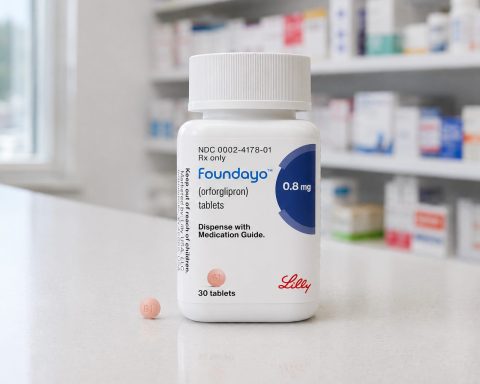
Another big one is orforglipron, an oral GLP-1 pill in late-stage trials. This year Lilly reported positive Phase 3 results (patients losing on average 10–12% of body weight on it) prnewswire.com. Lilly plans to submit it for obesity treatment approval by year-end. If approved, an oral GLP-1 could dramatically expand Lilly’s weight-loss market, especially for patients averse to injections.
On top of drug therapy, Lilly is also enhancing diagnostics: for example, it partnered with Roche to get FDA clearance on a blood test (pTau181) to detect Alzheimer’s faster, which could “speed uptake” of treatments like Kisunla ts2.tech. All this shows Lilly is reinforcing its leadership in diabetes, obesity, Alzheimer’s, cancer, and beyond.
Investing in Innovation and AI
Lilly is pouring money into research and tech partnerships. In May 2025, it announced a landmark $250 million, eight-year partnership with Purdue University axios.com. The goal is to collaborate on accelerating drug discovery and manufacturing using AI and other advanced technologies. Purdue faculty will work with Lilly scientists on AI-driven drug design, with Lilly building new labs on campus. As Lilly’s CEO put it, this deal helps train talent and hedge against uncertain federal research funding axios.com.
Lilly is also teaming up with AI-driven biotech startups. For example, in May it licensed rights to an antibody discovered by UK startup Alchemab for ALS (a neurodegenerative disease) medcitynews.com. Lilly will pay up to $415M, including milestones, to develop this AI-found drug. The company already has partnerships with QurAlis and Verge Genomics on ALS, and its own AI-developed Alzheimer’s drug Kisunla. This focus on AI reflects Lilly’s strategy to use cutting-edge tech to fill its pipeline.
Market Context and Competitors
Compared to other big pharma, Lilly stands out for its recent growth. It is now valued at about $720+ billion ca.investing.com, making it the largest U.S. healthcare/pharma company by market cap reuters.com. For context, its nearest competitors (like Pfizer or Merck) lack a blockbuster obesity drug and have much slower growth profiles, while its GLP-1 rival Novo Nordisk is big but still trailing Lilly in U.S. weight-loss sales. (In fact, Novo’s U.S.-listed stock fell ~1.6% when Lilly reported its Q3 results, as investors anticipated a strong lead for Lilly reuters.com.)
Analyst forecasts reflect Lilly’s outperformance. Besides the consensus Strong Buy rating stockanalysis.com, models vary on how high LLY can go. Some quant models see it reaching ~$1,030 by end-2026 ts2.tech, while more conservative outlooks (notably on stockanalysis.com) range ~$768 for end-2025 up to ~$1,190 possible high target ts2.tech. Even on the low end, analysts’ targets imply mid-to-high single-digit gains from current levels, indicating broad confidence.
Risks and Valuation Concerns
Despite the optimism, investors note some risks. The biggest is drug pricing pressure. President Trump’s policy proposals (a “most favoured nation” rule on drug prices, and recent comments on slashing Ozempic costs) could limit how much Lilly can charge for its therapies reuters.com ts2.tech. Any significant price rollback on GLP-1 drugs would impact Lilly’s margins. Another risk is competition: Novo Nordisk is also expanding (and FDA has its GLP-1 competitor for Alzheimer’s on the horizon), so Lilly must maintain its lead.
Valuation is another concern. Lilly’s stock trades at around 40–50 times forward earnings ts2.tech (reflecting very high growth expectations). This premium is well above typical pharma multiples, so any earnings miss or policy shock could be painful. A few analysts have even cautioned that the stock is “expensive” and needs continued strong growth to justify the price.
Bottom Line
Eli Lilly’s recent stock performance reflects its blockbuster drugs and robust outlook. Its GLP-1 weight-loss/diabetes medicines are driving unprecedented growth, and the company is plowing profits into new therapies (Alzheimer’s, cancer, gene therapy) and partnerships. Many analysts believe the rally has more room to run, with consensus targets near the high-$900s and some looking past $1,000. However, Lilly’s lofty valuation means investors are watching policy and competition risks closely. For now, Lilly seems to be capitalizing on the obesity-drug boom better than anyone, but keeping an eye on the next hurdles will be key to its future stock trajectory.
Sources: Reuters, Yahoo/Investing.com, Nasdaq, ts2.tech, PR Newswire, Axios, Fierce Biotech, BioSpace, MedCity News, and analyst consensus sites reuters.com prnewswire.com ts2.tech reuters.com stockanalysis.com.
Related articles: NYSE:LLY