
Dubai, November 17, 2025 — Emirates is set to transform the in‑flight internet experience by rolling out free, ultra‑fast Starlink Wi‑Fi across its entire wide‑body fleet, creating what it says will be the world’s largest Starlink‑enabled international fleet.
The announcement was made today at Dubai Airshow 2025 and covers all 232 in‑service Boeing 777 and Airbus A380 aircraft, with the rollout starting this month and targeted for completion by mid‑2027.
What Emirates Announced at Dubai Airshow 2025
At the Dubai Airshow, Emirates confirmed that:
- Starlink Wi‑Fi will be installed across its full in‑service fleet of 232 aircraft (Boeing 777s and Airbus A380s).
- The first Starlink‑equipped commercial flight will depart on 23 November 2025, operated by a Boeing 777‑300ER already on display at the Airshow.
- Installations will begin on the Boeing 777 fleet in November 2025, with A380 retrofits starting in February 2026.
- Emirates plans to retrofit around 14 aircraft per month, aiming for a fleet‑wide Starlink rollout by mid‑2027.
The airline is positioning this as a key pillar in a wider multibillion‑dollar cabin retrofit and product upgrade programme, which also includes new Premium Economy cabins, updated Business and First Class products, and refreshed entertainment systems.
Free, One‑Click Wi‑Fi for Every Passenger
One of the most striking parts of the announcement: Starlink Wi‑Fi will be completely free for all passengers in every cabin on Starlink‑equipped aircraft.
Emirates and multiple regional outlets confirm that:
- Access will be via simple one‑click login, with no payment required.
- Passengers will not need to be members of the Emirates Skywards loyalty programme.
This is a significant shift from typical long‑haul Wi‑Fi models, where many airlines still charge for full‑flight access, restrict usage, or only offer free basic messaging.
With Starlink in place, Emirates says passengers will be able to:
- Stream movies, TV and sports in HD
- Join video calls and voice calls
- Play online games
- Work over cloud‑based tools
- Browse and use social media on multiple devices simultaneously Emirates+2Khaleej Times+2
How Fast Will Starlink Be in the Sky?
Starlink’s low‑Earth‑orbit (LEO) satellite network is designed to deliver broadband speeds comparable to home fibre or 5G — but at 40,000 feet.
According to technical figures highlighted in today’s coverage of the Emirates rollout, advertised performance for Starlink includes:
- 100–250 Mbps download speeds
- 8–25 Mbps upload speeds
- Latency under 99 ms
These numbers are similar to Starlink’s ground offering and are expected to give Emirates passengers a noticeably smoother experience than traditional geostationary satellite systems, particularly for bandwidth‑hungry services like video calls and streaming.
Starlink also provides coverage across international waters and more than 150 countries, although the service still depends on local regulatory approval — a factor that can influence where and when full connectivity is available on a flight.
The Hardware: Antennas, Aircraft and Live TV
Behind the scenes, the upgrade is a substantial hardware project:
- Each Boeing 777 will receive two Starlink antennas.
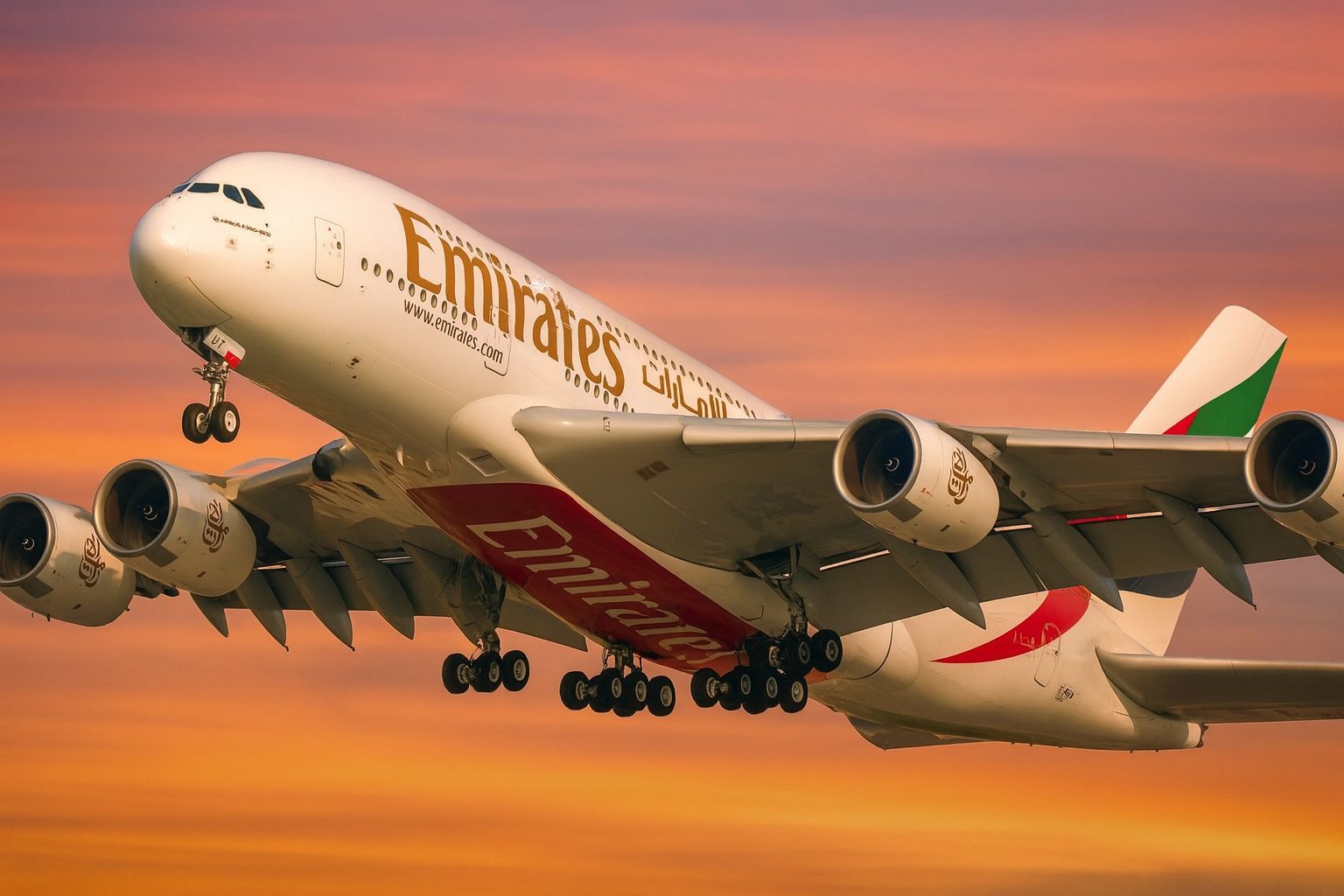
- Each Airbus A380 will receive three antennas, described as an industry first for connectivity capacity on a passenger aircraft.
The triple‑antenna architecture on the A380 is designed to maximise bandwidth and redundancy across all cabin classes, helping ensure that even when large numbers of travellers are streaming or gaming, performance remains usable.
Emirates also plans to layer Live TV over Starlink:
- Live TV streams will first be available on passengers’ personal devices.
- Integration into seatback screens is scheduled from late December 2025.
This means that, in addition to on‑demand content, passengers could soon watch live sports, news and events via a connection powered entirely by Starlink’s satellite network.
Rollout Timeline: From First Flight to Full Fleet
The Emirates–Starlink programme follows a compressed timeline by airline retrofit standards:
- Now – November 2025
- Starlink‑equipped Boeing 777‑300ER (registration A6‑EPF) showcased at Dubai Airshow 2025, with visitors able to test the connection on the ground.
- 23 November 2025
- First commercial Emirates flight operating with Starlink Wi‑Fi, using the same Boeing 777 returning to service after the Airshow.
- November 2025 onward
- Progressive rollout across the Boeing 777 fleet at a pace of roughly 14 aircraft per month.
- February 2026
- Start of installations on the Airbus A380 fleet, including what Emirates says will be the world’s first A380 fitted with Starlink for commercial service.
- Late 2025–2026
- Introduction of Live TV streams via Starlink, first to personal devices and then to seatback screens.
- By mid‑2027
- Target date for Starlink to be available across all 232 in‑service Emirates wide‑body aircraft.
Part of a Bigger Fleet and Product Upgrade
The connectivity upgrade is closely tied to Emirates’ wider cabin and fleet strategy.
Emirates has already embarked on one of the largest retrofit programmes in commercial aviation, covering nearly 220 aircraft. To date, around 76 aircraft have been fully refurbished with Premium Economy cabins, updated Business Class, refreshed First Class suites and new cabin finishes, according to the airline’s own figures and regional coverage.
Reporting from regional media also notes that Emirates is investing roughly $5 billion in overall fleet upgrades and has continued to post strong financial results, with half‑year profits of Dh9.9 billion ($2.7 billion) helping underpin these investments.
On the aircraft acquisition side, Emirates also used Dubai Airshow 2025 to announce an order for 65 additional Boeing 777‑9 aircraft worth about $38 billion, further reinforcing its long‑term reliance on the 777 and A380 as the backbone of its wide‑body operations.
How Emirates’ Move Fits into the Global In‑Flight Wi‑Fi Race
In‑flight Wi‑Fi has been evolving rapidly, but passengers often still complain about slow speeds, dropped connections and high prices. LEO constellations like Starlink are widely seen as a step‑change technology for aviation connectivity because they offer:
- Shorter signal distances than traditional geostationary satellites
- Lower latency suitable for real‑time apps such as video calls
- The ability to deliver higher per‑aircraft bandwidth
Qatar Airways became the first airline in the Middle East to introduce Starlink on selected aircraft in 2024, but Emirates’ decision to roll out the service across its entire 232‑strong wide‑body fleet takes the region’s adoption of LEO‑based Wi‑Fi to another scale.
More broadly, several carriers worldwide are trialling or deploying Starlink on specific routes and aircraft types, but Emirates’ plan to standardise it across all long‑haul flagships — and to offer it free of charge — raises competitive pressure on other premium airlines to improve their own connectivity propositions.
What This Means for Business and Leisure Travellers
For business travellers
- Reliable remote work: With ground‑like speeds and lower latency, tasks such as VPN access, large file transfers and video conferences should become more practical gate‑to‑gate on long‑haul flights.
- Stronger value for corporate travel programmes: Travel buyers weighing airline choices for global networks will now factor in always‑on, free high‑speed Wi‑Fi on Emirates as a tangible productivity benefit.
For leisure travellers
- Seamless entertainment: Streaming platforms, social media, cloud gaming and live sports could all remain usable throughout the flight.
- Family connectivity: Parents can keep children entertained with online content while staying connected with relatives on the ground.
Etiquette and experience
Some in the travel community have already raised questions about etiquette — particularly around video calls and loud speakerphone use in shared cabins — as airlines move toward higher‑bandwidth Wi‑Fi.
While Emirates has not yet detailed any specific onboard policies around video calls or voice apps for the Starlink service, airlines typically retain the option to limit or throttle certain services to protect the overall cabin experience. That balance between ultra‑fast connectivity and cabin calm is likely to be closely watched as the rollout unfolds.
FAQs: Emirates Starlink Wi‑Fi
When will Emirates Starlink Wi‑Fi start?
The first commercial Emirates flight with Starlink Wi‑Fi is scheduled for 23 November 2025, operated by a Boeing 777‑300ER that has already been showcased at Dubai Airshow 2025.
Which Emirates aircraft will get Starlink?
All 232 in‑service wide‑body aircraft — the Boeing 777 and Airbus A380 fleets — are included in the rollout plan.
Will the Wi‑Fi really be free for everyone?
Yes. Emirates and multiple independent reports confirm the Wi‑Fi will be complimentary for all customers in every cabin, with one‑click access and no payment or Skywards membership required.
How long until every Emirates 777 and A380 has Starlink?
The airline expects to retrofit around 14 aircraft per month and is targeting mid‑2027 to complete the installation across the entire in‑service wide‑body fleet.
What can passengers actually do with Starlink onboard?
With bandwidth of roughly 100–250 Mbps download and 8–25 Mbps upload, plus latency under 99 ms, passengers should be able to stream HD content, join video calls, play online games, browse and work in the cloud much as they would on the ground — subject to any usage policies Emirates may apply in practice.
Related articles: NYSE:BA