
NEW YORK, June 24, 2026, 07:14 (EDT)
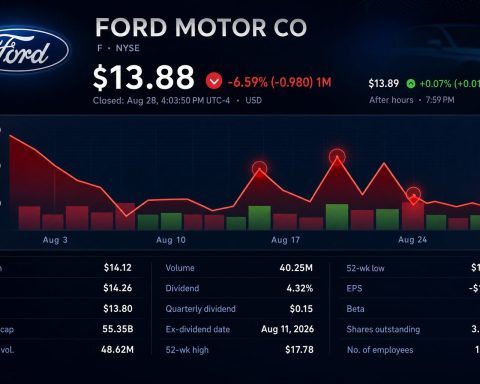
- Ford finished Tuesday at $14.00 a share, with a premarket quote at $14.03 before New York trading started. The stock still sits around 5% under the average analyst price target from Barron’s.
- Ford has had 50 vehicle recalls so far this year, covering 11,271,100 vehicles, according to a June 23 count. The company also recalled 2,633 engine block heaters in a separate action.
- Ford started labor talks with Unifor this week, pushing toward a July 10 contract deadline that will set a short-term cost signal for the carmaker.
Ford Motor shares NYSE:F slipped 0.78% to close at $14.00 Tuesday and ticked up to $14.03 in pre-market trade at 7:08 a.m. EDT, a small move before the opening bell. That’s while the S&P 500 dropped 1.4% and the Nasdaq lost 2.2% Tuesday.
Ford dropped a bit Tuesday, but the bigger thing to watch is the gap between the share price and where Wall Street thinks the stock should trade. The average analyst target is $14.72, according to Barron’s, which is just over 5% above where the stock finished Tuesday. Ford is up 6.71% in 2024 and 33.59% for the past year, though it’s still trading about 21% below its 52-week high of $17.78.
That means headlines on recalls, warranty spending or new labor contracts can hit the stock harder than they did in the May rally. Motor1, citing NHTSA figures, reported Tuesday Ford has logged 50 vehicle recalls this year, impacting 11,271,100 vehicles, and one equipment recall for 2,633 engine block heaters. That’s about one recall campaign every 3.4 days through June 23. U.S. regulators define a recall campaign as a formal safety or compliance fix.
Ford’s biggest recall this year hits 4,381,878 vehicles, including F-Series trucks. The flaw is in the software and might keep trailer brakes and indicator lights from working, Motor1 reported. Ford is handling the fix with an over-the-air update.
Guidance is at the center here. In April, Ford bumped up its full-year adjusted EBIT forecast to between $8.5 billion and $10.5 billion. That number strips out some items. The outlook counts on $1 billion in lower material and warranty costs. Ford put commodity headwinds at about $2 billion and pegged tariff effects at roughly $1 billion.
Ford execs are pitching investors on stronger execution. “We built the foundation for a more modern, resilient Ford,” CEO Jim Farley said in the April earnings report. “The path to higher margins is clear,” CFO Sherry House added in that release. Q4 Investor Relations
Ford surged 13% on May 13, its biggest one-day rise in six years, after Morgan Stanley flagged its energy-storage unit. Reuters said Ford is planning to use space at its Kentucky plant, which had been earmarked for EV batteries and LFP tech, an iron-based battery, to supply data centers and utilities.
Ford was more resilient than GM and Tesla in Tuesday’s session. GM slid 1.84% while Tesla sank 5.79%. Ford lost 0.78%. Even so, Ford remains close to the middle of the range on analyst calls, Barron’s says. The breakdown: 15 holds, six positive ratings, one underweight, and one sell.
Labor is the next cost problem. Unifor started talks with Ford on Monday, covering almost 19,000 Canadian employees at Ford, GM and Stellantis. The union gave a July 10 deadline for reaching a deal with Ford, then plans to use that pattern for the other Detroit Three, Reuters said.
But a lot of recalls don’t always mean big costs. Costs stay low if Ford can use software fixes or dealer checks instead of replacing pricey parts. Still, there’s a risk for shareholders: if recall and labor bills stack up quicker than Ford’s warranty savings, it could squeeze the $8.5 billion to $10.5 billion adjusted EBIT range.
Ford will release its Q2 results on July 29. Investors now look to see if Ford Energy, Ford Pro and Blue Oval truck margins can balance out recall numbers that are out in the open.
Related articles: NYSE:F