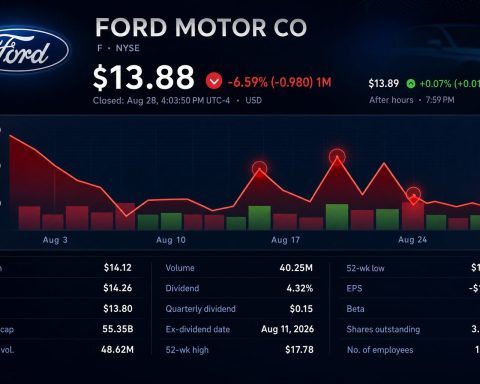

Dec. 16, 2025 — Ford Motor Company stock is trading around $13.65 on Tuesday, roughly $0.11 lower versus the prior close, as investors digest a fast-moving mix of corporate strategy news, earnings guidance changes, and fresh headline risk from a U.S. vehicle recall.
The big story powering today’s coverage is Ford’s decision to pull back from several large, capital-intensive EV plans, absorb a $19.5 billion set of EV-related charges over 2025–2027, and redeploy spending toward hybrids, extended-range electric vehicles (EREVs), trucks and vans, and a new battery energy storage business.
Below is what changed, what it means for Ford stock, and where Wall Street forecasts sit as of Dec. 16.
Why Ford stock is moving: the company’s EV strategy rewrite meets a raised 2025 profit outlook
Ford says it is “following the customer” by dialing back on select large EV programs where “the business case has eroded,” while expanding hybrid options and shifting its pure-EV focus to a lower-cost “Universal EV Platform” aimed at smaller, more affordable models. Q4 CDN
At the same time, Ford raised its 2025 adjusted EBIT guidance to about $7 billion and reaffirmed adjusted free cash flow guidance of $2 billion to $3 billion, trending toward the high end—an important counterweight for investors worried that an EV pullback automatically equals weaker profitability.
Reuters’ roundup of “five things to know” about the write-down framed the move as one of the clearest signs yet of a broader industry reassessment of earlier EV timelines—especially for big, battery-heavy vehicles where costs and demand have not matched the most optimistic projections. Reuters
The $19.5 billion charge: what it is, and why cash impact matters for Ford shares
Ford’s EV-related hit is not a single, immediate cash bill. The company’s own “Summary of Estimated Special Items” breaks the $19.5 billion total into $12.5 billion in 2025 and $7.0 billion across 2026–2027, with an estimated $5.5 billion total cash effect largely landing in 2026–2027. Q4 CDN+1
From Ford’s breakdown, the major components include: Q4 CDN
- $8.5B: Model e asset impairment / program asset write-down (2025)
- $6.0B total: battery JV disposition-related impacts split across 2025 and 2026–2027
- $5.0B total: additional program-related expenses split across 2025 and 2026–2027
- $5.5B total: estimated cash impact (mostly later, not in 2025)
Reuters separately reported that much of the charge reflects costs tied to canceling or reshaping fully electric models and battery plans that were years in the making.
Why investors care: For Ford stock, the market tends to react differently to (1) non-cash impairments and (2) cash restructuring costs that pressure future free cash flow. Ford’s disclosed timing—cash effects weighted toward 2026 and 2027—helps explain why the stock’s immediate move has looked more muted than the headline number might suggest.
The F-150 Lightning isn’t “gone”—but Ford is changing what it means
One of the most attention-grabbing outcomes of Ford’s strategy shift is the future of the F-150 Lightning nameplate.
Ford says the next-generation F-150 Lightning will be an EREV (Extended Range Electric Vehicle)—a setup in which the truck is driven 100% by electric motors, but supported by a generator-backed range extender to reduce the need for charging stops on longer or heavier-duty trips.
In its product note, Ford said the next-gen Lightning EREV is targeted at an estimated range of “more than 700 miles,” while keeping hallmark EV benefits like quick acceleration and the ability to provide exportable electricity for work sites or even homes during outages. shareholder.ford.com
Meanwhile, Ford indicates production of the current Lightning ends in 2025, with additional details on launch timing for the next model to come later.
Coverage from major outlets including AP and The Wall Street Journal emphasized how sharply Ford is reallocating capital away from large pure-EV programs and toward hybrids and other profit-focused segments, reflecting weaker-than-hoped EV economics in certain categories.
The underappreciated twist: Ford wants to sell batteries to the grid and data centers
Ford isn’t just reallocating EV spending into hybrids and trucks—it’s also trying to turn underused battery capacity into a new revenue line.
Ford says it plans to launch a battery energy storage systems (BESS) business, begin shipping systems in 2027, and scale to at least 20 GWh of annual capacity by late 2027, supported by roughly $2 billion of investment over the next two years.
TechCrunch reported that Ford intends to repurpose existing battery manufacturing capacity (rather than scrapping it) and position the storage systems for grid infrastructure and the growing electricity needs of large commercial users, including data centers.
Investing.com’s write-up highlighted the same strategic thread: move away from lower-return EV bets, lean into businesses that can be accretive to cash flow, and use Ford’s manufacturing scale to compete in adjacent markets like energy storage.
Why this matters for Ford stock: Investors typically value diversification only when it is (a) credible operationally and (b) financially disciplined. Ford is explicitly pitching storage as a way to monetize capacity that might otherwise sit idle—an argument that could resonate if the unit economics and customer traction become visible in 2026–2027 disclosures.
Today’s “other headline”: Ford recall news adds near-term risk noise
Alongside the strategy reset, Ford is also dealing with routine-but-market-relevant safety headlines.
Reuters reported Tuesday that Ford is recalling 32,160 vehicles in the U.S. over an issue that could lead to loss of drive power, raising crash risk. The report cites the U.S. National Highway Traffic Safety Administration (NHTSA) and describes a half shaft that may not be fully engaged with the primary drive unit, with a potential rollaway risk if the parking brake is not applied.
For Ford shares, recalls can matter less for the single-day headline and more for what follows: remedy costs, warranty trends, and whether quality issues cluster within key high-margin product lines.
Market reaction: why Ford shares look steadier than the EV write-down headline
Despite the size of the EV-related charge, some market commentary focused on how Ford shares have remained comparatively steady—with more pain showing up in parts of the battery supply chain.
MarketWatch reported that battery-related names (including certain South Korean suppliers) fell on the news, and cited analyst commentary viewing Ford’s pivot as negative for battery demand tied to large EVs—while also noting some analysts saw Ford’s decisiveness as a relative positive.
That dynamic fits a broader pattern: when a company frames a write-down as the “cost of changing course,” the stock response often depends on whether investors believe the new course improves future cash generation.
Ford stock forecast: where analyst targets and ratings stand on Dec. 16, 2025
Analyst expectations remain cautious overall.
MarketBeat’s compilation as of Tuesday shows: MarketBeat
- Consensus rating: Hold (based on 17 analyst ratings)
- Average 12-month price target:$12.04 (MarketBeat calculates this as an implied downside from recent prices)
- Target range:$7.00 (low) to $15.50 (high)
On the “what changed today” front, MarketScreener reported that Goldman Sachs raised its Ford price target to $14 from $13 while maintaining a Neutral rating, citing MT Newswires. MarketScreener
How to interpret this: The wide target range is basically Wall Street admitting uncertainty about the slope of Ford’s next two years—especially whether hybrids and Ford Pro strength can offset EV volatility and restructuring noise while maintaining healthy free cash flow.
What to watch next for Ford Motor Company stock
The next catalysts for Ford stock are likely to be less about today’s headlines and more about proof points:
Ford’s press release notes the company expects to report fourth-quarter and full-year 2025 results on Feb. 10. That event should clarify how much of the 2025 portion of the special items hits reported results immediately, and how investors should think about 2026–2027 cash impacts.
Beyond earnings, investors will likely track:
- Execution on the hybrid/EREV roadmap, including what the next-gen Lightning EREV looks like in pricing and timing once Ford releases more details.
- Progress toward Model e profitability by 2029, including whether Ford can show “annual improvements beginning in 2026,” as it states. Q4 CDN
- Early commercial traction for the battery storage business (customers, margins, and ramp timing) ahead of planned 2027 shipments.
- Quality and warranty trends, as recalls can become an earnings story when they cluster or grow.
Ford’s strategy update is, in effect, a bet that the near future belongs to practical electrification: hybrids, range-extenders, and profitable commercial vehicles—while keeping a lane open for affordable EVs rather than expensive “halo” trucks. Whether that bet lifts Ford stock from “steady” to “compelling” will depend on margins and cash flow, not press-release adjectives.
Related articles: NYSE:F