
New York, May 23, 2026, 09:01 EDT
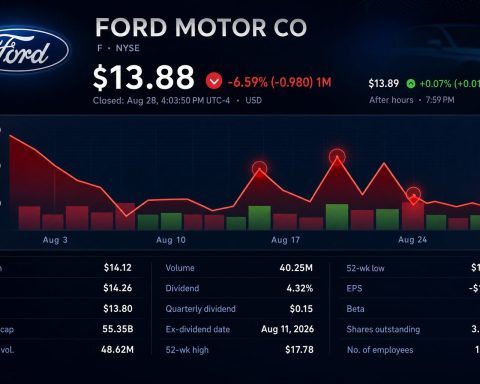
- Ford jumped 9.22% Friday, closing at $14.93. That move put its weekly gain at 11.4% ahead of the Memorial Day holiday.
- Ford Energy and its battery-storage business came back into the spotlight, with investors also looking at the five-year supply agreement with EDF. The move followed that renewed attention.
- Risks remain in play. Legal challenges, aluminum supply costs and delays tying into the grid could all weigh on the rally.
Ford Motor shares surged Friday, closing up 9.22% at $14.93. That move pushed the stock near its session high of $14.95 and brought the week’s gain to 11.4% from last Friday’s $13.40 finish, putting Ford back in growth-stock discussions for now.
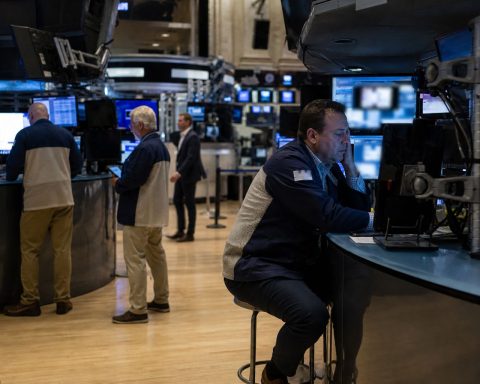
Timing is key here. U.S. equity markets shut on Saturday and Sunday, and the NYSE will stay closed Monday, May 25, for Memorial Day. That means Friday’s closing price is what investors will have to hold over a three-day stretch. NYSE core trading hours are 9:30 a.m. to 4:00 p.m. ET. Memorial Day is also marked as a 2026 NYSE holiday.
S&P 500 rose 0.4% Friday and clocked its eighth week of gains. The Dow finished up 0.6%, with Nasdaq ahead 0.2%, according to the Associated Press. Reuters said the Dow also touched an intraday record as buyers responded to better earnings and optimism around Middle East talks.
Ford’s news was tied to energy storage. On Monday, Ford Energy and EDF power solutions North America said they signed a five-year deal. The agreement gives EDF up to 4 gigawatt-hours per year of Ford DC Block battery energy storage systems, or BESS—these are grid-scale batteries that store and return power. The deal could mean as much as 20 GWh total, with deliveries slated to start in 2028.
Lisa Drake, Ford Energy president, said the deal with EDF pointed to demand for a supplier with “industrial-scale manufacturing discipline” and “lifecycle accountability.” Tristan Grimbert, chief executive of EDF power solutions North America, said the agreement gives EDF “supply visibility and product confidence.” EDF power solutions North America
That is why Ford shares at one point traded more like an AI infrastructure stock than a car company. Earlier this month, Reuters said Morgan Stanley analysts called Ford’s deal with China’s CATL an “underappreciated strategic competitive advantage,” and noted Ford would put $2 billion into its storage business after taking a $19.5 billion writedown on EV programs. Reuters
Automakers push battery storage as demand shifts. Reuters says Ford and General Motors are reworking their battery lines as EV sales slow, while Tesla has spent years building up its energy-storage arm, now one of its fastest-growing segments. Ford is after more than car buyers, aiming to reach utilities, grid operators and data centers too.
Battery storage is getting real demand, but the sector isn’t clean. U.S. battery storage players are getting attention from AI data centers, Reuters said, but they’re still facing grid delays and rely on China-linked supply chains. Annual battery storage deployments in the U.S. could reach 110 GWh by 2030, the Solar Energy Industries Association told Reuters.
Ford entered the storage trade with momentum on earnings. The automaker in late April lifted its 2026 adjusted EBIT target to a range of $8.5 billion to $10.5 billion, up from $8 billion to $10 billion. EBIT stands for earnings before interest and taxes, which gives investors a read on operating profit. For the first quarter, Ford posted revenue of $43.3 billion and adjusted earnings per share of 66 cents.
But there are problems. On Friday, a U.S. appeals court brought back $82.2 million of a verdict for Versata Software against Ford in a case over trade secrets and a licensing contract, Reuters said. Ford is also still dealing with aluminum supply costs from Novelis plant fires. JPMorgan’s Ryan Brinkman said last month Ford “may be having a more difficult time” rebounding from that issue than earlier thought. Reuters
Markets reopen Tuesday after the holiday, with a light start before a packed macro schedule. The next big event comes May 28, when the Bureau of Economic Analysis will post the latest personal consumption expenditures price index—PCE is the Fed’s preferred inflation gauge, tracking what consumers pay for goods and services.
Ford faces a clear test after the long weekend. The company has to keep its new valuation story alive and convert battery-storage orders into actual revenue and margins. Friday’s move drew attention, but now Ford has to deliver proof in the next phase.
Related articles: NYSE:F