NEW YORK, July 30, 2026, 15:03 EDT — U.S. markets have begun trading.
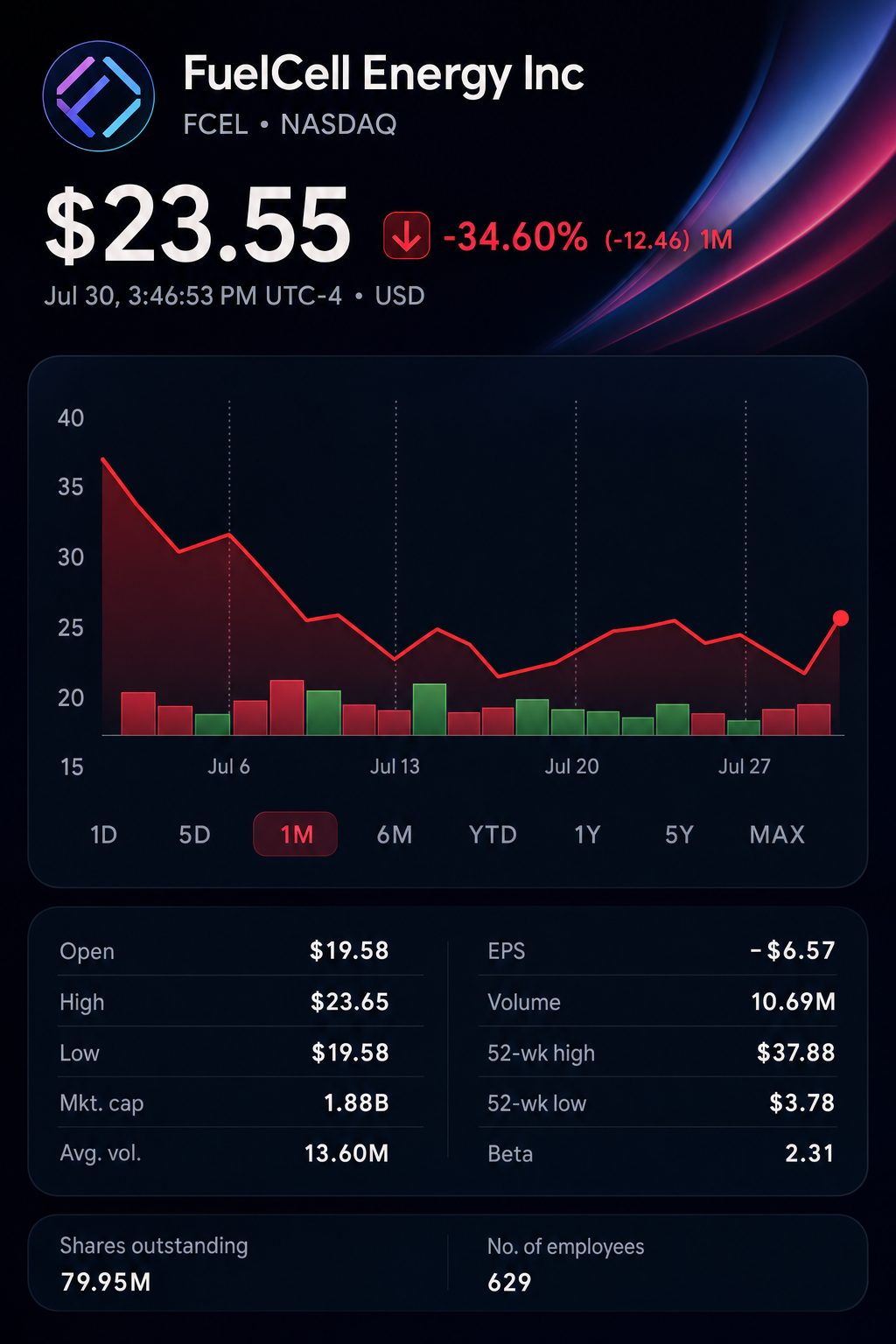
Early intraday figures indicated FuelCell at $23.26, rising 28.7%. Bloom advanced 25.4%.
Bloom reported quarterly revenue up 165.5%, reaching a record $1.065 billion.
FuelCell was still trading 38.6% lower than its intraday peak on June 30.
Shares of FuelCell Energy, Inc. NASDAQ:FCEL jumped 28.7% in Thursday afternoon trading. The stock climbed to $23.36 before pulling back. Trading volume was close to 10 million shares as of 3 p.m.
The timing indicates this is a sector-driven move, not prompted by new developments from FuelCell itself. No updates had been posted on the company’s investor page since July 9. The latest signal came from Bloom’s record quarterly outcome.
Investors used FuelCell as a higher-beta stand-in for Bloom in response to data-center growth. The price moved in a comparable way, though the companies’ financials differed.
Prices reflected preliminary indications at about 3 p.m. EDT.
The sector’s breadth backs the trade. However, FuelCell surpassed the wider technology recovery by 25.5 percentage points. Its advance was also three times greater than the gains seen by Plug and Ballard.
Bloom posted second-quarter revenue of $1.065 billion, surpassing analysts’ consensus forecast by approximately 29%. Adjusted earnings came in about 90% above projections. Chief Executive KR Sridhar stated: “Bloom is now a standard for AI onsite power.” Bloom Energy
Latest reported quarter
FuelCell Energy
Bloom Energy
Period ended
April 30, 2026
June 30, 2026
Revenue
$35.6 million
$1.065 billion
Year-on-year revenue growth
-5.0%
+165.5%
GAAP gross margin
-36.3%
+33.4%
GAAP operating margin
-218.9%
+17.1%
Net income or loss
-$77.6 million
+$196.3 million
FuelCell margins are based on published revenue and loss figures. Reporting periods are not the same.
The difference is pronounced. Bloom generated operating income and achieved positive operating cash flow, while FuelCell continued to post losses prior to operating expenses.
FuelCell’s argument centers on prospective conversions. The company’s sales pipeline expanded to four gigawatts, a sequential increase of 267%. Still, management notes these are negotiations rather than finalized deals. The contracted backlog declined by 9.9% to $1.14 billion.
Chief Executive Jason Few called the approach “extending the grid to the data center.” FuelCell is targeting a manufacturing capacity reaching 500 megawatts per year. The planned expansion may require between $200 million and $275 million. SEC
The company has restructured its capital. In July, FuelCell issued 12.32 million shares at $21 each. With the underwriter option fully taken up, estimated net proceeds reached $245.4 million.
Preliminary capital comparison
Before July offering
Current pro forma
Shares outstanding
67.61 million
79.93 million
Reference share price
$29.73
$23.26
Estimated equity value
$2.01 billion
$1.86 billion
Change in equity value
—
-7.5%
The initial column is based on shares as of June 30 and the closing price from July 6. The second column accounts for all offering shares and relies on Thursday’s intraday price. These estimates do not reflect subsequent adjustments for equity compensation.
That reflects the investor perspective. Thursday’s rally lifted FuelCell shares 10.8% above the offering price. However, its estimated market value was still under the pre-offering benchmark. Dilution has reduced the impact of the upswing.
The headline move came after sharp declines. FuelCell fell 15.9% over Tuesday and Wednesday. The rally on Thursday brought it to 8.2% above Monday’s close, but the stock was still 38.6% under its June 30 peak.
Risks continue to be elevated. FuelCell reports negative gross margins and relies on a non-binding sales pipeline. As many as 12 million performance-based warrants have an exercise price of $26.44. If fully exercised, these would provide an influx of cash but increase the share count following the offering by roughly 15%.
The next hurdle is conversion. Investors are looking for confirmed data-center contracts and better unit economics. Until those materialize, FuelCell continues to be the smaller and more volatile reflection of Bloom’s proven demand.
What is driving today’s surge in FCEL, and at what price is the stock currently trading?
By 2:46 p.m. ET, FCEL was trading at $23.25, marking a 28.6% gain. Shares fluctuated between $18.03 and $23.36 on close to 10 million shares exchanged. The Nasdaq advanced roughly 2%, with FCEL significantly outperforming the index. Reuters Despite the surge, the stock remained 38.6% below its June 30 peak of $37.88. marketwatch.com The latest update on FuelCell’s press release page was from July 9. FuelCell Energy Investors The stock’s movement aligned with gains in other AI-power and fuel-cell companies. The specific trigger for today’s rally was unclear.
What were the actual results in FuelCell Energy’s most recent quarter?
Revenue for the fiscal second quarter declined by 5% to $35.6 million. Gross loss increased to $12.9 million from $9.4 million. Net loss rose to $77.6 million, including a $42.6 million impairment charge. FuelCell Energy Investors Adjusted EBITDA loss narrowed to $17.1 million from $19.3 million. Loss per share improved to $1.45 despite the higher net loss. Weighted average shares outstanding increased to 54.2 million from 21.7 million. The company remains in the red.
What proportion of the 4 GW pipeline is genuinely under contract?
The company’s disclosed sales pipeline grew to 4 GW, marking a 267% increase from the previous quarter. Management clarifies that the pipeline refers only to negotiations, not finalized customer deals. This is a crucial distinction. Only signed contracts are included in the firm's reported backlog. FuelCell Energy Investors Investors look for deposits, purchase commitments, and reliable delivery dates. Whether these pipeline talks translate to confirmed orders will be key to justifying the current market value.
What is the level of certainty regarding the 380 MW Fit Energy deal?
The Fit deal covers 380 MW split across four planned phases. Payment commitments are currently in place only for the first 30 MW. Fit holds the exclusive option to proceed with the remaining 350 MW. Deposits and payments based on milestones will be required for those future phases. Twelve million warrants have a $26.44 strike price and vest under set conditions. Thus, 380 MW refers to possible capacity, not revenue that has been fully secured.
Does FuelCell have enough funding for its planned 500 MW facility expansion?
As of April 30, FuelCell held $373.2 million in unrestricted cash. Net proceeds from post-quarter ATM and other offerings added approximately $298.3 million. FuelCell Energy Investors A mechanical pro forma calculation puts available funds near $671.5 million, excluding subsequent spending. This does not reflect a July cash figure. Torrington expansion is projected to require between $200 million and $275 million. FuelCell Energy Investors Operating cash burn totaled $61.2 million over six months. On paper, available funds cover the expansion but a significant portion comes from share issuance.
At the current valuation, how significant is dilution?
FuelCell reported 67.6 million common shares outstanding as of June 30. The July share offering added 12.3 million more shares, including the overallotment option, bringing the pro forma total close to 79.9 million shares. SEC At a price of $23.25, this figure suggests an equity value near $1.86 billion. SEC That is about 74% higher than the 46.1 million share count recorded in October. SEC Fit owns warrants subject to conditions for another 12 million shares. Exercising these in full would increase the pro forma count by roughly 15%.
What is actually delivered by the $1.14 billion backlog?
Backlog reached $1.14 billion, falling 9.9% from the previous year. Generation contracts made up $928.5 million, equating to about 82% of the total backlog. The service backlog amounted to $155.4 million. Commitments in both service and generation averaged about 15 years. FuelCell Energy Investors That points to extended-term visibility but not near-term quarterly sales. Project failures can result in lost revenue as well as potential penalties or impairments.
What do analysts’ latest projections indicate for FCEL’s share price?
The consensus 12-month price target from analysts stands at $22.83, just under the current share value. Published targets range from $8 up to $32, indicating potential downside risk of 66% or upside of 38%. According to MarketBeat, there are four buy ratings, three holds, and two sells. MarketBeat Other platforms list either six or eight analysts with varying ratings terminology. Public Divergent coverage contributes to uncertainty over the consensus outlook. In addition, targets may not reflect the latest 28.6% share surge.
What figures and developments might impact FCEL soon?
There are three main checkpoints ahead. Fit's first 30 MW of capacity is set to come online in 2026. Further stages rely on deposits before firm financing is secured. FuelCell Energy Investors FuelCell Energy must expand Torrington output while managing gross losses. FuelCell Energy Investors EXIM is financing $49 million for five Korean units totalling 2.8 MW each. FuelCell Energy Investors In July, Siemens reached only a memorandum of understanding, not a definitive sales deal. FuelCell Energy Investors Groton’s expansion is scheduled for completion by fiscal 2027.
Mateusz Kaczmarek is a financial and technology journalist at TS2.tech. His coverage ranges from stocks and artificial intelligence to semiconductors and developments across global markets. He graduated from the Poznań University of Economics and Business and worked in financial analysis before becoming a business journalist. Follow Mateusz Kaczmarek on Google News.
The 9:45 AM ET pair has the strongest broad-market potential today because growth surprises can quickly reprice Treasury yields, the dollar and rate expectations.
#2
BJ's Wholesale Club
Results can influence consumer and retail sentiment, particularly around value-seeking behavior, traffic and gross margins.
#3
Ubiquiti
Its results are relevant for communications equipment and networking demand, with earnings sensitivity to margins and product mix.