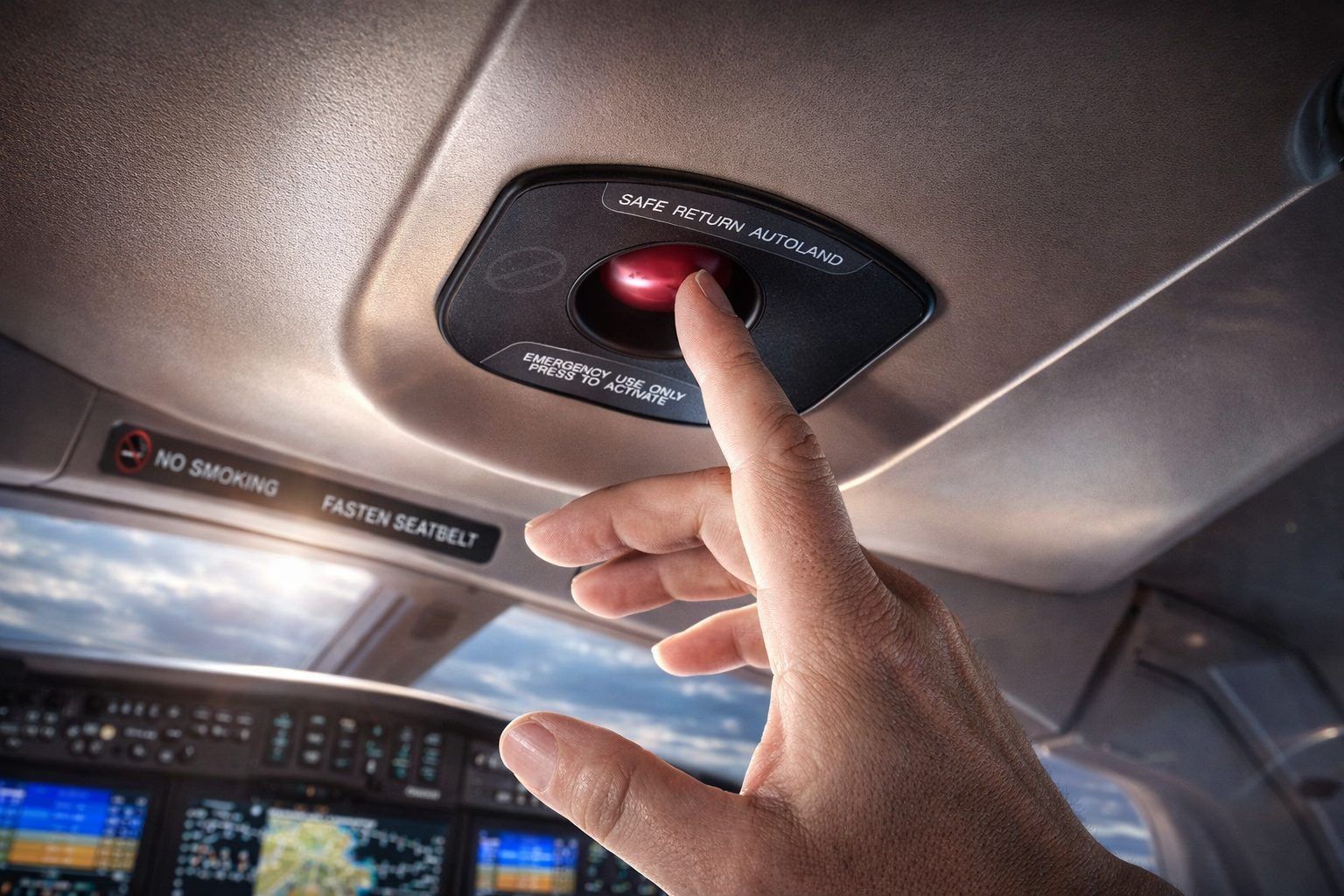

BROOMFIELD, Colo. (Dec. 25, 2025) — A twin‑engine Beechcraft Super King Air 200 touched down at Rocky Mountain Metropolitan Airport (KBJC) near Denver with a twist that’s rippling across aviation: the airplane effectively landed itself using Garmin’s Emergency Autoland technology, in what Garmin and multiple aviation outlets describe as the first confirmed real‑world start‑to‑finish activation of the system during an actual emergency.
While early air‑traffic audio and automated radio calls referenced “pilot incapacitation,” the aircraft’s operator later clarified that both pilots remained conscious and deliberately chose to let the automation complete the landing after an abrupt pressurization problem—an episode that, even with a safe ending, is now prompting new questions about training, procedures, and the expanding role of cockpit automation. ABC News
What happened: a “rapid, uncommanded” pressurization loss — and then the airplane took over
The FAA says the Beechcraft Super King Air landed safely at Rocky Mountain Metropolitan Airport around 2:20 p.m. local time on Saturday, Dec. 20, after the pilot lost communication with air traffic control and an onboard emergency autoland system was activated. Two people were on board, and the FAA says it is investigating.
According to statements reported by local and national outlets, the aircraft experienced a rapid, uncommanded loss of pressurization while climbing through about 23,000 feet. The operator, Buffalo River Aviation, said the two pilots immediately donned oxygen masks as standard procedure and that the aircraft’s Garmin emergency systems engaged as designed once cabin altitude exceeded prescribed safe limits.
From there, Emergency Autoland selected Rocky Mountain Metropolitan Airport (KBJC), navigated to the field, and communicated automatically with air traffic control—setting the stage for a moment that pilots, controllers, and aviation watchers will be discussing for a long time.
Why air traffic control heard “pilot incapacitation” — even though the crew says they weren’t incapacitated
The most viral detail of the incident came from air‑traffic recordings: an automated voice repeatedly declaring an emergency and referencing “pilot incapacitation.”
ABC News reported that an automated message alerted controllers that the pilot was no longer in control and that the aircraft would land at the nearest suitable airport; the recording included the aircraft number and “pilot incapacitation,” while also updating controllers on distance-to-runway. But Buffalo River Aviation later stated there was no pilot incapacitation, and that the wording resulted solely from the Garmin emergency system’s automated communication and reporting functions. ABC News
Local reporting captured the robotic cadence of the call. CBS Colorado cited LiveATC audio in which a robotic voice could be heard saying: “Pilot incapacitation, two miles south… emergency Autoland in 19 minutes on runway 3-0.” CBS News
In other words: the “pilot incapacitation” phrase appears to be part of the system’s standardized emergency message set—intended to clear airspace and prioritize the aircraft—rather than a definitive diagnosis of what happened inside the cockpit. ABC News
The key update as of Dec. 25: the crew chose to let Autoland finish the job
As coverage evolved through Dec. 25, a crucial clarification emerged across aviation press: this wasn’t a Hollywood scenario of an empty cockpit. It was, instead, a high‑stakes decision under abnormal conditions.
AVweb reported that the Autoland landing was the result of a conscious decision by the flight crew, not pilot incapacitation. The operator told CBS Colorado that after the pressurization failure, the pilots deliberately allowed the automated system to retain control, describing the choice as “conservative judgment.” AVweb also reported there were no passengers and that the aircraft returned to service the following day. AVweb
ABC similarly reported that the pilots decided to leave the system engaged due to the “complexity” of the situation, while remaining prepared to resume manual control if the system malfunctioned. ABC News
This distinction matters: Emergency Autoland is designed for the worst case—when the pilot cannot safely fly—yet this episode shows it may also be used as a risk‑reduction tool when the situation is deteriorating and the cockpit workload is spiking.
Emergency response: “no patients” treated, no injuries reported
On the ground, airport and fire officials treated the arrival as a serious emergency—because from their perspective, it was.
Denver7 reported that North Metro Fire Rescue and Westminster Fire Department responded to the emergency landing and that no one on the plane was treated on scene or transported to a hospital.
PEOPLE, citing a statement from North Metro Fire Rescue District, echoed that response posture: units stood by as the aircraft landed safely, and officials said it was unclear at the time why the plane’s emergency system was activated—but again, no patients were treated or transported.
How Garmin Emergency Autoland works — and what it can’t do
Emergency Autoland is not simply an “autopilot that can land.” It’s an integrated automation suite built to take full control, choose a suitable airport, communicate with ATC, and execute a landing—all while minimizing the need for pilot input in a crisis. Denver 7 Colorado News (KMGH)
Based on reporting that cites Garmin’s descriptions of the system, Autoland typically evaluates factors including:
- Runway length and suitability
- Terrain
- Weather
- Approach options
- Fuel range and distance Denver 7 Colorado News (KMGH)
But it also has limits. ABC News reported, citing Garmin’s guidance, that the system is designed for emergencies when the pilot is not capable of landing the aircraft and may not function as intended in scenarios involving certain mechanical issues, fuel exhaustion, or restricted flight‑control movement.
One of the scale indicators that stands out in Dec. 25 coverage: Garmin says more than 1,700 in‑service aircraft are equipped with the system—meaning the technology is no longer experimental, even if a real-world “full sequence” event has been rare until now. ABC News
A milestone years in the making — and why this landing is different from airline “autoland”
Airliner autoland has existed for decades under specific conditions (notably with highly structured instrument landing systems and trained crews monitoring the automation). What made this Colorado event different—and newsworthy worldwide—is that Emergency Autoland is designed to initiate from an abnormal situation, then navigate to an appropriate airport, and land without the pilot actively flying the approach.
Denver7 underscored that while autoland systems have been around, this is a first-of-its-kind system designed to automatically take over in the event of pilot incapacitation—and this was the first time Garmin’s version had been used in a real emergency.
CBS Colorado reported Garmin’s general aviation Autoland dates back to 2019, and that this was the first activation.
The investigation: what the FAA and NTSB have said so far
As of Dec. 25, official findings remain limited—and that’s typical at this stage.
- The FAA has publicly stated it is investigating the Dec. 20 Broomfield, Colorado incident involving the Super King Air and activated autoland system.
- ABC News reported that the National Transportation Safety Board said it is aware of the incident and is gathering information to determine whether it meets criteria for an investigation.
That means the public may be waiting for answers to questions like: What exactly triggered the communications loss? Was Autoland activated manually, automatically, or as part of a cascade triggered by cabin altitude thresholds? And how should pilots and operators think about using a “last resort” tool when conditions are urgent but not incapacitating? AVweb
Why this moment matters beyond one flight: safety, training, and “when to push the button”
To many pilots, the headline is simple: the aircraft landed safely, nobody was hurt, and a technology built for nightmare scenarios worked exactly as advertised.
But aviation is a discipline that learns from near-misses and abnormal events, not just crashes—and this story is already shifting into a second phase: human factors.
AOPA noted that while the landing is being described as the first use of the system outside testing and certification, a charter operator later said the crew responded to a loss of cabin pressure by allowing the system to take over—and it wasn’t clear why the crew didn’t make radio calls during the descent and landing.
That nuance matters because emergency automation introduces a new kind of cockpit decision:
- Do you keep flying while managing a cascading abnormal condition (pressurization, oxygen masks, communication issues)?
- Or do you reduce variables by letting a certified system run a stable, pre-programmed emergency profile—while you monitor and remain ready to intervene? ABC News
Even on the ground, the system’s automated “pilot incapacitation” phrasing can create operational consequences—airspace sterilization, runway closures, dispatch of emergency resources—so the industry may need clearer playbooks for when this tool is appropriate and how to coordinate around it. CBS Colorado reported that flights were kept out of the airspace for about an hour during the event. CBS News
What’s next: more details from Garmin, and lessons from regulators
Garmin has indicated it will share additional information at an appropriate time, while emphasizing this was the first activation and landing of its Autoland system.
In the near term, expect attention to focus on three tracks:
- The technical trigger chain (pressurization, cabin altitude thresholds, communications loss, and Autoland engagement) People
- Operational guidance (when crews should consider using Emergency Autoland, especially in two‑pilot operations) AVweb
- ATC and emergency services coordination (how automated messaging should be interpreted—and whether standardized phrases like “pilot incapacitation” should evolve) ABC News
For now, the confirmed bottom line as of Dec. 25 is stark in its simplicity: a King Air flew into trouble, a certified autonomous emergency system took control, and the airplane came to rest safely on a Colorado runway—opening a new chapter in aviation automation that is no longer theoretical.





![Australia Stock Market Today 28/08/2026 [UPDATE: 12:40 AEST] [WAM Dividend Cut Deepens Selloff as ASX Rebound Fades]](https://ts2.tech/wp-content/uploads/2026/08/AU-market-dashboard-2026-08-28-1237-480x384.jpg "Australia Stock Market Today 28/08/2026 [UPDATE: 12:40 AEST] [WAM Dividend Cut Deepens Selloff as ASX Rebound Fades]")