On Saturday, December 6, 2025, space weather and night-sky fans are watching an unusual mix of cosmic events:
- a giant sunspot complex on the sun that rivals the one linked to the 1859 Carrington Event,
- the after-effects of this week’s G2–G3 geomagnetic storm, which brought enhanced aurora chances, and
- the lingering glow of December’s Cold Moon, the last supermoon of 2025. Live Science+2NOAA Space Weather Predictio…
Here’s what you need to know now, what’s already happened, and what to watch for over the next couple of nights.
A giant Carrington-scale sunspot is pointed straight at Earth
A massive, magnetically tangled sunspot complex labeled AR 4294–4296 has rotated onto the Earth‑facing side of the sun and is currently aimed almost squarely at our planet. Live Science
According to reporting from Live Science, the complex:
- is made up of at least two main active regions, AR 4294 and AR 4296, whose magnetic fields are intertwined;
- spans an area roughly 90% as large as the enormous sunspot drawn by British astronomer Richard Carrington before the historic 1859 solar superstorm; and
- is described as “one of the biggest sunspot groups of the past 10 years.” Live Science
The region was first spotted about a week earlier from an unusual vantage point: NASA’s Perseverance rover on Mars, which had a clear view of the sun’s far side while the complex was still rotating toward Earth. Live Science
How active is AR 4294–4296?
So far, the sunspot cluster has:
- produced at least one potential X‑class flare while it was still on the sun’s far side; Live Science
- developed a “beta‑gamma‑delta” magnetic configuration, the most complex and flare‑prone class used by forecasters; SpaceWeather
- been given around a 20% chance of producing X‑class flares in the short term by some space weather forecasters, reflecting a genuinely elevated but not extreme risk. threads.com
In other words, the region has the ingredients for powerful solar flares and Earth‑directed coronal mass ejections (CMEs), and it is now perfectly placed so that any major eruptions over the coming days would likely be geo‑effective.
Is another Carrington Event on the way?
Short answer: no sign of that right now.
Scientists quoted by Live Science stress that size alone doesn’t guarantee a superstorm. The structure and timing of eruptions matter at least as much as the raw area of the sunspot. So far, despite its size and tangled magnetism, AR 4294–4296 has not shown evidence of an imminent Carrington‑level event, and experts say there is no clear indication of a comparable superstorm in the immediate future. Live Science
That said, a region this large can still produce serious space weather:
- Strong X‑class flares can cause temporary radio blackouts on the sunlit side of Earth.
- Fast CMEs aimed at Earth can trigger geomagnetic storms that disturb satellites, navigation systems, and power grids, while also boosting aurora borealis far from the poles. Live Science+1
Agencies like NOAA’s Space Weather Prediction Center (SWPC) and independent forecasters are watching AR 4294–4296 closely as it crosses the face of the sun over the next week.
From G2 watch to G3 warning: this week’s geomagnetic storm
The big sunspot complex isn’t the only driver of space weather this week. A separate solar eruption has already delivered geomagnetic storm conditions to Earth.
What triggered the G2 geomagnetic storm watch?
On December 1, instruments detected an X1.9 solar flare from active region AR 4299, accompanied by a coronal mass ejection. Although most of the ejected plasma was directed east of the Sun–Earth line, NOAA modeling suggested that Earth could receive a glancing blow. NOAA Space Weather Prediction Center+1
Because of that CME — and its possible interaction with a high‑speed solar wind stream from a coronal hole — NOAA SWPC issued a G2 (Moderate) geomagnetic storm watch for December 3–4 (UTC). NOAA Space Weather Prediction Center+1
The storm over‑performed: G3 conditions observed
As the solar wind and CME arrived, the disturbance in Earth’s magnetic field briefly exceeded the original forecast:
- Local and regional outlets report that NOAA upgraded the watch to a G3 (Strong) geomagnetic storm warning on December 3, after measurements showed storm conditions reaching G3 levels that afternoon (about 3:31 p.m. EST). Midland Daily News+1
- Media summaries based on NOAA data suggested that auroras could be seen farther south than usual, potentially down toward the Michigan–Indiana border and similar mid‑latitude regions if skies were clear. Midland Daily News+1
Popular outlets like People highlighted the possibility of “back‑to‑back northern lights” visible across a wide swath of the northern United States — from Alaska and Washington through the Dakotas, Minnesota, Wisconsin, Michigan, New York and Maine, with a chance of reaching states like Illinois, Ohio and Pennsylvania if G3 conditions held. People.com+1
What does G2 or G3 actually mean?
NOAA uses a 5‑step G‑scale (G1 to G5) to describe geomagnetic storms:
- G2 (Moderate, Kp = 6)
- High‑latitude power systems can experience voltage alarms, and long storms can contribute to transformer wear.
- Satellite operators may need to correct spacecraft orientation and account for increased drag on low‑Earth‑orbit satellites.
- HF radio can fade at higher latitudes, and auroras have been seen as low as New York and Idaho (around 55° geomagnetic latitude). NOAA Space Weather Prediction Center+1
- G3 (Strong, Kp = 7)
- Voltage control problems can appear further equatorward.
- Spacecraft may experience more significant surface charging and drag.
- Aurora can shift well into the mid‑latitudes, sometimes reaching the northern United States and comparable latitudes globally. NOAA Space Weather Prediction Center+1
By contrast, a Carrington‑class storm would rank at or beyond G5 (Extreme), enough to cause widespread grid and satellite disruptions if it hit modern infrastructure. The storms this week, while impressive, have stayed far below that threshold.
The short‑term aurora outlook
After the peak of the G2–G3 disturbance on December 3–4, forecasts show the geomagnetic field gradually calming:
- NOAA’s aurora and Kp guidance points to the greatest expected 3‑hour Kp around 5 (G1, Minor) between December 5–7, indicating continued but more modest aurora chances at higher latitudes. NOAA Space Weather Prediction Center+1
- Spaceweather.com notes that a separate CME from an M6 flare on December 4 (from sunspot 4300) could deliver a glancing blow on December 7, potentially sparking another G1‑level storm and renewed auroras for northern observers. SpaceWeather
In practical terms, strong mid‑latitude auroras are less likely tonight than earlier in the week, but high‑latitude regions (Alaska, northern Canada, parts of Scandinavia, Iceland) should continue to keep an eye on the sky and on short‑notice alerts.
‘Cold Supermoon’ 2025: the last and highest supermoon of the year
While the sun has been busy, Earth’s moon has been putting on a show of its own.
When was the 2025 Cold Moon supermoon?
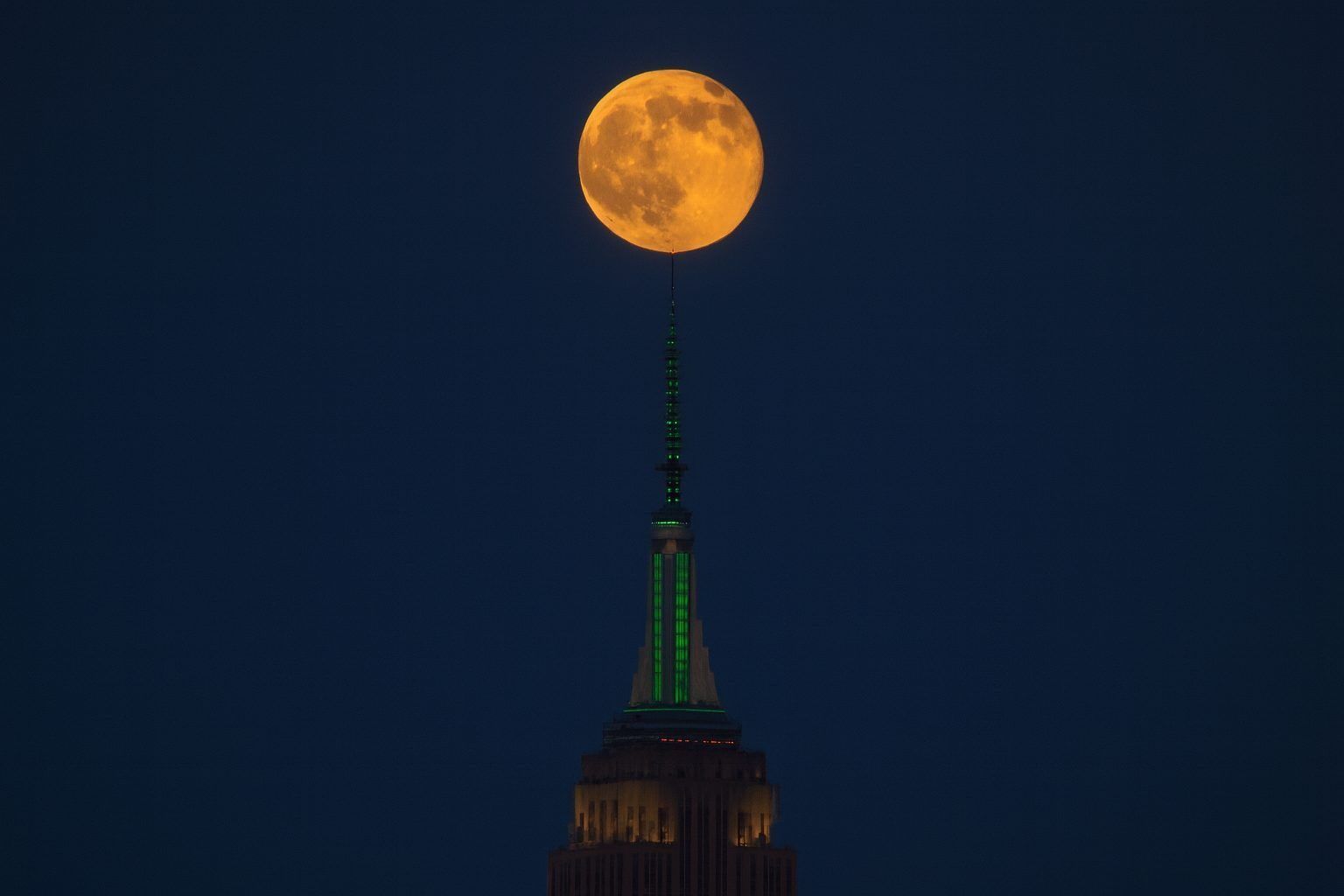
This week’s full moon — known as the Cold Moon — is the 12th and final full moon of 2025 and also a supermoon.
Key facts from Live Science and other skywatching sources: Live Science+2Live Science+2
- The Cold Moon reached official fullness at 6:14 p.m. EST on Thursday, December 4, 2025.
- Although “full” is a precise moment, the moon appears bright and essentially full on December 3, 4 and 5, and is still very nearly full on December 6. Live Science
- It’s the third in a series of four consecutive supermoons (October, November, December 2025 and January 2026), and the second‑largest full moon of the year, just behind November’s Beaver Moon. Live Science+1
A supermoon occurs when the full moon coincides with the moon’s closest approach to Earth (perigee), making it appear about 10% larger and noticeably brighter than an average full moon. Live Science+1
Why does the Cold Moon ride so high in the sky?
Observers in the Northern Hemisphere often notice that December’s full moon climbs higher than any other full moon of the year. That’s not your imagination — it’s geometry.
As the winter solstice (Dec. 21) approaches, the sun appears low in the sky at noon. The full moon, sitting almost opposite the sun in the sky, does the reverse: it takes a high arc across the night sky, making this Cold Moon both bright and lofty. Live Science
Where does the name “Cold Moon” come from?
Traditional names compiled by sources like The Old Farmer’s Almanac and summarized by Live Science trace “Cold Moon” to Mohawk speakers, with other Indigenous and historical names including: Live Science+1
- Frost Exploding Trees Moon (Cree)
- Moon of the Popping Trees (Oglala)
- Moon When the Deer Shed Their Antlers (Dakota)
- Winter Maker Moon (Western Abenaki)
- Long Night Moon (Mohican and Old English tradition)
All of them reflect what December feels like in the Northern Hemisphere: long, cold nights and deep winter setting in.
Supermoon vs. aurora: friend or foe?
The same dazzling brightness that makes the Cold Supermoon such a spectacular sight also washes out fainter phenomena:
- A recent CT Insider weather piece notes that the intense light from the Cold Moon supermoon is already making the Geminid meteor shower harder to see under otherwise good conditions. CT Insider
- The same logic applies to subtle auroral glows: under a full or near‑full moon, you generally need a stronger geomagnetic storm than usual to see vivid colors with the naked eye at mid‑latitudes.
So, if you’re going out tonight, treat the supermoon and any possible northern lights as a combined spectacle — but don’t be surprised if the moon’s glow steals the show.
How it all fits into an unusually active solar cycle
The current surge of sunspots, flares and geomagnetic disturbances isn’t a one‑off. It’s part of a broader pattern:
- The sun is in the most active phase of its ~11‑year solar cycle, known as solar maximum. Live Science
- Live Science notes that 2024 produced more X‑class flares than any year since modern records began in 1996, including back‑to‑back eruptions that drove a G4 (Severe) geomagnetic storm in November 2024 and an even more intense disturbance in May 2024 that produced some of the most widespread auroras in decades. Live Science
Against that backdrop, large sunspot groups like AR 4294–4296 and frequent geomagnetic alerts are expected, not exceptional. What is unusual about this week is how many phenomena — a Carrington‑scale sunspot, a G2–G3 storm, and a supermoon — have lined up at once.
What to do tonight and over the next few days
Whether you’re a casual skywatcher, an astrophotographer or just curious, here’s how to make the most of this moment — and stay realistic about the risks.
1. For aurora hunters
- Check updated forecasts, not just headlines. Use NOAA’s Aurora Dashboard and Space Weather Enthusiasts Dashboard for real‑time Kp values and short‑term predictions. NOAA Space Weather Prediction Center+1
- Know your latitude. With Kp values expected to hover near G1–G2 at most, bright aurora is most likely at high latitudes (Alaska, northern Canada, northern Scandinavia, Iceland). Mid‑latitudes may need a bit of luck and darker skies. NOAA Space Weather Prediction Center+1
- Get away from light pollution. Urban skyglow plus a brilliant moon will drown out all but the strongest displays. Head to dark, north‑facing horizons if you can.
- Use a camera to extend your vision. Even when the aurora looks faint or gray to the eye, a smartphone in night mode or a camera with longer exposures (and ISO around 1600–3200) can reveal greens and purples, as numerous aurora guides have pointed out this week. People.com+1
2. For supermoon watchers
- Catch moonrise. The moon always looks largest and most dramatic when it’s low on the horizon, thanks to the moon illusion and foreground objects for scale. Look up your local moonrise time and aim to be in position 10–15 minutes early. Live Science
- Look toward Taurus. The Cold Moon is rising in or near the constellation Taurus, not far from the bright star Aldebaran and the Pleiades star cluster, making for great binocular views. Live Science+1
- Bundle up and stay out a bit. Even though the moon peaked on December 4, it will remain strikingly bright for several nights, including December 6, as a high, nearly full disc.
3. For anyone worried about impacts
- Everyday risk remains low.
- The recent storm, while strong enough to shift aurora southward, stayed in the G2–G3 range, not the extreme G5 territory associated with severe, Carrington‑like impacts. NOAA Space Weather Prediction Center+1
- Power grid operators, satellite controllers and aviation services routinely monitor NOAA alerts and take protective steps when needed. NOAA Space Weather Prediction Center+1
The main takeaway: this is a time to watch and enjoy, not to panic. Agencies are tracking the situation; your job is mostly to decide whether you’d rather point your camera at the moon, the northern horizon — or both.
The bottom line
As of December 6, 2025:
- AR 4294–4296, a giant sunspot complex rivaling the Carrington sunspot in size, is facing Earth with a complex magnetic field and the potential for major flares — but no sign yet of a catastrophic superstorm. Live Science+1
- The G2 geomagnetic storm watch for December 3–4 evolved into a short‑lived G3 storm, boosting aurora visibility and underscoring how dynamic space weather can be once solar eruptions reach Earth. NOAA Space Weather Prediction Center+1
- The Cold Moon, the last and highest supermoon of 2025, has just peaked and is still dominating the night sky, making this a memorable week to look up — even if its glare makes auroras and meteors harder to see. Live Science+1
If you step outside tonight, you’re witnessing a snapshot of a restless sun, a glowing moon, and a magnetosphere that’s very much alive. For skywatchers and scientists alike, December 2025 is delivering exactly what solar maximum promised: a busy, beautiful, and occasionally noisy space weather season.