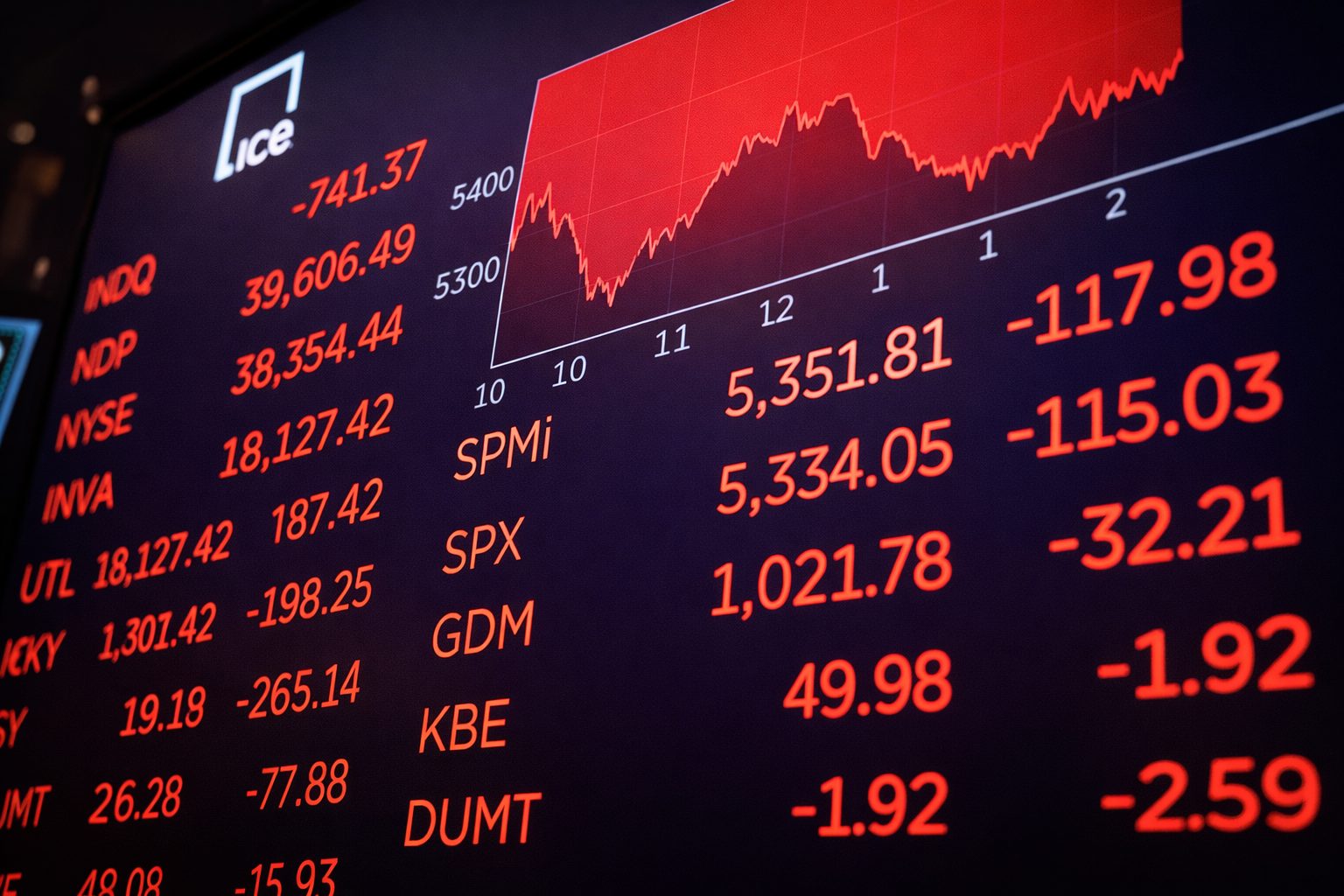
Global stock markets are spending Christmas Day in “low-liquidity mode,” with most major Western exchanges shut and investors leaning on the final full sessions of the year for direction. The tone is broadly constructive: U.S. equities headed into the holiday at fresh record closes, while parts of Asia traded mixed-to-firmer in thin volumes. Meanwhile, Gulf equities eased as softer oil prices pressured the region’s heavyweight energy-linked markets. Reuters
With calendars thinned out and year-end positioning largely done, the conversation has shifted quickly from “what happened” in 2025 to “what could break” or “what could extend” the rally in 2026—especially around artificial intelligence spending, the next phase of interest-rate policy, and the durability of global growth.
Christmas Day market reality: what’s open, what’s closed, and why volumes matter
December 25 is a full market holiday across much of Europe, and several venues also remain closed on December 26 (Boxing Day/St. Stephen’s Day) as well—meaning global liquidity is fragmented and price moves can be exaggerated by light flows. Euronext Live
That thinness is already showing up in the way investors are interpreting the final pre-holiday session in the U.S.: trading volume in the Christmas Eve session was far below typical levels, even as the benchmarks pushed to records. Reuters
Asia-Pacific stocks: Japan steady above 50,000, China supported by policy signals
In Asia, where some markets continued operating through the Christmas period, trading was mixed but resilient.
- Japan: Tokyo’s Nikkei 225 edged higher to 50,407.79, cementing a standout year with gains approaching 30%. AP News
- Mainland China: The Shanghai Composite advanced to 3,959.62, with sentiment helped by messaging from the People’s Bank of China around maintaining adequate liquidity to support financing and growth. AP News
- Hong Kong: The Hong Kong exchange was closed, reducing regional price discovery and contributing to the “patchwork” feel of global trading today. AP News
Currency and commodity backdrops also stayed active despite the holiday: the AP report noted the dollar eased slightly against the yen and the euro ticked higher, while oil prices remained subdued versus earlier in the year. AP News
A key Asia macro watch: Japan’s rate path after a historic move
Investors are paying close attention to Japan’s policy trajectory after the Bank of Japan’s latest hike took its policy rate to 0.75%, the highest in decades, and as BOJ Governor Kazuo Ueda is expected to offer clues about the 2026 rate path in a speech on December 25. Investing
Middle East stocks: Gulf markets ease as oil’s 2025 slide weighs
In the Middle East, most Gulf markets drifted lower on December 25, a move Reuters linked to weaker oil prices and thin trading as the Christmas holiday reduced foreign participation. Reuters
Saudi Arabia’s benchmark index was slightly down, with pressure from major financial and energy names; Dubai and Qatar also slipped. Reuters emphasized that oil—central to the region’s fiscal outlook—has been on track for its steepest annual decline since 2020, keeping investors cautious into year-end. Reuters
Wall Street: markets closed today, but records set the tone heading into the “Santa rally” window
U.S. stock markets are closed on December 25, but the lead-in matters: in the holiday-shortened session on December 24, the S&P 500 and Dow closed at record highs, extending a multi-day streak of gains. Reuters
Reuters highlighted three dynamics underpinning the late-year push:
- A rebound in AI-linked names after a bout of valuation and capex anxiety,
- Continued signs of U.S. economic resilience (including jobless-claims data cited in the report),
- Market expectations for roughly 50 basis points of Fed cuts in 2026, even if a January move is viewed as unlikely. Reuters
The seasonal frame is also back in focus: Reuters notes the “Santa Claus rally” window runs through early January, and investors are watching whether seasonality reinforces momentum—or whether thin liquidity amplifies any wobble. Reuters
Why December 26 is getting outsized attention this year
One of today’s most-shared tactical talking points: MarketWatch cited Bespoke Investment Group data showing December 26 has historically been one of the most consistently positive single trading days for the S&P 500, while also warning investors not to treat seasonality as a strategy on its own. MarketWatch
Europe: closed today, but ending 2025 near record highs
European cash equities are shut for Christmas Day, but the region enters the break with strong momentum. Reuters reported that European shares ended the holiday-shortened week near record highs and were on track for their strongest annual performance since 2021, helped by easing-rate dynamics, Germany’s fiscal push, and some investor diversification away from richly valued U.S. tech. Reuters
The 2025 backdrop: a volatile year that still delivered big gains
The late-December calm masks how dramatic the year’s path has been.
Reuters’ year-in-review framing described 2025 as a year of sharp cross-asset moves—highlighting that world stocks added about $14 trillion in market cap and recovered from tariff-driven volatility earlier in the year, while gold surged toward its best annual performance in decades, the U.S. dollar fell materially, and oil posted a steep decline. Reuters
Those cross-currents matter for equities because they shape earnings assumptions (via energy costs), discount rates (via yields), and global risk appetite (via FX stability and policy credibility).
2026 forecasts: higher, but harder — and a correction risk remains on the table
Strategists broadly expect equities can rise further in 2026, but with more modest returns and higher volatility than 2025’s run.
A Reuters poll of equity strategists projected that most major global indexes could finish higher by end‑2026, while warning that replicating 2025’s strength may be difficult. Importantly, more than half of surveyed analysts said a correction across many of the indexes looked likely or very likely in the coming months. Reuters
The same poll included benchmark-level targets that investors will likely anchor to in early-2026 positioning:
- S&P 500: median estimate pointing to 7,490 by end‑2026 (implying further upside but not necessarily a straight line). Reuters
- STOXX Europe 600: expected to rise to 623 by end‑2026 in the poll’s median. Reuters
- Japan’s Nikkei: expected to rise about 13% in 2026 in the poll’s median view, tied to earnings and stimulus-related growth assumptions. Reuters
The three swing factors likely to define global equity pricing in 2026
1) AI spending: earnings accelerator or valuation trap?
AI remains the central equity narrative. Reuters has pointed to AI spending, expectations of stronger and broader earnings growth, and the potential for Fed easing as key inputs into the 2026 stock-market story—while also flagging that momentum, policy, and geopolitics (including U.S.-China dynamics) can quickly flip sentiment. Reuters
2) The global rates regime: easing momentum, but not a one-way bet
Major central banks delivered their biggest easing push in over a decade in 2025, according to Reuters—yet the same reporting notes some analysts see the potential for a shift in tone into 2026, with certain central banks sounding less dovish than markets might prefer. Reuters
3) Oil, the dollar, and “macro spillovers” into equities
Oil’s weakness has been supportive for many importing economies but challenging for oil-linked equity markets (as seen in the Gulf today). Reuters
Meanwhile, the weaker dollar narrative has been a major 2025 feature—affecting global asset allocation, emerging-market conditions, and multinational earnings translation. Reuters
What investors are watching next: the year-end “thin tape” and early-2026 catalysts
With many desks lightly staffed into year-end, the next market-moving inputs are likely to come from:
- Post-holiday reopening sessions (especially December 26 in the U.S.) and whether liquidity returns smoothly. MarketWatch
- Japan inflation and BOJ signaling, following the recent hike and the closely watched late-December communications. Investing
- Narrative tests around AI capex vs. profitability, as investors decide whether the next leg higher is “earned” through earnings breadth or “borrowed” through multiple expansion. Reuters
- Policy uncertainty—including the economic effects of tariffs, growth, and inflation sensitivity, which Washington Post reporting described as key risks investors and economists are tracking into 2026. The Washington Post
Bottom line: 2025 ends with optimism — 2026 begins with higher expectations and less room for error
Global stock markets close out Christmas Day with a familiar late-year mix: upbeat index levels, thin liquidity, and a fast-shifting narrative. Asia’s mixed trade and the Gulf’s oil-linked softness are reminders that “global markets” aren’t moving in lockstep today—but the common thread is clear: investors are looking beyond holiday headlines to the first real test of 2026 positioning.
If 2025 was the year markets learned to live with tariff shocks, shifting rates, and AI-driven leadership, 2026 is shaping up to be the year those themes are stress-tested—under the harsher spotlight of stretched valuations, policy uncertainty, and higher expectations for earnings to do the heavy lifting. Reuters