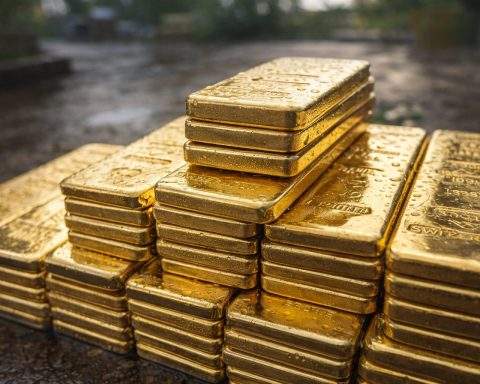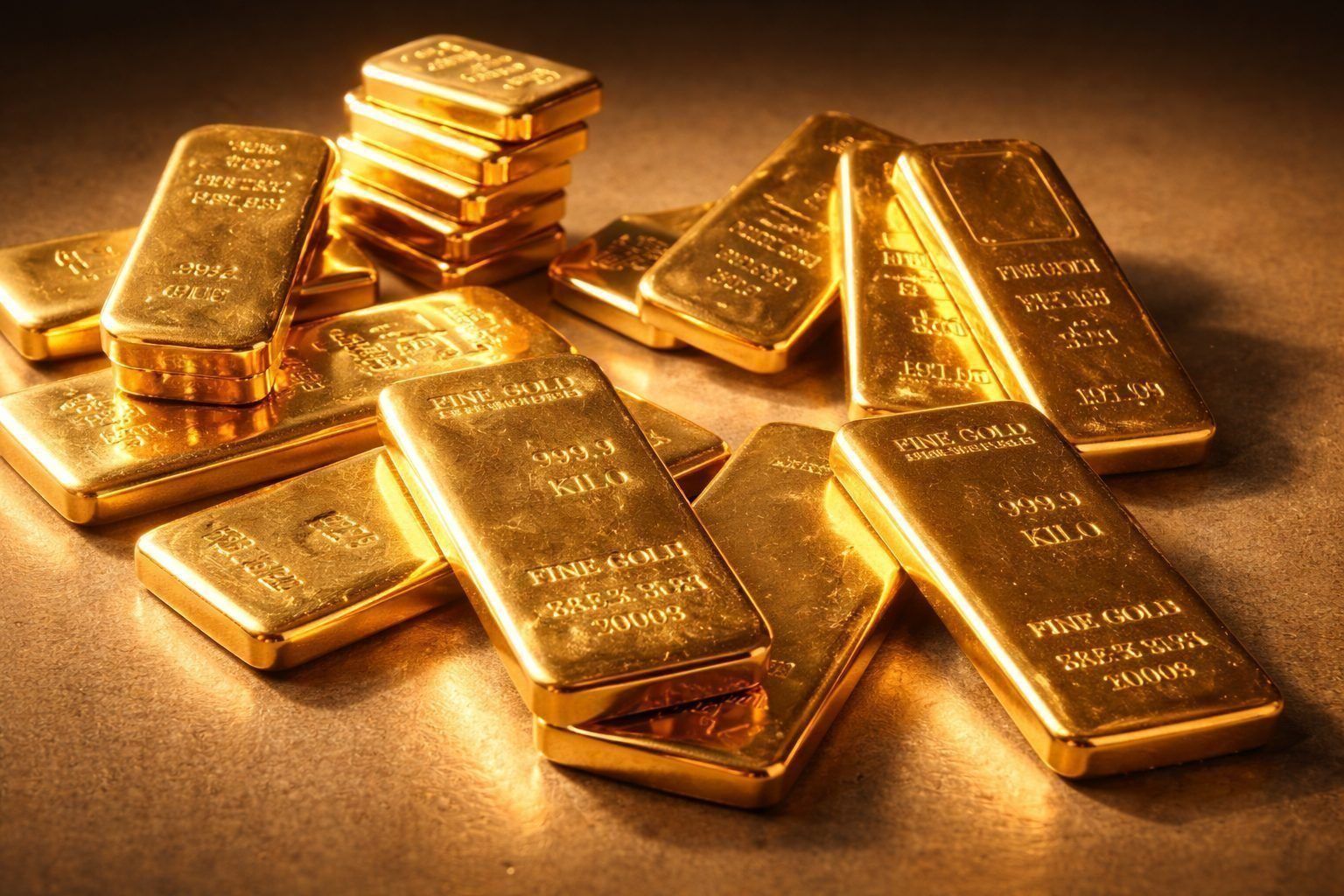

Gold prices in Australia are ending 2025 with a bang. On Wednesday, 24 December 2025, bullion pushed through a fresh psychological barrier globally—US$4,500 per troy ounce—and that strength translated into record-high Aussie dollar gold prices, even as the Australian dollar climbed to a 14‑month high against the greenback.
For Australians watching the market—whether you buy jewellery, trade bullion bars, hold an ASX gold ETF/ETP, or own local miners—today’s move is about much more than a single number. It’s the collision of safe-haven demand, geopolitics, trade tensions, central-bank buying, ETF inflows, and interest-rate expectations—with year-end liquidity amplifying every swing.
Gold price Australia today: the key AUD levels investors are watching
Because Australians often see different “gold prices” depending on where they look (spot, retail bullion, jewellery buyback), the most useful way to frame today’s market is to separate spot from what you can actually buy/sell at a dealer.
1) Perth Mint spot price (AUD): a real-time yardstick for Australians
The Perth Mint’s live pricing showed AUD spot gold around:
- Ask: A$6,718.48
- Bid: A$6,669.07
(Updated 24/12/2025, 5:45pm Perth Mint display time.
This “spot-style” view matters because it’s the base layer underneath most local pricing: bullion products add fabrication costs, dealer margins, and (sometimes) availability premiums. Perth Mint
2) What Australians pay for physical bullion: coins vs bars vs small sizes
Per the Perth Mint’s indicative retail tables (updated at the same time), the 1 oz gold coin price was:
- Perth Mint sells (1 oz coin): from A$6,936.83
- Perth Mint buys (1 oz coin): A$6,519.02 Perth Mint
For 1 oz minted bars, the indicative prices were:
- Perth Mint sells (1 oz minted bar): A$6,843.48
- Perth Mint buys (1 oz minted bar): A$6,519.02 Perth Mint
And for Australians who prefer small denominations, the 1 gram minted bar was shown at:
- Perth Mint sells (1 g): A$254.99
- Perth Mint buys (1 g): A$208.61 Perth Mint
That spread is not a “prediction”—it’s a reminder of the real-world difference between headline spot and tradable retail pricing, especially in smaller bar sizes where fabrication and handling costs are proportionally larger. Perth Mint
3) “Gold price per gram Australia” depends on the product
The Perth Mint’s indicative hallmarked jewellery buy prices (scrap-style pricing) show why “per gram” can look very different from spot:
- 24k (999) jewellery buy price: A$166.01 per gram (indicative; updated 24/12/2025) Perth Mint
This is one reason Australians comparing “gold price per gram” across websites can get confused: spot gold per gram is a pure metal value, while jewellery buyback rates typically reflect refining, verification, and resale economics. Perth Mint
What happened on 24 December 2025: why gold exploded higher
The headline move today came from offshore first.
Reuters reported that spot gold hit a record high of US$4,525.19 and traded around US$4,481.90 during the session, with silver and platinum also striking record highs.
Market commentary pinpoints several overlapping drivers:
- Geopolitical and trade risk hedging pushed investors toward “neutral” assets. Reuters
- Expectations of additional US rate cuts in 2026 lowered the opportunity cost of holding non-yielding gold.
- Thin year-end liquidity magnified price swings—an important nuance on Christmas Eve-week trading.
In the UK/Europe morning, The Guardian also framed the day as a “frenzy” across precious metals, noting gold’s jump above US$4,500 and the role of geopolitical risk and anticipated US rate cuts. The Guardian
Why Australian gold prices can rise even when the Aussie dollar is strong
Normally, a stronger AUD can dampen local gold moves, because the global gold price is largely set in US dollars.
But today, gold’s US-dollar surge was so large that it overpowered the currency effect.
ABC reported the Australian dollar was trading around 67 US cents, its strongest level since October 2024, helped by US dollar weakness and shifting rate expectations.
Even with that currency tailwind, ABC still highlighted the scale of the move in local terms—saying Australians would be paying around A$6,725 for about 31 grams of gold at the time of its update.
In other words:
- USD gold up hard = pushes AUD gold up
- AUD up vs USD = partially offsets
- Net result today = AUD gold still at/near records
That exchange-rate push-pull is one of the most important “Australia-specific” factors to watch into 2026: if the AUD rallies further, it can cap local gains; if it weakens, it can supercharge local prices even if USD gold pauses.
Australia’s gold shares react: miners hit record levels too
It wasn’t just bullion.
ABC reported the All Ords Gold sub-index climbed to its highest level ever, with large miners including Evolution Mining and Northern Star Resources up as much as 1.5%, and the index up roughly 129% year-to-date.
For Australian investors, that’s a key distinction:
- Physical gold is primarily an asset-price story (spot + currency).
- Gold miners add operational leverage (costs, production, hedging, project execution, M&A) on top of the gold price.
When gold rises as rapidly as it has in 2025, miners can outperform—but they can also become more volatile if gold consolidates or if costs rise.
The big structural story behind gold in 2025
A big part of why today’s surge resonated is that it capped a year already described as historic by multiple institutions.
The World Gold Council said gold in 2025 logged more than 50 all-time highs and was up over 60% (as of late November), driven by a mix of geopolitical/economic uncertainty, US dollar weakness, and momentum—with both investors and central banks increasing allocations.
CBA’s commodities head Vivek Dhar similarly pointed to the 2025 metals rally being driven by falling interest rates, geopolitical tensions, and resilient industrial demand, and described heightened demand visible at Australian bullion dealers.
Central banks and ETFs: the demand engines still running
Two of the most-cited supports for gold heading into 2026 are official sector buying and ETF flows—and recent reporting suggests both remain pivotal.
Reuters cited Metals Focus estimating central banks are on track to buy around 850 tonnes of gold in 2025 (down from 2024 but still “healthy”), while the World Gold Council data cited in the same Reuters report showed physically backed gold ETFs drawing US$82 billion of inflows (about 749 tonnes) so far this year—on course for the biggest inflow since 2020. Reuters
On the official data side, the World Gold Council’s Gold Demand Trends (Q3 2025) showed central banks bought an estimated ~220 tonnes in Q3 and noted survey evidence that many central banks intend to keep building reserves.
These are not small numbers. They help explain why strategists increasingly talk about gold demand as structural, not just crisis-driven.
Forecasts for 2026: where analysts think gold prices are headed next
With gold already above US$4,500, forecasts now revolve around two questions:
- Can the market hold these levels when liquidity normalises after the holidays?
- Does the next leg require a new shock—or just the same forces continuing?
Near-term targets being discussed right now
Reuters quoted analyst Ilya Spivak suggesting gold could target US$5,000 in the next 6–12 months, while also warning that thin year-end liquidity can exaggerate moves.
Major bank and strategist projections (most-cited in December 2025 coverage)
- Goldman Sachs: Base case US$4,900 by December 2026, citing central bank demand and Fed cuts as cyclical support.
- Morgan Stanley: Forecast US$4,800/oz by Q4 2026, with upward momentum supported by rate cuts and a weaker dollar (even as it expects slower gains).
- Deutsche Bank: Raised 2026 forecast to US$4,450/oz (range US$3,950–US$4,950), pointing to ETF flows and central bank demand absorbing supply.
- HSBC: Said gold could reach US$5,000/oz in 1H 2026, while also flagging volatility and possible moderation later in 2026.
- Bank of America: Lifted its 2026 outlook for gold to US$5,000/oz (average US$4,400), while warning of correction risk along the way.
- ANZ (scenario framing): Bullish risks could push gold above US$5,000/oz in 2026, while a stronger USD / hawkish Fed scenario could pull it back to around US$3,500/oz.
- J.P. Morgan: Forecast gold could average US$5,055/oz by Q4 2026, tied to assumptions about investor demand and central bank buying.
Institutional outlooks: “rangebound, but surprising” is a common theme
The World Gold Council’s 2026 outlook argues the base case could be rangebound if current conditions persist, but that 2026 could still “surprise”—with stronger upside in a downturn and downside risk if growth accelerates and the USD strengthens. World Gold Council
State Street Global Advisors also expects moderation and consolidation in 2026 (base case US$4,000–US$4,500), but sees a meaningful upside probability for US$5,000 if structural supports remain in place.
Business Insider’s round-up of strategist views on 24 December echoed that idea: gold may extend its bull run into 2026 even without a fresh crisis, as long as conditions such as debt concerns and policy uncertainty persist.
What Australians should watch next
For “gold price Australia” in 2026, the biggest swings are likely to come from a short list of variables:
1) The Fed path and real yields
Gold has been tightly linked to the direction of real yields and the opportunity cost of holding cash/bonds. Reuters’ reporting on today’s surge highlighted expectations for further US rate cuts in 2026 as a key pillar.
2) The Australian dollar
If the AUD stays strong (or strengthens), it can reduce the AUD impact of any further USD gold gains. ABC’s reporting that the AUD is near 67 US cents and at a 14‑month high underscores how relevant the currency channel is right now.
3) Central bank demand and ETF flows
A market supported by large, steady buyers behaves differently from one driven only by hot money. The 2025 figures being cited for central banks and ETF inflows are a major reason forecasters remain constructive into 2026.
4) Year-end volatility vs January reality
Multiple reports stressed thin liquidity around Christmas. If gold cools in early January, it wouldn’t automatically “break” the bull thesis—many banks explicitly expect pullbacks to attract buyers. Reuters+1
How Australians can access gold exposure (without confusing spot and retail pricing)
Australians typically access gold in three broad ways:
- Physical bullion (coins, minted bars, cast bars)
- Exchange-traded exposure (ETPs/ETFs)
- Gold equities (miners, royalty companies)
For physical buyers, the Perth Mint’s own tables show why it’s crucial to compare spot vs buy/sell levels, especially for smaller bar sizes and coins.
For market-based access, the Perth Mint explicitly points to its ASX-listed gold ETP (ASX: PMGOLD) as one of the “ways to invest in gold” beyond coins and bars. Perth Mint
And for equity exposure, the ABC’s record reading for Australia’s gold share sub-index shows how powerfully miners can move when bullion prices surge.
Bottom line (24 December 2025): Gold prices in Australia are being pulled higher by an extraordinary global rally—one that has pushed the metal through US$4,500 and lifted local pricing to around A$6,700 per ounce on spot measures, even as the Aussie dollar strengthens. Whether this becomes the platform for a move toward US$5,000 in 2026, as several major banks suggest, will depend on rates, the US dollar, central-bank behaviour, ETF flows, and whether today’s risk backdrop remains the new normal.