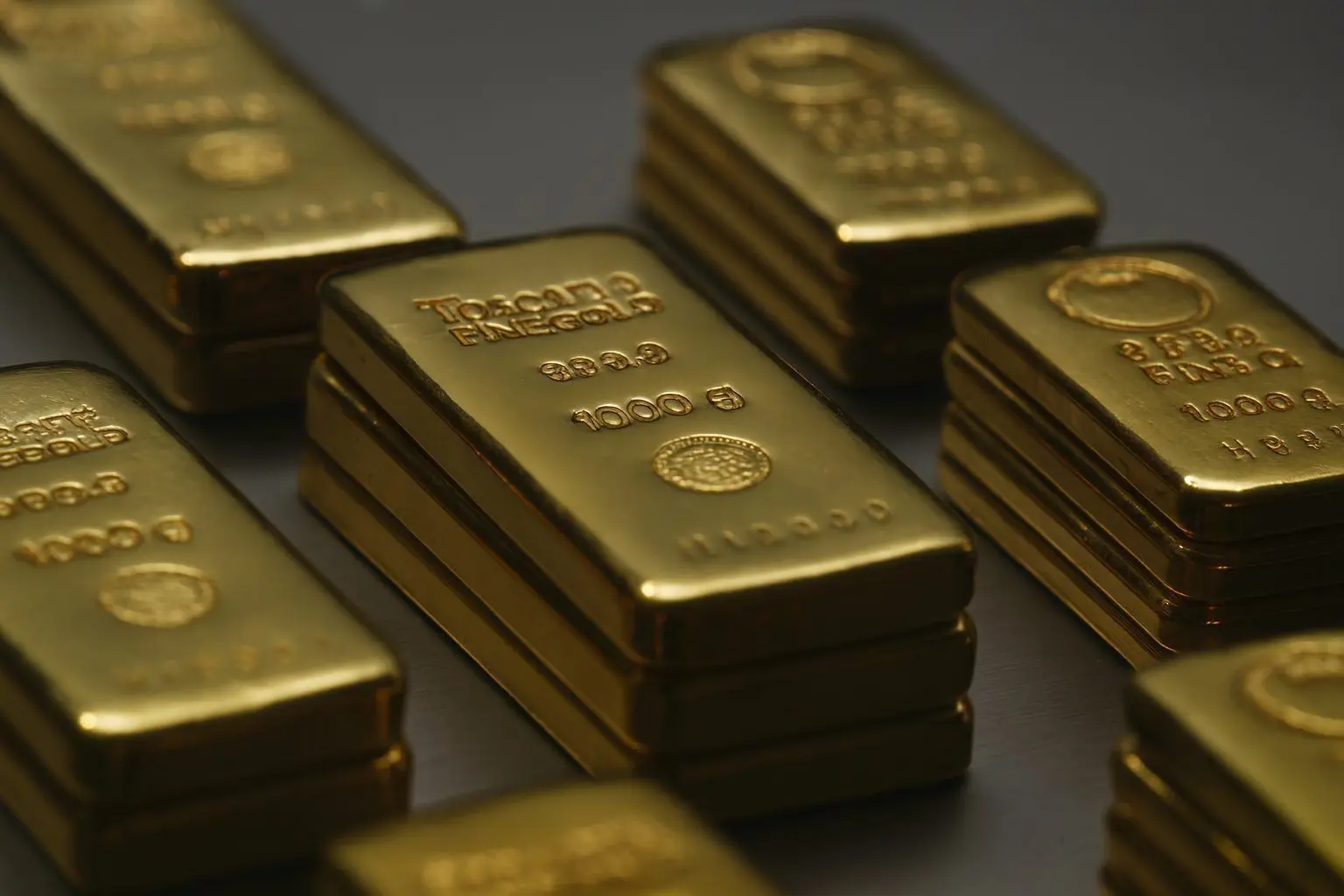
Gold prices in Germany climbed on Monday, December 15, as global bullion demand firmed and the euro-denominated spot price edged closer to recent records. By today’s quoted levels, gold in euros is trading around €3,694 per troy ounce (Feinunze) — a move that keeps the precious metal in striking distance of its all-time highs set earlier this year. GOLD.DE
At the same time, international markets are watching a packed macro calendar and shifting interest-rate expectations, both of which continue to dominate day-to-day moves in gold.
Gold price in Germany today (EUR): latest spot levels
Gold is typically priced globally in US dollars, but German investors and buyers experience the market in euros — and today’s key reference levels in Germany are:
- €3,694.50 per ounce (31.103 g)
- €118.78 per gram
- €118,780.93 per kilogram GOLD.DE
The intraday range being tracked for today (based on widely followed German spot-price dashboards) shows:
- Day high: €3,705.97/oz
- Day low: €3,662.35/oz GOLD.DE
For longer-term context, the same German spot feed shows gold’s 2025 performance in euros at roughly +47.53%, underscoring how much of the “gold story” this year has been about sustained momentum rather than a single short-lived spike. GOLD.DE
And while gold is strong today, it is still below the euro all-time highs listed on the same data source:
- All-time high (intraday): €3,763.50/oz
- All-time high (close): €3,741.98/oz GOLD.DE
What’s happening globally: today’s news driving gold
The day’s move in Germany mirrors the broader global market: spot gold rose about 1% to around $4,343.96/oz in Monday trading, supported by a softer US dollar, lower US Treasury yields, and a familiar mix of rate-cut expectations and safe-haven demand tied to geopolitical tensions. Reuters
Reuters also highlighted that the US dollar hovered near a two‑month low and benchmark 10‑year yields edged lower, conditions that often underpin gold because bullion does not pay interest and tends to look more attractive when real yields ease. Reuters
A key theme in today’s reporting is that the gold bid isn’t only about short-term positioning. UBS analyst Giovanni Staunovo pointed to a combination of stronger investor demand, three months of solid central-bank demand, and investors anticipating lower rates in 2026. Reuters
Why the gold price matters differently in Germany
If you’re searching “gold price in Germany today,” it’s important to separate two realities:
- Spot price (the global market reference in EUR)
- What German buyers pay (or receive) for physical gold, which includes manufacturing premiums, dealer spreads, and product-specific demand.
That gap is visible in real dealer quotes in Germany published today.
Example: German dealer buyback prices (what you may receive when selling)
One major German precious-metals service shows buying prices for bank-tradable investment gold around:
- €117.01 per gram (post-in purchase price)
- €116.73 per gram (counter purchase price)
These figures are timestamped during the day on 15.12.2025 and sit below the spot reference — a typical reflection of spreads and handling costs. scheideanstalt.de
Example: retail buy/sell spreads for small bars and popular coins
A German dealer price list published for 15.12.2025 illustrates how premiums expand at small weights:
- 1g gold bar: Ankauf €118 / Verkauf €134
- Krügerrand 1 oz: Ankauf €3,632 / Verkauf €3,770
- Maple Leaf 1 oz: Ankauf €3,632 / Verkauf €3,812 exchange-ag.de
This is why two people can both be “tracking the gold price” in Germany and still see meaningfully different numbers — spot pricing answers “what is gold worth right now in the market,” while dealer pricing answers “what will I pay (or get paid) for a specific product right now.”
Macro calendar: what traders are watching this week
Monday’s gold strength is landing right at the start of a week filled with potential volatility catalysts.
Reuters flagged that multiple central banks are due to meet, including the ECB, Bank of Japan, Bank of England, Sweden’s Riksbank, and Norges Bank, while delayed US economic data (including jobs and inflation) is expected to resume. Reuters
In the same global markets report, Reuters noted gold extended its rally into a fifth consecutive day, approaching the record zone in dollars. Reuters
From a German perspective, these events matter because:
- The euro–dollar exchange rate directly affects the EUR gold price (Germany’s “goldpreis heute” often rises even faster when gold rises in USD and the euro weakens).
- Central bank decisions influence bond yields, and bond yields are one of gold’s most consistent macro drivers.
Technical view: “near records” can mean higher volatility
Beyond the macro narrative, short-term technical positioning is also part of today’s story.
A widely read technical analysis note described gold futures as testing a key resistance area near the record zone, warning that momentum can “risk a pullback” if important supports fail — while also pointing out that a sustained move above nearby resistance could re-open the path to a fresh record. Investing.com
For everyday investors in Germany, the practical takeaway is simple: when gold trades close to record levels, intraday swings can grow and dealer spreads can widen, especially on smaller bars and high-demand coins.
Forecasts and outlook: where analysts see gold in 2026
Gold’s rally in 2025 has shifted the forecasting debate from “can gold hold gains?” to “how far can the next leg go — and what would change the trend?”
Here’s what major strategy desks and research notes are emphasizing as of mid‑December 2025.
Goldman Sachs: $4,900 by end‑2026 (and “upside risk”)
A Business Insider report citing Goldman Sachs research says the bank forecasts gold at $4,900 by the end of 2026, arguing that US investor exposure to gold remains low enough that even modest allocation increases could push prices materially higher. markets.businessinsider.com
Goldman’s core logic: gold is a relatively small market compared with the size of household and institutional portfolios, so incremental demand can have an outsized price impact. markets.businessinsider.com
State Street Global Advisors: base $4,000–$4,500, bull case $5,000
State Street Global Advisors (SSGA) lays out a scenario framework suggesting gold could moderate but consolidate at elevated levels in 2026. Their overview includes:
- Base case (50% probability): $4,000–$4,500
- Bull case (30% probability): $4,500–$5,000
- Bear case (20% probability): $3,500–$4,000 SSGA
SSGA ties upside potential to structural themes such as Fed easing, central bank demand, ETF inflows, and concerns about debt — while acknowledging a stronger USD or improved growth could cap or reverse gains. SSGA
UBS: central banks still a pillar — projected 900 metric tons of buying in 2026
In a UBS “House View” brief dated December 12, 2025, strategists argue gold should post further gains supported by central bank buying, large fiscal deficits, lower US real interest rates, and ongoing geopolitical risks. Italy
UBS also projects central bank and sovereign wealth gold buying of 900 metric tons in 2026, described as a modest slowdown from 2025 but still far above the 2010–2021 annual run rate (around 450–500 metric tons). Italy
World Gold Council: scenarios, not point forecasts — but a wide range of outcomes
The World Gold Council’s 2026 outlook frames next year as a scenario-driven market rather than a simple “up or down” call.
It notes gold had risen more than 60% by the end of November 2025 and set more than 50 all-time highs, driven by geopolitical/geoeconomic risks, USD weakness and marginally lower rates, and a broad push toward diversification. World Gold Council
The WGC’s scenario ranges are explicitly not price forecasts, but they do illustrate how widely outcomes could vary depending on macro conditions — from modest moves around flat to meaningfully positive upside in stress scenarios, and downside in a “risk premia fades” reflation-style environment. World Gold Council
The Germany-specific outlook: what could push EUR gold higher or lower next
Because Germany experiences gold in euros, the short-term direction often comes down to two “levers” moving together or against each other:
What could lift gold in Germany (EUR)
- US yields drifting lower and markets leaning toward easier policy (bullish for gold in USD; also reflected in today’s news flow). Reuters
- A weaker US dollar and/or a weaker euro, amplifying the local EUR price even when USD gold is steady. Reuters
- Renewed geopolitical stress driving safe-haven demand (also cited as a factor in today’s rally). Reuters
- Central bank buying continuing to underpin the market into 2026, a theme repeated across Reuters commentary and major bank outlooks. Reuters+2Italy+2
What could knock EUR gold lower
- A rebound in the dollar or a sharp rise in real yields (typically a headwind for non-yielding assets like bullion). Reuters
- Risk sentiment improving if growth data surprises upward and the market reprices rate cuts (one reason technical analysts warn about pullback risk near record zones). Investing.com
- Profit-taking after an already historic year — especially near all-time highs, when positioning can get crowded. (This risk is implied in record-zone technical commentary and in the fact gold is trading close to the listed euro records.) Investing.com+1
Bottom line: gold price in Germany today is strong — and the debate is shifting to 2026
As of 15 December 2025, Germany’s gold price is back in a “near record” posture around €3,694 per ounce and €118.78 per gram, supported by a softer dollar, lower yields, and persistent safe-haven and central-bank demand narratives. GOLD.DE+1
For German consumers and investors, the more practical story is that spot strength does not equal a single “buy price”: dealer spreads remain material, especially for small bars and popular coins, and today’s published German price lists show that difference clearly. exchange-ag.de+1
Looking into 2026, forecasts from major institutions span a wide range — but the center of gravity has moved higher, with multiple research notes arguing that central bank demand and the interest-rate backdrop could keep gold elevated even if 2025’s pace cools. World Gold Council+3markets.businessinside…
This article is for informational purposes only and does not constitute investment advice. Gold prices are volatile, and retail quotes can differ significantly from spot prices depending on product, size, and dealer.