Updated: December 4, 2025
A once‑in‑a‑lifetime interstellar visitor is putting on its strangest act yet.
New observations released in the last few days suggest that the comet 3I/ATLAS – only the third known object to enter our solar system from another star – is:
- Likely covered in erupting “ice volcanoes” (cryovolcanoes) and built from metal‑rich primitive material. Live Science+1
- Emitting the first detected radio signal from an interstellar comet, revealing classic cometary water chemistry rather than alien technology. Live Science+1
- Being tracked from deep space by NASA’s Psyche spacecraft as part of a 12‑mission, solar‑system‑wide observing campaign. NASA Science+1
- Serving as the target for a United Nations–linked planetary‑defense drill, the International Asteroid Warning Network’s 2025 Comet Astrometry Campaign. iawn.net+1
And later this month, on December 19, 2025, 3I/ATLAS will make its closest approach to Earth – still a very safe 1.8 astronomical units (about 270 million km / 170 million miles) away, but bright enough for dedicated observers with telescopes to chase. IFLScience+1
Here’s where the science stands today, and how you can follow this interstellar comet from your own backyard.
What is interstellar comet 3I/ATLAS?
3I/ATLAS, also cataloged as C/2025 N1 (ATLAS), was first reported on July 1, 2025 by the Asteroid Terrestrial‑impact Last Alert System (ATLAS) survey telescope in Chile. NASA Science
As more data came in, its orbit turned out to be hyperbolic, meaning it is not gravitationally bound to the Sun. That’s why it was reclassified as 3I/ATLAS:
- “3” – the third confirmed interstellar object, after 1I/ʻOumuamua (2017) and 2I/Borisov (2019).
- “I” – “interstellar.”
- “ATLAS” – the survey that discovered it. NASA Science+1
From orbital modeling and stellar‑population studies, researchers estimate that 3I/ATLAS is older than the solar system, possibly several to more than 10 billion years old, having wandered the Milky Way for eons before dropping into our neighborhood. Wikipedia+1
Key orbital and physical facts:
- Origin: Interstellar, based on its high eccentricity and inbound speed. NASA Science+1
- Perihelion (closest to Sun): October 29–30, 2025, at about 1.4 AU (just inside Mars’s orbit). NASA Science+1
- Closest approach to Earth: December 19, 2025, at about 1.8 AU / 270 million km / 170 million miles. IFLScience+1
- Future flyby: A pass roughly 53 million km (0.36 AU) from Jupiter on March 16, 2026, after which it will leave the solar system forever. IFLScience+1
- Size: Hubble data suggest a nucleus between ~440 m and 5.6 km across. NASA Science+1
NASA and ESA both stress that 3I/ATLAS poses no impact risk. Even at its closest, it will be far beyond the Moon’s distance and on the opposite side of the Sun from Earth. NASA Science+1
New December 2025 finding: ice volcanoes on an interstellar comet
The biggest headline this week is that 3I/ATLAS appears to be cryovolcanically active – effectively, it has ice volcanoes.
An international team led by Josep Trigo‑Rodríguez monitored the comet from July to November 2025, using the Joan Oró Telescope in Spain and other observatories. As the comet approached the Sun, they recorded: Live Science+1
- A sharp, sustained brightening when the comet was roughly 2.5 AU from the Sun.
- High‑resolution images showing spiraling jets of gas and dust coming off the nucleus.
- Spectra matching carbonaceous chondrite meteorites – ancient, metal‑rich rocks that in our solar system are linked to the early building blocks of planets and the delivery of volatile ingredients to Earth.
The team interprets these jets as cryovolcanoes:
- As sunlight warms the comet, solid carbon dioxide (dry ice) sublimates, opening pathways into the interior.
- Liquid phases and oxidizing fluids can then react with iron‑nickel grains and sulfides in a metal‑rich core, releasing extra heat and gas.
- That extra energy drives powerful outgassing jets, forming the observed spiral structures and boosting the coma’s brightness. Live Science+1
What makes this remarkable is that 3I/ATLAS appears chemically similar to icy bodies beyond Neptune and to some of the most primitive meteorites found on Earth, despite coming from another star system. Live Science+1
If that picture holds up under peer review, it suggests that planet‑forming disks around different stars may produce surprisingly similar types of icy, metal‑bearing small bodies.
The comet that “talks”: radio signal confirms water and a natural origin
Headlines about a “radio signal” from 3I/ATLAS sound like the plot of a sci‑fi movie, but the reality is very down‑to‑Earth – and very useful scientifically.
In late October, astronomers using South Africa’s MeerKAT radio array detected radio emission associated with hydroxyl (OH) radicals in the comet’s coma. Live Science+1
Here’s what that means:
- When water vapor from a comet is exposed to solar ultraviolet light, some molecules break apart into OH radicals.
- Those radicals absorb and emit radio waves at characteristic frequencies, which radio telescopes can pick up.
- The signal detected from 3I/ATLAS matches precisely this well‑known cometary process. Live Science
In other words, the “radio signal” is not a beacon from aliens; it is water chemistry in action, providing independent confirmation that 3I/ATLAS is a typical, volatile‑rich comet, just from another star. Live Science+1
This follows a pattern: every time 3I/ATLAS does something odd – from a dramatic tail to color changes near perihelion – detailed analysis has found natural explanations, even as a few scientists (most prominently Avi Loeb) continue to speculate about exotic possibilities. Live Science+1
Strange pulses, anti‑tails and talk of alien tech
3I/ATLAS has genuinely weird behavior, and that’s been catnip for speculation.
Recent reports highlight two unusual features:
- A “heartbeat”‑like pulse – Observers have found that the comet’s brightness modulates on a roughly 16‑hour cycle, a pattern that has been likened to a cosmic heartbeat. One camp, including Loeb, has floated the idea that such a controlled pulse might reflect artificial jets or maneuvers. New York Post+1
- The more conventional explanation is that the comet’s rotation and localized jets periodically rotate into sunlight, making it appear to “blink” as it spins. VICE+1
- A sunward “anti‑tail” that looks like a teardrop – Rather than trailing directly away from the Sun, part of 3I/ATLAS’s glowing envelope seems to stretch toward the Sun. Loeb has proposed that this structure could be produced by a swarm of accompanying objects that do not feel the same outgassing forces as the main comet. New York Post+1
These ideas get attention, but the wider scientific community remains unconvinced that anything exotic is required. Radiation pressure, outgassing, and viewing geometry can all produce anti‑tails and complex coma shapes; similar features have been seen in solar‑system comets before. Live Science+1
NASA’s official language is blunt: everything observed so far is consistent with 3I/ATLAS being a natural comet from an unknown star system, not a spacecraft. NASA Science+1
Psyche and a solar‑system‑wide observing campaign
3I/ATLAS isn’t just a spectacle for backyard observers; it’s become the focus of a massive coordinated campaign across the solar system.
Psyche’s deep‑space view
On September 8–9, 2025, NASA’s Psyche spacecraft – en route to the metal‑rich asteroid (16) Psyche – turned its multispectral imager toward 3I/ATLAS for eight hours. At the time, the comet was about 33 million miles (53 million km) from the spacecraft. NASA Science
Those observations:
- Tracked the comet’s motion against background stars with exquisite precision.
- Helped refine its trajectory and coma properties.
- Demonstrated how missions headed elsewhere can provide “bonus science” for planetary defense and comet studies. NASA Science+1
A dozen missions, one comet
Psyche is just one member of a multi‑mission 3I/ATLAS watch party. NASA lists a long roster of assets that have already collected data on the comet, including: NASA Science
- Hubble Space Telescope – constrained nucleus size and early coma structure.
- James Webb Space Telescope (JWST) – near‑infrared spectra revealing abundant CO₂, water, and other volatiles. European Space Agency+1
- SPHEREx, TESS, Swift – multi‑wavelength measurements of gas production and water breakdown. NASA Science+1
- Mars Reconnaissance Orbiter (MRO), MAVEN, and the Perseverance rover – images and ultraviolet data captured during the comet’s October flyby of Mars. European Space Agency+1
- Lucy, PUNCH, STEREO, SOHO, Parker Solar Probe, Europa Clipper, Psyche – additional perspectives from widely scattered points around the solar system. NASA Science+1
Together, these views give scientists an unprecedented 3D picture of how an interstellar comet responds to the Sun, from the chemistry around its nucleus to the way the solar wind sculpts its growing tails.
A real‑world planetary‑defense drill
Even though 3I/ATLAS is harmless, it has become the centerpiece of a global planetary‑defense exercise.
The International Asteroid Warning Network (IAWN) is running a Comet Astrometry Campaign from November 27, 2025 to January 27, 2026, with observatories around the world measuring 3I/ATLAS’s position as precisely as possible. iawn.net
Key points from the campaign:
- It is the eighth IAWN observing exercise since 2017, planned well before 3I/ATLAS was discovered as a way to practice handling comets, which are fuzzy and harder to measure than point‑like asteroids. iawn.net
- Professional and amateur astronomers are encouraged to contribute high‑quality astrometry using standardized data formats (such as ADES) and well‑calibrated timing systems. iawn.net
- The campaign is coordinated with NASA’s Planetary Defense Coordination Office and other national agencies, effectively turning 3I/ATLAS into a live‑fire test of the world’s ability to track a challenging object. iawn.net+1
ESA’s work with ExoMars Trace Gas Orbiter (TGO) illustrates what’s at stake: by imaging 3I/ATLAS from Mars in early October, then combining those data with Earth‑based observations, ESA scientists improved the comet’s predicted position by a factor of ten – the first time astrometry from a spacecraft orbiting another planet has been formally used this way. European Space Agency
If a truly hazardous object were ever discovered, this kind of multi‑planet triangulation could dramatically sharpen impact forecasts.
How and when to see 3I/ATLAS in December 2025
3I/ATLAS will never become a naked‑eye spectacle; it is simply too distant and faint. But for dedicated observers, December offers the best chance to bag an interstellar comet in the eyepiece.
Brightness and visibility
As of late November, 3I/ATLAS was around magnitude 10–10.5, roughly at the edge of what can be spotted with large binoculars and small telescopes under dark skies. Wikipedia+1
At that brightness:
- Casual stargazers will not see it by eye.
- You’ll want at least good 20×80 binoculars or, preferably, a telescope with an aperture in the 20–30 cm (8–12 inch) range, as recommended by NASA and observing guides. IFLScience+1
Where to look
Because of its distance, 3I/ATLAS moves slowly against the background stars, but it does shift constellations over the month:
- Early December 2025: Star charts (such as TheSkyLive) place the comet in the general region of Virgo, visible in the pre‑dawn eastern sky. TheSkyLive+1
- Around closest approach on December 19, 2025: Observing guides suggest searching east to northeast before dawn, near the bright star Regulus in Leo, using up‑to‑date online ephemerides for exact coordinates. IFLScience+1
Practical tips:
- Pick a night with dark, transparent skies and little Moon interference if possible (the December “Cold Supermoon” on the 4th will brighten the sky near full phase). Live Science
- Use a reliable star chart or app that can load comet ephemerides (for example, TheSkyLive or your planetarium software of choice) and plot 3I/ATLAS for your exact time and location. TheSkyLive
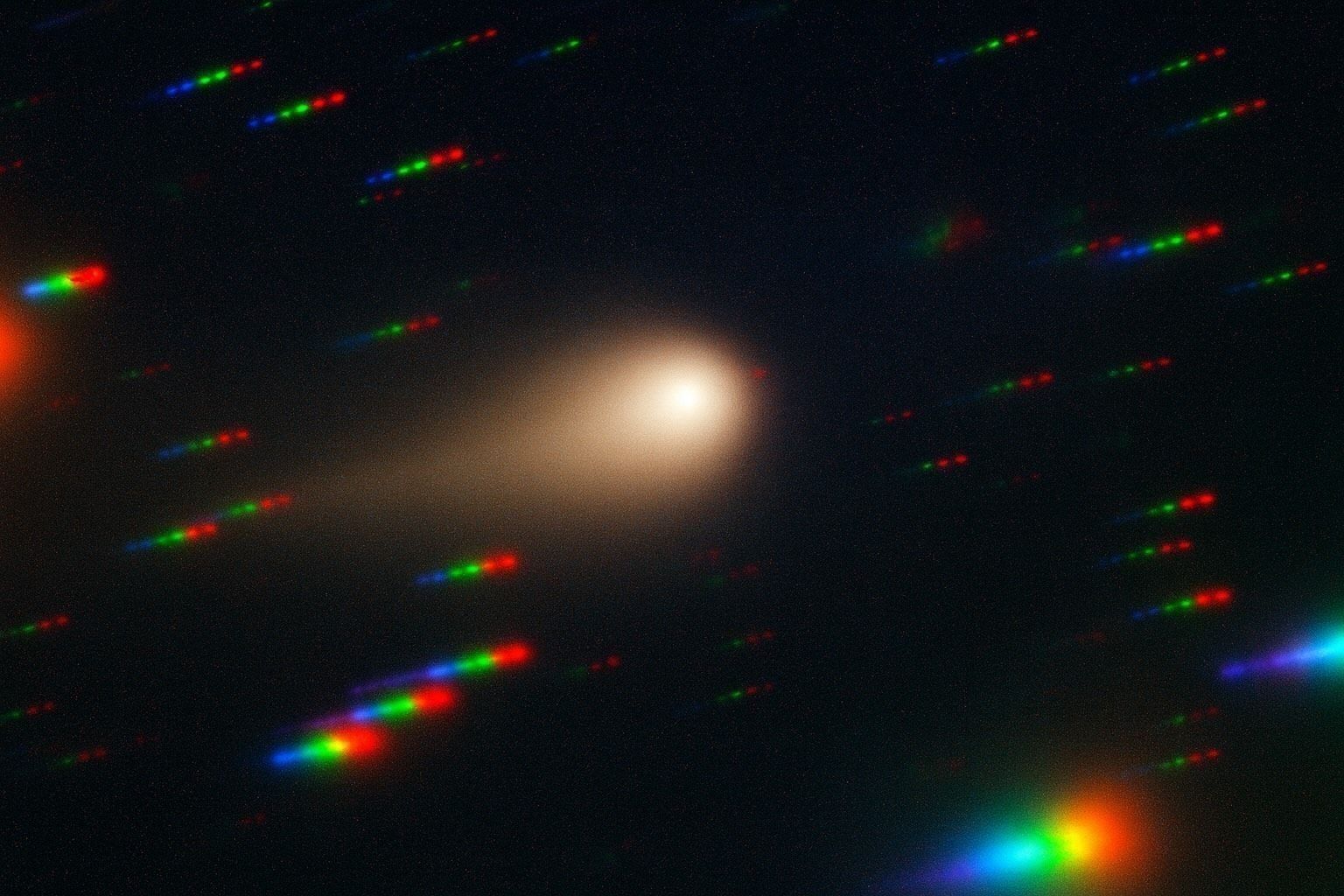
- Start with low magnification to locate the faint fuzz of the coma, then increase power to tease out structure. At the eyepiece, expect a small, diffuse patch of light, not a dramatic “photographic” tail.
Seeing it at all is the real prize: you’re looking at ices and dust that formed around another star before the Sun existed.
Why 3I/ATLAS matters so much
Beyond the headlines and speculation, 3I/ATLAS is scientifically precious for several reasons:
- It is only the third known interstellar visitor, and the first interstellar comet for which we can gather detailed, multi‑wavelength data across the inner solar system. NASA Science+1
- Its composition – CO₂‑rich ices, water vapor, complex organics and a likely metal‑rich interior – looks surprisingly similar to distant objects in our own Kuiper Belt and to primitive meteorites that may have seeded early Earth with volatiles. Live Science+1
- Dynamical studies suggest it may be older than the solar system, a genuine time capsule from the early Milky Way. Wikipedia+1
- As a test case for planetary defense, it is helping agencies shake down the tools and coordination they would need if the next interstellar visitor were on a less friendly trajectory. iawn.net+1
In short, 3I/ATLAS is giving scientists a laboratory for both cosmic archaeology and planetary‑defense readiness, all wrapped in one faint, fast‑moving speck.
What to watch next
Over the coming weeks and months, expect more:
- Follow‑up analyses of the cryovolcanism claim, including detailed comparisons with trans‑Neptunian objects and carbonaceous meteorites. Live Science+1
- Refined orbit models as data from Psyche, Mars missions, and ground‑based observatories continue to flow in. NASA Science+1
- Results from the IAWN comet campaign, which will show just how precise the global network can get on a challenging target. iawn.net
For now, if the weather cooperates, December is your moment: grab a chart, point your telescope into the cold pre‑dawn sky, and know that somewhere in that faint smudge of light is a visitor from another star – venting ice volcanoes, whispering in radio waves, and then vanishing back into interstellar space.