Interstellar comet 3I/ATLAS is turning December 2025 into one of the most dramatic months in modern astronomy. The icy visitor from another star system is firing powerful jets, showing signs of possible “ice volcanoes,” pulsing with a 16‑hour light pattern and inspiring everything from rigorous science to wild alien‑probe speculation.
At the same time, NASA and ESA have tightened its trajectory, confirmed it poses no threat to Earth, and used it as a live-fire drill for planetary‑defense planning. NASA Science+2Universe Today+2
Here’s a detailed look at what 3I/ATLAS is, what the newest data show as of 2 December 2025, why some people think it might be alien technology – and what mainstream scientists actually say.
What Is 3I/ATLAS?
A rare interstellar visitor
3I/ATLAS – also designated C/2025 N1 (ATLAS) – is an interstellar comet, meaning its orbit is so strongly hyperbolic that it cannot be bound to the Sun and clearly comes from outside our solar system. It is only the third confirmed interstellar object after 1I/ʻOumuamua (2017) and 2I/Borisov (2019). Wikipedia+2NASA Science+2
The comet was:
- Discovered: 1 July 2025 by the NASA‑funded Asteroid Terrestrial‑impact Last Alert System (ATLAS)telescope in Rio Hurtado, Chile, with pre‑discovery images going back to mid‑June. NASA Science+1
- Named: “3I” for the third interstellar object; “ATLAS” for the survey that spotted it. NASA Science+1
Orbit and distance from Earth
NASA’s official trajectory shows that 3I/ATLAS: NASA Science+2Universe Today+2
- Reached perihelion (closest to the Sun) around 30 October 2025 at ~1.4 AU (about 130 million miles or 210 million km), just inside Mars’ orbit.
- Will make its closest approach to Earth on 19 December 2025, at about 1.8 AU (~170 million miles / 270 million km) – almost twice the Earth–Sun distance.
- Is racing out of the inner solar system at roughly 250,000 km/h (~155,000 mph) on a one‑time fly‑through. Universe Today+1
NASA is explicit: 3I/ATLAS poses no impact risk and will remain very far from Earth throughout its passage. NASA Science+2Reuters+2
Size and age
Hubble Space Telescope data, now combined with newer modeling, suggest 3I/ATLAS’s nucleus is somewhere between ~440 meters and 5.6 km in diameter – big on human scales but modest for a comet. NASA Science+2Live Science+2
Spectroscopic studies and modeling indicate that:
- It likely formed in a very cold outer region of its home system. International Business Times UK+1
- Its materials point to an age of around 7 billion years, roughly twice the age of Earth, making it probably the oldest comet ever observed. Sky at Night Magazine+2Live Science+2
Don’t confuse it with the “other” ATLAS comet
There is also a different comet, C/2025 K1 (ATLAS), a conventional solar‑system comet that recently fragmented after a close pass by the Sun. It just happens to be discovered by the same survey. It is not interstellar and is unrelated to 3I/ATLAS beyond the shared survey name. Live Science+2Live Science+2
Latest 3I/ATLAS News (as of 2 December 2025)
NASA’s big press conference: “This object is a comet”
On 19 November 2025, NASA held a widely watched press conference to release the most comprehensive set of images and measurements of 3I/ATLAS so far. Data came from more than a dozen space missions, including Hubble, JWST, Swift, Lucy, Psyche, MRO, MAVEN, SOHO, PUNCH and Perseverance. EarthSky+3NASA Science+3NASA Science+3
Key takeaways: Reuters+2Sky Telescope+2
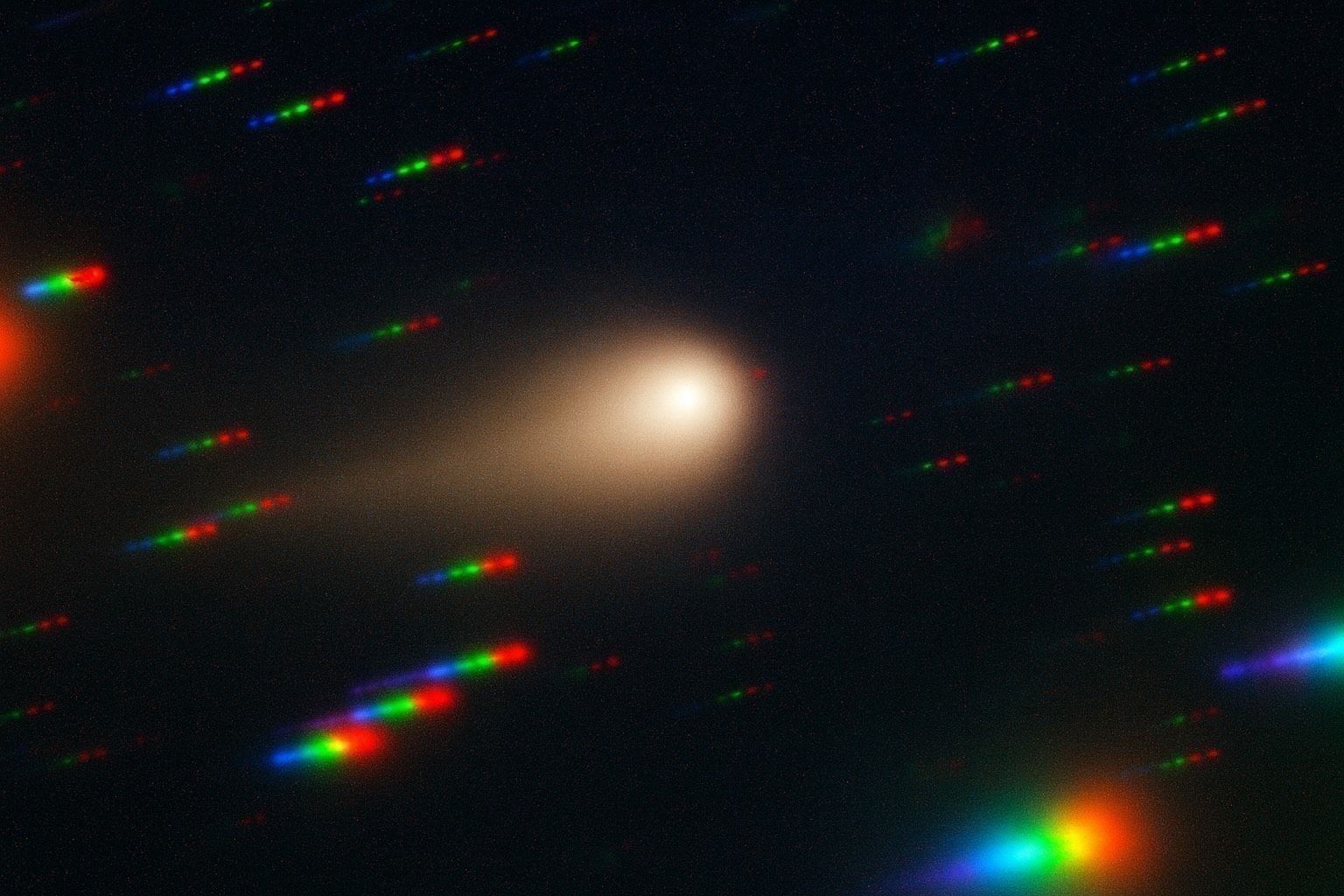
- The object shows a classic cometary coma and tail, with gas and dust streaming away as it nears the Sun.
- Its composition includes abundant carbon dioxide, water, carbon monoxide, cyanide and nickel‑bearing material, broadly similar to – though not identical with – known comets.
- NASA officials strongly rejected alien‑spacecraft rumors, stressing that no “technosignatures” (artificial signals or maneuvering) have been detected.
One NASA official summarized the verdict in plain language: it looks and behaves like a comet, and all available evidence supports a natural origin.
“Ice volcanoes” erupting on an interstellar comet
On 1 December 2025, a new preprint led by Josep M. Trigo‑Rodríguez hit the arXiv and was covered by Live Science: the team interprets detailed jet structures as evidence of cryovolcanism – essentially “ice volcanoes” erupting on 3I/ATLAS. Live Science
From their observations with the Joan Oró Telescope and other facilities, they conclude:
- As 3I/ATLAS approached perihelion, it entered an intense sublimation phase and brightened rapidly.
- High‑resolution images reveal spiraling jets of gas and dust, which they interpret as cryovolcanic plumes venting from beneath the surface.
- Spectral comparisons suggest the comet’s surface resembles trans‑Neptunian objects (TNOs) in our own system: icy bodies rich in volatiles and metals far beyond Neptune. Live Science
- A comparison with carbonaceous chondrite meteorites indicates 3I/ATLAS may be metal‑rich, with significant iron and nickel. Live Science+1
In other words, despite coming from another star, 3I/ATLAS looks surprisingly similar to the icy debris we see in our own outer solar system.
The 16‑hour “heartbeat” pattern
An October paper in Astronomy & Astrophysics described a 16.16‑hour periodic variation in 3I/ATLAS’s brightness, interpreted as a kind of “heartbeat” in the comet’s light curve. Futurism highlighted the result on 1 December 2025, dubbing it a repeating “heartbeat pattern.” Futurism
The likely explanation:
- The comet is spinning, and one or more active jets periodically turn toward the Sun and then away.
- When a large patch of ice on the rotating nucleus faces the Sun, a sunward jet can “pump up” the coma, making the whole comet briefly brighter before fading again. Futurism+1
Some commentators link this heartbeat to the idea of technological thrusters, but the observed periodicity is entirely consistent with a rotating, naturally venting comet, and that is the interpretation favored by the original researchers. Futurism+2Sky Telescope+2
Dramatic jets and a puzzling “anti‑tail”
As 3I/ATLAS emerged from behind the Sun in November, images from amateur astronomers and major observatories revealed: Sky at Night Magazine+3Sky Telescope+3Me…
- Multiple narrow, collimated jets extending millions of kilometers.
- A striking sunward-pointing “anti‑tail” – a structure that appears to point toward the Sun instead of away from it.
Mainstream comet scientists note that anti‑tails are rare but well‑understood: large, slow‑moving dust grains can form a tail that, from our line of sight, appears to point sunward due to projection effects and the geometry of the orbit. Sky Telescope+1
However, Harvard astronomer Avi Loeb and others have proposed more exotic possibilities. In a recent Medium post, Loeb suggests the sunward feature may be a swarm of non‑evaporating objects – perhaps natural fragments, perhaps something artificial – that are less affected by radiation pressure than the main comet. Medium+2Medium+2
Tabloid‑style coverage has amplified this, with some outlets describing the tail as a “swarm of unknown objects” trailing the comet, though no such swarm has been independently confirmed. New York Post+2Sky Telescope+2
Europe’s Mars‑based trajectory fix and planetary‑defense drill
On 14 November 2025, ESA announced that by using images from its ExoMars Trace Gas Orbiter (TGO) around Mars, combined with ground‑based observations, it improved predictions of 3I/ATLAS’s location by a factor of ten. This is the first time an object’s path has been refined using a spacecraft orbiting another planet. European Space Agency+1
Universe Today points out that this work: Universe Today
- Confirms 3I/ATLAS will pass Earth at a safe distance of ~270 million km on 19 December.
- Serves as a planetary‑defense rehearsal, demonstrating how to combine space‑ and ground‑based data for future hazardous objects.
According to USA Herald, European agencies have layered a full‑scale planetary‑defense communication drill on top of this exercise, using 3I/ATLAS as the “scenario comet” to test how governments and scientists would coordinate during a real emergency – not because this comet is dangerous, but precisely because it isn’t. USA Herald – The People’s Voice+2Universe …
Solar eruption at “the worst possible time”
The TechStock² December sky guide and additional USA Herald coverage note that a powerful X‑class solar flare on 30 November 2025 erupted just weeks before 3I/ATLAS’s closest approach. TechStock²+1
The flare and any associated coronal mass ejection could:
- Enhance auroras on Earth around the December solstice. TechStock²
- Potentially buffet the comet’s tail, creating extra structure in dust and gas streams.
But the Sun’s outbursts do not change 3I/ATLAS’s overall orbit in any significant way; they affect its environment, not its trajectory. NASA Science+1
Live science in front of a global audience
In late November, the Gemini North telescope in Hawaiʻi joined the action with a public “Shadow the Scientists”webinar. Viewers watched astronomers collect real‑time spectra and images of 3I/ATLAS as it reappeared from solar conjunction. Space+1
Earlier Gemini South data had already revealed a large plume of cyanogen gas, and the new observations track how the comet’s chemistry and brightness evolve post‑perihelion. The raw data are being released immediately, letting professionals and amateurs alike dig into the measurements. Space+2Sky Telescope+2
What Is 3I/ATLAS Made Of?
Multiple telescopes – from Hubble and JWST to NASA’s Neil Gehrels Swift Observatory – are piecing together 3I/ATLAS’s chemistry.
Water and OH: a breakthrough detection far from the Sun
Swift’s ultraviolet instruments detected hydroxyl (OH) – a breakdown product of water – around 3I/ATLAS when it was nearly three times farther from the Sun than Earth. That’s much farther out than where water usually becomes active in typical comets. Sky at Night Magazine
The team measured water loss of about 40 kg per second at that distance, implying that: Sky at Night Magazine+1
- The comet is very rich in water and ices.
- Small icy grains may be lofted off the nucleus and heated by sunlight, feeding a large, extended water coma.
This lets astronomers study interstellar comet chemistry using the same tools they use for ordinary comets, opening a window into how planets form in other star systems. Sky at Night Magazine+1
CO₂‑dominated coma and unusual ratios
JWST observations show that 3I/ATLAS has a CO₂‑dominated gas coma, with significant H₂O, CO, OCS, water ice and dust. Its CO₂/H₂O ratio is much higher than most solar‑system comets but still within the range of natural behavior. International Business Times UK+2Sky Tel…
This suggests 3I/ATLAS formed in a colder region than our Kuiper Belt, where CO₂ and other volatiles can remain frozen for billions of years.
Cryovolcanism and metal‑rich material
The new cryovolcano study adds several tantalizing clues: Live Science+1
- Jet structures are consistent with subsurface reservoirs of volatile ices erupting through a crust.
- Spectral comparisons to Antarctic meteorites hint at a composition similar to primitive carbonaceous chondrites, including metal‑rich grains.
- This supports the idea that 3I/ATLAS is a TNO‑like body from another star, carrying the raw ingredients that can seed planets – and potentially life – elsewhere.
Every interstellar object so far has been weird in a different way: ʻOumuamua seemed dry, Borisov was rich in carbon monoxide, and now ATLAS is shedding water and CO₂ at unusual distances. Together, they emphasize just how diverse planetary systems can be. Sky at Night Magazine+2Reuters+2
Does 3I/ATLAS Pose Any Danger to Earth?
Short answer: no.
- The closest approach on 19 December 2025 will be around 170 million miles (270 million km) from Earth, almost twice the Earth–Sun distance. NASA Science+2Universe Today+2
- ESA’s Mars‑based triangulation and NASA’s ongoing tracking agree on a safe, hyperbolic flyby out of the solar system. European Space Agency+2Universe Today+2
Planetary‑defense experts are using 3I/ATLAS as a practice case precisely because it is harmless: it lets them rehearse orbit determination, data sharing and crisis communication without worrying about an actual impact. Universe Today+2USA Herald – The People’s …
Is 3I/ATLAS an Alien Spacecraft?
This is the question driving much of the public fascination – and a lot of confusion.
The case from Avi Loeb and speculative outlets
Harvard astrophysicist Avi Loeb and collaborators have argued that 3I/ATLAS deserves to be treated as a possible technological object until ruled out. Their main points, as summarized by IBTimes and Loeb’s own blog posts, include: USA Herald – The People’s Voice+3Internati…
- The comet’s trajectory is unusually well aligned with the ecliptic (the plane of the planets) and passes near several planets, which they argue is statistically unlikely for a random interstellar rock.
- The perihelion geometry produced a brief Sun–object–Earth alignment, which Loeb describes as a good window for a hypothetical spacecraft to perform a “reverse Oberth maneuver” near the Sun with minimal detection.
- Observations of non‑gravitational accelerations, narrow jets, the 16‑hour heartbeat pattern, and the sunward anti‑tail are interpreted as possible signs of controlled thrust.
- Commentaries in outlets like USA Herald push this further, suggesting the jets show “directional discipline” more consistent with engineered propulsion than random venting. USA Herald – The People’s Voice+2Futurism+…
Loeb himself stops short of declaring 3I/ATLAS alien technology, instead arguing that science should remain open to that possibility given the potentially huge implications. International Business Times UK+1
The mainstream scientific view
By contrast, NASA, ESA and most comet specialists emphasize that all current data are consistent with a very unusual but natural comet: Live Science+4Reuters+4Sky Telescope+4
- The observed non‑gravitational acceleration is expected from asymmetrical outgassing near perihelion and appears small compared with typical cometary forces.
- Anti‑tails, complex jets and brightness variations are known in other comets and can be explained by combinations of rotation, dust grain sizes and viewing geometry.
- Spectroscopy shows ordinary cometary materials – water, CO₂, CO, dust, cyanogen – rather than exotic alloys or manufactured structures.
- NASA officials explicitly state that no technosignatures have been seen, and independent astronomers quoted by Reuters and others call the spacecraft idea “nonsense” given current evidence. Reuters+2Sky Telescope+2
In other words:
- Extraordinary claims require extraordinary evidence.
- So far, 3I/ATLAS looks like a chemically odd, dynamically interesting, but natural interstellar comet, not a confirmed alien probe.
Scientists will keep testing that hypothesis with more data in December – but at present, the natural‑comet explanation is overwhelmingly favored.
How and When to See 3I/ATLAS in December 2025
Because 3I/ATLAS never comes close to Earth, it will not become a naked‑eye spectacle like famous comets of the past. But dedicated observers can still try to catch it.
According to NASA’s December sky updates and a detailed night‑sky guide compiled from National Geographic, EarthSky and other sources: EarthSky+3TechStock²+3Sky Telescope+3
- Closest approach: around 19 December 2025.
- Where to look: in the pre‑dawn sky near Regulus, the bright heart of the constellation Leo, low in the east to northeast for mid‑northern latitudes. TechStock²+1
- Brightness: too faint for the unaided eye; you’ll likely need at least a 30 cm (12‑inch) telescope and dark skies. TechStock²+2Sky Telescope+2
- Best strategy:
- Check your local astronomy club, observatory or planetarium – many are planning special 3I/ATLAS viewing nights around 19 December, weather permitting. TechStock²
- Use NASA’s “Eyes on the Solar System” interactive tool to track the comet’s real‑time position before heading out. NASA Science+1
Even if you never see 3I/ATLAS directly, you’ll likely notice its effects in the news: it shares December’s night sky with a supermoon, the Geminid and Ursid meteor showers, and strong aurora potential thanks to heightened solar activity. TechStock²+1
Why 3I/ATLAS Matters
3I/ATLAS is more than a curiosity; it’s a natural probe from another star system.
A laboratory for planet formation and life’s ingredients
Because it formed around a different star, 3I/ATLAS lets scientists:
- Compare chemical recipes for comets across planetary systems – including the water, organic molecules and metals that can kick‑start planets and possibly life. Sky at Night Magazine+2Live Science+2
- Test how interstellar ices survive billions of years of irradiation. Live Science+1
- Probe how volatile‑rich bodies behave when they encounter a new star for the first time.
As one Swift researcher put it, detecting water in an interstellar comet is like reading a “note from another planetary system” about its chemistry. Sky at Night Magazine+1
A stress test for planetary defense
For ESA and NASA’s planetary‑defense teams, 3I/ATLAS is also a dress rehearsal: Universe Today+2European Space Agency+2
- It shows how quickly we can discover and characterize an unexpected object with multiple telescopes and spacecraft.
- It demonstrates the value of triangulating orbits from different vantage points – including spacecraft at Mars.
- It helps justify and tune future missions like ESA’s Comet Interceptor and NEOMIR asteroid‑spotter, which are designed to study comets (including possible future interstellar visitors) up close. Universe Today+1
If – or more likely, when – another interstellar object appears on a less friendly course, the tools and techniques honed on 3I/ATLAS will be crucial.
Final Word
As of 2 December 2025, the picture of 3I/ATLAS looks like this:
- A 7‑billion‑year‑old, water‑rich comet from another star system. Sky at Night Magazine+1
- Exhibiting cryovolcanoes, powerful jets, a sunward anti‑tail and a 16‑hour heartbeat that fascinate comet physicists. Live Science+2Futurism+2
- Passing Earth at a comfortably safe distance while offering a once‑in‑a‑generation science opportunity. NASA Science+2Universe Today+2
The alien‑spacecraft narrative makes catchy headlines, but so far the evidence continues to point toward a strange, natural interstellar comet. Over the next few weeks, as 3I/ATLAS reaches its closest approach and telescopes worldwide gather more data, we’ll learn even more about how other star systems build their icy worlds – and how our own planetary‑defense systems perform when the universe sends us a visitor from afar.