As of December 7, 2025, interstellar comet 3I/ATLAS has become the most closely watched object in the sky. In just a few days, NASA, ESA and independent astronomers have released a flood of new images and analyses: Hubble’s fresh November 30 portrait, ESA’s Juice spacecraft NavCam teaser, a Psyche mission tracking update, and new scientific work on the comet’s jets, strange sunward “anti‑tail” and 16‑hour brightness rhythm. Wikipedia+3NASA Science+3European Space Ag…
At the same time, the comet is heading toward its closest approach to Earth on December 19, when it will pass at a safe distance of about 1.8 astronomical units (≈270 million km), still far beyond the orbit of the Moon. Wikipedia+1
Here’s a breakdown of what all the latest observations tell us about this rare visitor — and what to watch for next.
A rare visitor from another star system
3I/ATLAS is only the third confirmed interstellar object ever seen passing through our Solar System, after 1I/ʻOumuamua (2017) and 2I/Borisov (2019). Wikipedia
Key basics:
- Discovery: First reported on July 1, 2025 by the ATLAS survey telescope in Chile, and initially catalogued as C/2025 N1 (ATLAS). Wikipedia+1
- Orbit: It follows a hyperbolic trajectory — meaning it is not gravitationally bound to the Sun and will never return once it leaves. Wikipedia+1
- Speed: Near perihelion it has been clocked at around 58 km/s, or over 210,000 km/h, faster than any current human‑made spacecraft. Wikipedia+1
- Flybys: It passed closest to the Sun on October 29, skimmed by Mars on October 3, Venus on November 3, and will swing past Jupiter on March 16, 2026 on its way back into interstellar space. Wikipedia+1
From Earth, 3I/ATLAS is faint. At roughly magnitude 11–12, it is invisible to the naked eye and requires at least a decent amateur telescope to spot. Wikipedia
Hubble’s November 30 image: teardrop coma and a sunward anti‑tail
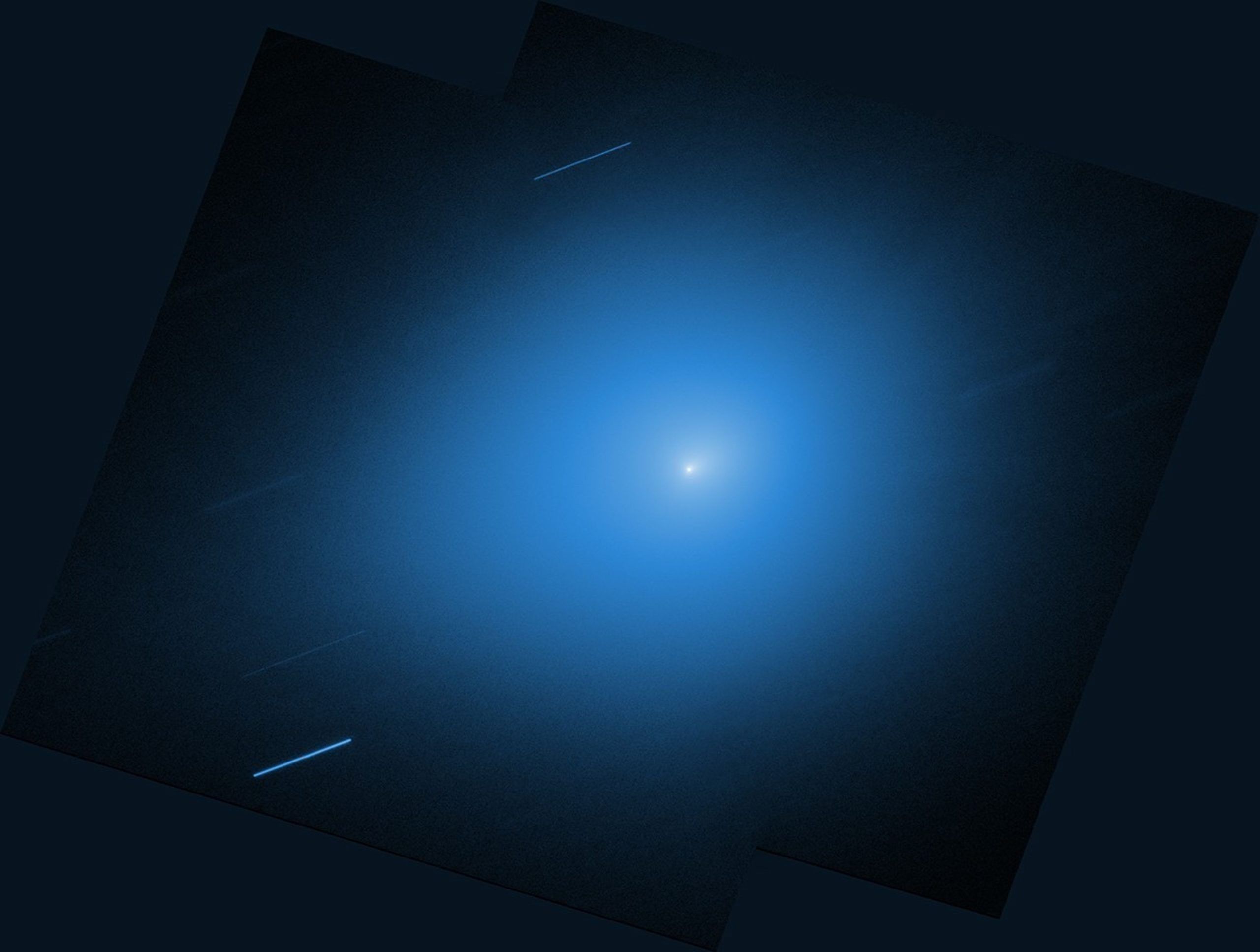
On December 4, NASA released a new Hubble Space Telescope image taken on November 30, when 3I/ATLAS was about 286 million kilometres (178 million miles) from Earth. Hubble used its Wide Field Camera 3 and tracked the comet as it moved, causing background stars to appear as streaks while the comet remained sharp. NASA Science+1
The image shows:
- A bright, compact nucleus enveloped in a glowing coma of dust and gas.
- A distinctly teardrop‑shaped halo that extends toward the Sun, rather than trailing away from it as in ordinary comets. This unusual, sunward feature is called an anti‑tail. Medium+1
Harvard astrophysicist Avi Loeb notes, based on the new Hubble data, that:
- The luminous teardrop‑like coma has a radius of order tens of thousands of kilometres.
- The anti‑tail stretches roughly 60,000 km sunward, consistent with his earlier prediction that a swarm of non‑volatile chunks could have separated from the comet and drifted slightly closer to the Sun. Medium+1
NASA emphasises that the goal of this and earlier July observations is to track how the comet’s activity evolves as it swings around the Sun and fades back into the darkness beyond our planetary neighbourhood. NASA Science+1
Juice’s NavCam teaser: a Jupiter mission grabs a surprise comet portrait
While Hubble watched from Earth orbit, ESA’s Jupiter Icy Moons Explorer (Juice) enjoyed a rare geometric advantage. In November 2025, as Juice cruises toward Jupiter, the spacecraft briefly found itself between the Sun and 3I/ATLAS, about 66 million km from the comet. European Space Agency+2The Times of India+…
ESA reports that:
- Juice used five scientific instruments — JANUS (camera), MAJIS, UVS, SWI and PEP — to observe the comet over multiple sessions in early November, just after its closest approach to the Sun. European Space Agency+1
- Because Juice is currently using its high‑gain antenna as a heat shield during a close solar pass, the spacecraft can only trickle data home via a smaller antenna. Full instrument datasets aren’t expected to arrive until February 18 and 20, 2026. European Space Agency+1
The mission team couldn’t wait. They pulled down just a quarter of a single image from Juice’s Navigation Camera (NavCam) — a camera meant for guidance, not science — and were astonished by what they saw:
- A clearly visible comet with a bright coma.
- A strong plasma tail pointing roughly away from the Sun.
- A fainter, likely dust tail extending at a different angle, consistent with heavier particles curving along the comet’s orbit. European Space Agency+3European Space Agen…
Even this low‑resolution teaser demonstrates how active 3I/ATLAS became just after perihelion — and showcases Juice’s versatility as a multi‑purpose observatory on its way to Jupiter’s icy moons.
Psyche, Mars orbiters and a whole fleet join the chase
3I/ATLAS is now one of the most widely observed objects in Solar System history, with NASA and ESA missions scattered across space turning their instruments toward it. NASA’s dedicated 3I/ATLAS page lists a coordinated timeline that reads like a who’s‑who of spacecraft. NASA Science
Highlights from recent weeks and months:
- Psyche mission (NASA): On September 8–9, the asteroid‑bound Psyche spacecraft used its multispectral imager to track the comet over eight hours from a distance of about 53 million km. These data help refine the comet’s trajectory and probe the structure of its faint coma. NASA Science+1
- Mars orbiters & rovers: ESA’s Mars Express, the ExoMars Trace Gas Orbiter, and NASA’s MRO, MAVEN and Perseverance rover have all contributed observations from Mars orbit and the Martian surface, dramatically tightening constraints on 3I/ATLAS’s path — one ESA analysis estimates an improvement in trajectory precision by roughly a factor of ten. European Space Agency+2Live Science+2
- Solar missions: NASA’s STEREO, ESA/NASA’s SOHO, and NASA’s PUNCH mission have captured the comet’s extended tail using stacked, long‑baseline images, sometimes with 3I/ATLAS “photobombing” observations of other comets like 2025 R2 (SWAN). IFLScience+2NASA Science+2
- Lucy & SPHEREx: On its way to the Trojan asteroids, Lucy spotted 3I/ATLAS in September, while the SPHEREx observatory studied its extended carbon‑dioxide‑rich coma in the infrared. NASA Science+1
Taken together, this multi‑mission campaign is giving scientists an unprecedented, 3D, time‑lapse view of an interstellar comet interacting with the Sun.
Jets, anti‑tails and maybe even “ice volcanoes”
Beyond pretty pictures, the big question is: what is 3I/ATLAS actually doing?
Jets and a persistent sunward anti‑tail
Hubble’s July 21 pre‑perihelion image already hinted at a sunward extension of the coma, rather than a classic tail stretching away from the Sun. Medium+1
New processing of the November 30 Hubble data, along with high‑contrast images from amateur astronomers, reveals:
- At least two distinct jets of material shooting out of the comet.
- A prominent anti‑tail that always seems to point roughly toward the Sun, before and after perihelion.
- An asymmetric coma whose teardrop shape extends tens of thousands of kilometres sunward. Medium+2Medium+2
Loeb interprets this in terms of a swarm of macroscopic fragments — possibly rocks or dust aggregates — that were pushed sunward by non‑gravitational forces (jets, outgassing) near perihelion and now sit slightly closer to the Sun than the main nucleus, reflecting sunlight and creating the anti‑tail. Medium+1
Other astronomers are exploring more conventional explanations involving particle dynamics in the comet’s orbit and viewing geometry. The key point: 3I/ATLAS is behaving differently from typical long‑period comets, and the anti‑tail geometry is one of the most intriguing puzzles to emerge from the new images.
Cryovolcano‑like “ice eruptions”
Ground‑based observations from the Joan Oró Telescope in Spain recently suggested that 3I/ATLAS is erupting with “ice volcanoes” (cryovolcanoes) — jets powered by the rapid sublimation of volatile ices beneath the surface. Live Science+1
Analysis of the evolving coma and jet structure indicates:
- Bursts of gas and dust consistent with internal pockets of carbon dioxide ice being heated and vented.
- Behaviour surprisingly similar to some trans‑Neptunian objects (icy bodies beyond Neptune), despite the comet’s origin around a different star. Live Science+1
If confirmed, that would mean 3I/ATLAS carries primitive materials — including reactive metals and sulfides — comparable to those found in certain carbonaceous meteorites that helped seed early Earth. Live Science
A 16‑hour “heartbeat” — and why scientists still say it’s a comet
Another line of recent research has uncovered a periodic brightness modulation: a subtle “heartbeat” every 16.16 hours.
A peer‑reviewed study in Astronomy & Astrophysics finds that this periodic signal arises naturally from the rotation of 3I/ATLAS’s nucleus, which carries active regions in and out of sunlight. Over about a month of monitoring, the team saw: Diario AS
- Growing dust activity and a red‑tinged coma.
- A steadily expanding, asymmetric halo of material.
- No signs of fragmentation or rapid, irregular outbursts.
The authors conclude that, despite its interstellar origin, 3I/ATLAS behaves like a weakly active outer‑Solar‑System‑type comet, just moving faster and on a hyperbolic orbit. Diario AS
At the more speculative end, Avi Loeb has suggested that the 16‑hour brightness modulation and unusual anti‑tail could, in principle, be consistent with artificial activity, such as controlled jets or accompanying objects, and some media coverage has amplified this into “alien spacecraft” headlines. New York Post+1
However:
- NASA and ESA explicitly classify 3I/ATLAS as a comet, based on its coma, tails, spectral properties and dynamical behaviour. NASA Science+1
- The interstellar‑object Wikipedia summary and broader scientific consensus note that while exotic hypotheses are occasionally floated, there is no credible evidence that 3I/ATLAS is anything other than a natural comet. Wikipedia+1
In short: the “heartbeat” and anti‑tail are real and scientifically fascinating, but current data support a natural explanation involving rotation, jets and dust dynamics.
Where is 3I/ATLAS now, and can you see it?
On December 7, 2025, 3I/ATLAS is:
- Roughly 11.5 magnitude in brightness.
- Located in the constellation Virgo, climbing into higher, darker skies before dawn for many observers. Wikipedia+1
Skywatching guides and observatories forecast that:
- The comet will move from Virgo into Leo during December.
- It will make its closest approach to Earth on December 19, at about 1.8 AU (≈270 million km) — far, but still close enough for decent‑sized amateur telescopes (around 25–30 cm aperture) to capture it as a small, fuzzy patch with a short tail under dark skies. Midland Reporter-Telegram+2NASA Science+2
For most people, the best views will come from professional and spacecraft imagery shared online by NASA, ESA and observatories around the world, rather than through backyard optics.
Why 3I/ATLAS matters far beyond this flyby
3I/ATLAS is scientifically precious for several reasons:
- A sample of another planetary system
Its composition — including possible CO₂‑rich ices, complex organics and irradiated surface layers — offers a direct probe of chemistry around another star billions of years ago. Live Science+2Live Science+2 - A comparison point for ʻOumuamua and Borisov
After the weirdly elongated, tail‑less 1I/ʻOumuamua and the relatively “normal” comet 2I/Borisov, 3I/ATLAS, with its cryovolcanic jets and anti‑tail, expands the diversity of known interstellar objects and helps test models of how such bodies form and evolve. Wikipedia+2Live Science+2 - Planetary defence and impact risk
Researchers note that interstellar comets, while rare, are potential collision hazards that we need to understand and track. Each new object refines our strategies for detection and follow‑up. Live Science+1 - A testbed for multi‑mission coordination
The coordinated campaign by Hubble, JWST, Juice, Psyche, Mars orbiters, SOHO, STEREO, PUNCH, Lucy and others is a showcase of how existing spacecraft can be re‑tasked on short notice to study a transient target of opportunity. IFLScience+3NASA Science+3NASA Science+3
What comes next for 3I/ATLAS
In the coming weeks and months, expect several key developments:
- More space telescope data:
Hubble will continue to monitor 3I/ATLAS as it recedes, and the James Webb Space Telescope is slated to take another detailed look at the comet’s infrared spectrum, searching for specific ices and organics. Live Science+1 - Juice’s high‑value science downlink:
Around February 18–20, 2026, Juice should finally deliver full datasets from JANUS, MAJIS, UVS, SWI and PEP, potentially revealing the gas composition, dust properties and plasma environment around this interstellar visitor in exquisite detail. European Space Agency+1 - Refined models of jets, anti‑tail and rotation:
Combined data from spacecraft and ground‑based observatories will help pin down jet orientations, nucleus spin state, mass loss rates and particle sizes, testing ideas about cryovolcanoes and swarms of fragments. Diario AS+3Medium+3Medium+3 - Continued discussion — and debunking — of exotic claims:
As new images appear, speculative ideas about alien origins will continue to circulate online. Agencies like NASA and ESA are already using 3I/ATLAS as a chance to educate the public on how scientific evidence is weighed and how to distinguish serious research from misleading viral content — a topic Avi Loeb himself has highlighted in the context of AI‑generated fake videos. NASA Science+2Medium+2
For now, the story of 3I/ATLAS is still being written. Over a span of just a few months, humanity has gone from not knowing this object existed to mapping its path, imaging its jets from multiple worlds and spacecraft, and probing its internal ices and rotation. And by the time it leaves our Solar System for good, it will have left behind a treasure trove of data — a time capsule from another star.