Updated December 1, 2025
On Friday, December 19, 2025, an ancient visitor from another star system will make its closest pass to Earth. Interstellar comet 3I/ATLAS will sweep by at a distance of about 170 million miles (270 million kilometers) — nearly twice as far away as the Sun and more than 700 times the distance to the Moon.NASA Science+1
It poses no danger whatsoever, but it does offer a once‑in‑a‑lifetime chance: a front‑row seat to the third confirmed interstellar object in history, after 1I/ʻOumuamua and 2I/Borisov.NASA Science+1
Now through mid‑December is the prime observing window for skywatchers with telescopes and for the global fleet of spacecraft racing to study this rare visitor before it vanishes back into interstellar space.
What Is Comet 3I/ATLAS?
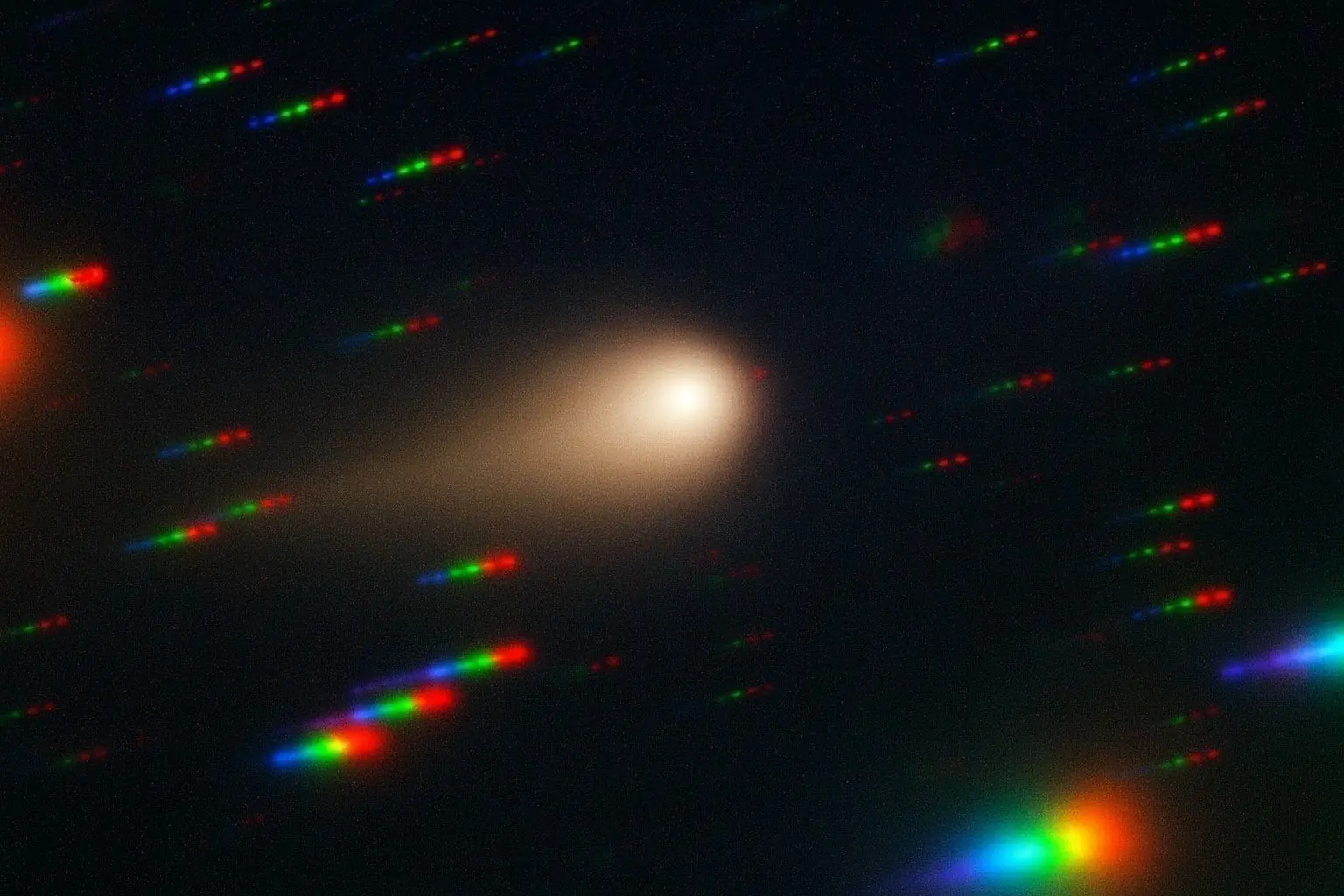
Comet 3I/ATLAS, also cataloged as C/2025 N1 (ATLAS), was discovered on July 1, 2025 by the NASA‑funded Asteroid Terrestrial‑impact Last Alert System (ATLAS) telescope at Río Hurtado, Chile.NASA Science+1
Astronomers quickly realized something extraordinary: its orbit is hyperbolic, meaning it’s moving too fast to be bound to the Sun. When its trajectory is traced backward, it clearly comes from outside our solar system, earning it the “I” designation for interstellar.NASA Science+1
Key facts from NASA and international teams:
- Type: Active interstellar comet, with an icy nucleus surrounded by a glowing coma (cloud of gas and dust) and a tail.NASA Science+1
- Speed: Around 137,000 mph (221,000 km/h) when discovered, accelerating to about 153,000 mph (246,000 km/h) near its closest point to the Sun in late October.NASA Science
- Size: Hubble Space Telescope constraints put the nucleus between roughly 1,400 feet (440 m) and 3.5 miles (5.6 km) across.NASA Science+1
- Composition: Rich in carbon dioxide, with smaller amounts of water, carbon monoxide, cyanide and an unusually high abundance of nickel in its gas.Reuters+1
From the moment of discovery, 3I/ATLAS has been treated as a natural laboratory for studying materials forged around another star, offering an unprecedented view of how planetary systems form and evolve far beyond our own.Space+1
How Close Will 3I/ATLAS Get on December 19?
Although headlines sometimes make it sound dramatic, “close” is purely astronomical here.
On December 19, 2025, 3I/ATLAS will pass Earth at a minimum distance of about:
- 1.8 astronomical units (AU)
- ≈ 170 million miles (270 million km)
around 06:00 UTC, according to orbital solutions from JPL and the Minor Planet Center.NASA Science+2Wikipedia+2
NASA, ESA and independent astronomers all stress that 3I/ATLAS poses no impact risk:
- NASA notes it “won’t come close to Earth at all” by planetary‑defense standards and will stay nearly twice as far away as the Sun.NASA Science+1
- A recent NASA briefing and Space.com analysis reiterated that it will not threaten any planet as it sweeps past the orbits of Mars, Venus and later Jupiter.Reuters+1
In other words: scientifically exciting, but cosmically distant.
Where Did This Interstellar Comet Come From — and How Old Is It?
Dynamical studies show that 3I/ATLAS arrived from the direction of the constellation Sagittarius, near the Milky Way’s galactic center, before diving into our solar system.NASA Science+1
Several teams have traced its motion through the galaxy and concluded that:
- It most likely comes from the Milky Way’s thick disk, a population of old stars orbiting high above and below the galactic plane.heise online+1
- Statistical studies of those stars suggest the comet’s age is somewhere between 7 and 14 billion years, making it older than the 4.6‑billion‑year‑old solar system and potentially the oldest comet ever observed.Wikipedia+1
If those estimates hold up, 3I/ATLAS is a fossil from deep galactic history, preserving chemistry from an era long before the Sun and planets even existed.
A Solar‑System‑Wide Spacecraft Campaign
Because 3I/ATLAS spends much of its journey on the far side of the Sun as seen from Earth, NASA and ESA have turned this into a multi‑mission observing campaign stretching across the solar system.NASA Science+1
Highlights so far:
- Mars fleet views:
- NASA’s Mars Reconnaissance Orbiter (HiRISE) captured one of the closest images of the comet on October 2, from about 19 million miles (30 million km) away.NASA Science+1
- The MAVEN orbiter recorded ultraviolet emissions from hydrogen gas, revealing how solar radiation strips water from the comet.NASA Science+1
- The Perseverance rover even snagged a faint glimpse from the surface of Mars.NASA Science
- Heliophysics missions:
NASA’s STEREO, SOHO and the new PUNCH mission tracked the comet as it passed behind the Sun, capturing its faint coma and tail where ground‑based telescopes could not.NASA Science+1 - Asteroid missions as comet chasers:
The Psyche and Lucy spacecraft took long‑distance images that help refine the comet’s orbit and reveal the structure of its dust coma and tail.NASA Science+1 - ESA’s ExoMars TGO boost:
By combining ExoMars data from Mars orbit with Earth‑based observations, ESA was able to improve predictions of 3I/ATLAS’s position by a factor of 10, an important proof‑of‑concept for future planetary‑defense work.European Space Agency
This coordinated “many eyes on one comet” approach is giving scientists an exceptionally detailed, 3D view of an interstellar object in real time.
What’s New This Week: “Ice Volcanoes” and a Comet With a “Heartbeat”
Cryovolcanoes on an interstellar world?
On December 1, a new preprint highlighted by Live Science reported evidence that 3I/ATLAS may be erupting in “ice volcanoes”, or cryovolcanoes.Live Science
Researchers using the Joan Oró Telescope in Spain found:
- Spiral jets of gas and dust rising from the comet, interpreted as cryovolcanic plumes triggered as sunlight heats buried volatile ices.
- Spectral fingerprints suggesting similarities to trans‑Neptunian objects in our own solar system — distant, icy worlds beyond Neptune — implying that although 3I/ATLAS formed around another star, its building blocks may resemble the outermost material of our own system.Live Science+1
The work has not yet been peer‑reviewed, but it adds to a growing picture of 3I/ATLAS as a complex, geologically active body rather than a simple dirty snowball.
A 16‑hour “heartbeat” in its light
Another recent storyline centers on a regular pulse in the comet’s brightness. A paper in Astronomy & Astrophysicsdescribed a 16.16‑hour periodic modulation in the light from 3I/ATLAS, likely tied to its rotation and to jets switching on and off as different parts of the surface face the Sun.Futurism+1
Coverage from outlets like Futurism and commentary by Harvard astrophysicist Avi Loeb have speculated more boldly, suggesting the pattern might hint at artificial activity.Futurism+1
However:
- The authors of the original study describe 3I/ATLAS as behaving like a weakly active outer‑solar‑system comet, and a rotational explanation fits the data naturally.Futurism+1
- During a widely covered NASA briefing, officials reiterated that no technosignatures or artificial signals have been detected, and that everything observed so far is fully consistent with a natural comet.Reuters+1
In short, the “heartbeat” is real, but the simplest explanation is that we’re watching a spinning, jetting comet, not an alien spacecraft.
How Big Is 3I/ATLAS — Really?
Early media reports sometimes described 3I/ATLAS as up to 7 or even 15 miles wide, but Hubble and other observatories have significantly tightened those estimates.
Current best constraints:
- Minimum size: ~1,400 ft (440 m)
- Maximum size: ~3.5 miles (5.6 km) across the solid nucleus.NASA Science+2AURA Astronomy+2
Because the nucleus is shrouded in a bright coma, even Hubble cannot see it directly; instead, astronomers infer its size from how much light is scattered by dust and gas close to the surface.
JWST and ground‑based spectroscopy show that 3I/ATLAS is:
- Unusually rich in carbon dioxide, with a higher CO₂‑to‑water ratio than typical solar‑system comets.
- Emitting cyanide gas and nickel vapor at levels broadly similar to some local comets, linking it chemically to known comet populations.Space+2Wikipedia+2
If 3I/ATLAS is roughly 1 km across and has a rocky, metal‑rich composition as suggested by some studies, its mass could be on the order of hundreds of millions of tons — a substantial shard of another planetary system.Live Science+1
How and When to See Comet 3I/ATLAS
Will you see it with the naked eye?
No. Even at its brightest, 3I/ATLAS is expected to reach only around magnitude 9–11, far below naked‑eye visibility.Wikipedia+1
Right now (December 1), TheSkyLive and comet observer databases report the comet around magnitude 10, visible only in moderate to large telescopes under dark skies.TheSkyLive
NASA’s FAQ notes that it can be seen with a small telescope, but you’ll still need optical aid — binoculars will struggle unless they’re very large.NASA Science
Where to look in the sky
NASA’s freshly released “What’s Up: December 2025” guide offers clear instructions for the night of closest approach:NASA Science
- Date of closest approach: December 19, 2025
- Time: Best in the early pre‑dawn hours
- Direction: Look east to northeast
- Constellation: The comet will sit just below Regulus, the bright star marking the heart of Leo, the Lion.
As of early December, 3I/ATLAS is moving through the region of the sky around Virgo, gradually shifting toward Leo as the month progresses.TheSkyLive+1
What equipment do you need?
For most observers:
- A telescope with at least a 30 cm (12‑inch) aperture is recommended to see the comet as more than a faint smudge, according to NASA’s observing guidance.NASA Science+1
- Experienced astrophotographers and observatories are capturing detailed views with instruments in the 30–40 cm class and above.
If you don’t own such a telescope:
- Check with local observatories, universities, and astronomy clubs — many are planning public viewing nightsaround December 19.
- The Virtual Telescope Project will host a live online broadcast of 3I/ATLAS at minimum distance starting at 04:00 UTC on December 19, streaming views from professional‑grade telescopes in Italy.The Virtual Telescope Project 2.0
You can also follow the comet’s path in real time via NASA’s “Eyes on the Solar System” interactive simulation, which includes a dedicated 3I/ATLAS mode.NASA Science+1
Don’t Confuse It With the “Other ATLAS” Comet
Adding to the December sky drama, there is (or rather, was) another comet with “ATLAS” in its name: C/2025 K1 (ATLAS). This unrelated comet recently passed close to the Sun and dramatically broke apart, with fragments now visible in the constellation Leo.Live Science+1
Key differences:
- 3I/ATLAS (C/2025 N1) – Interstellar comet, hyperbolic orbit, passing far from Earth on December 19.
- C/2025 K1 (ATLAS) – Ordinary solar‑system comet, now fragmented after perihelion.
If you see references to a “golden ATLAS comet” disintegrating, that’s not 3I/ATLAS. The interstellar comet remains intact and under close watch.
Why 3I/ATLAS Is a Big Deal for Science
3I/ATLAS is exciting not because it’s dangerous, but because it is different:
- Only the third known interstellar object
After ʻOumuamua and 2I/Borisov, 3I/ATLAS is just the third time we’ve seen solid evidence of an object that formed around another star sailing through our neighborhood.NASA Science+1 - A window into ancient star systems
If it truly hails from the Milky Way’s thick disk and is older than the solar system, 3I/ATLAS lets scientists test models of planet formation in environments that existed billions of years before Earth formed.Wikipedia+2heise online+2 - Extreme speed and hyperbolic orbit
Traveling at over 130,000 mph, it’s one of the fastest comets ever observed. Its speed and trajectory encode the gravitational tugs it has experienced from stars and nebulae over cosmic time.esahubble.org+2NASA Science+2 - Chemical surprises
The unusually CO₂‑rich composition and hints of cryovolcanism challenge existing theories of comet chemistry and hint at diverse planetary architectures across the galaxy.Space+1 - A planetary‑defense test case
For agencies like NASA and ESA, 3I/ATLAS is an ideal “drill” — a fast‑moving, faint object whose orbit must be nailed down quickly. The success of techniques like Mars‑based triangulation will feed directly into how we respond to any future object that does come close.European Space Agency+1
What Happens After December 19?
After its closest approach to Earth, 3I/ATLAS will continue outward, passing within about 0.36 AU of Jupiter in March 2026 before leaving the solar system altogether, never to return.Wikipedia+1
Ground‑based observers should be able to follow it with telescopes into spring 2026, though it will gradually fade as sunlight weakens and activity subsides.NASA Science+1
For many scientists, the real work will only be beginning: years of modeling, lab experiments and data analysis aimed at decoding what this ancient shard of another planetary system is trying to tell us.
How to Make the Most of This Interstellar Visitor
If you’d like to experience 3I/ATLAS over the coming weeks:
- Mark your calendar for December 19, 2025 — closest approach and best chance for live online coverage and public telescope nights.
- Plan a pre‑dawn observing session with a local astronomy club, especially if they have 12‑inch or larger telescopes.
- Follow NASA and ESA updates, which are adding new images and analyses from across the solar system almost daily.NASA Science+2Space+2
- Use tools like NASA Eyes on the Solar System and TheSkyLive to track the comet’s position from your location in real time.NASA Science+1
3I/ATLAS is not a harbinger of doom or an alien mothership — it’s something arguably more profound: a message in a bottle from another sun, drifting through our skies for just a few months before disappearing back into the dark.