
Updated: November 9, 2025
What’s new today
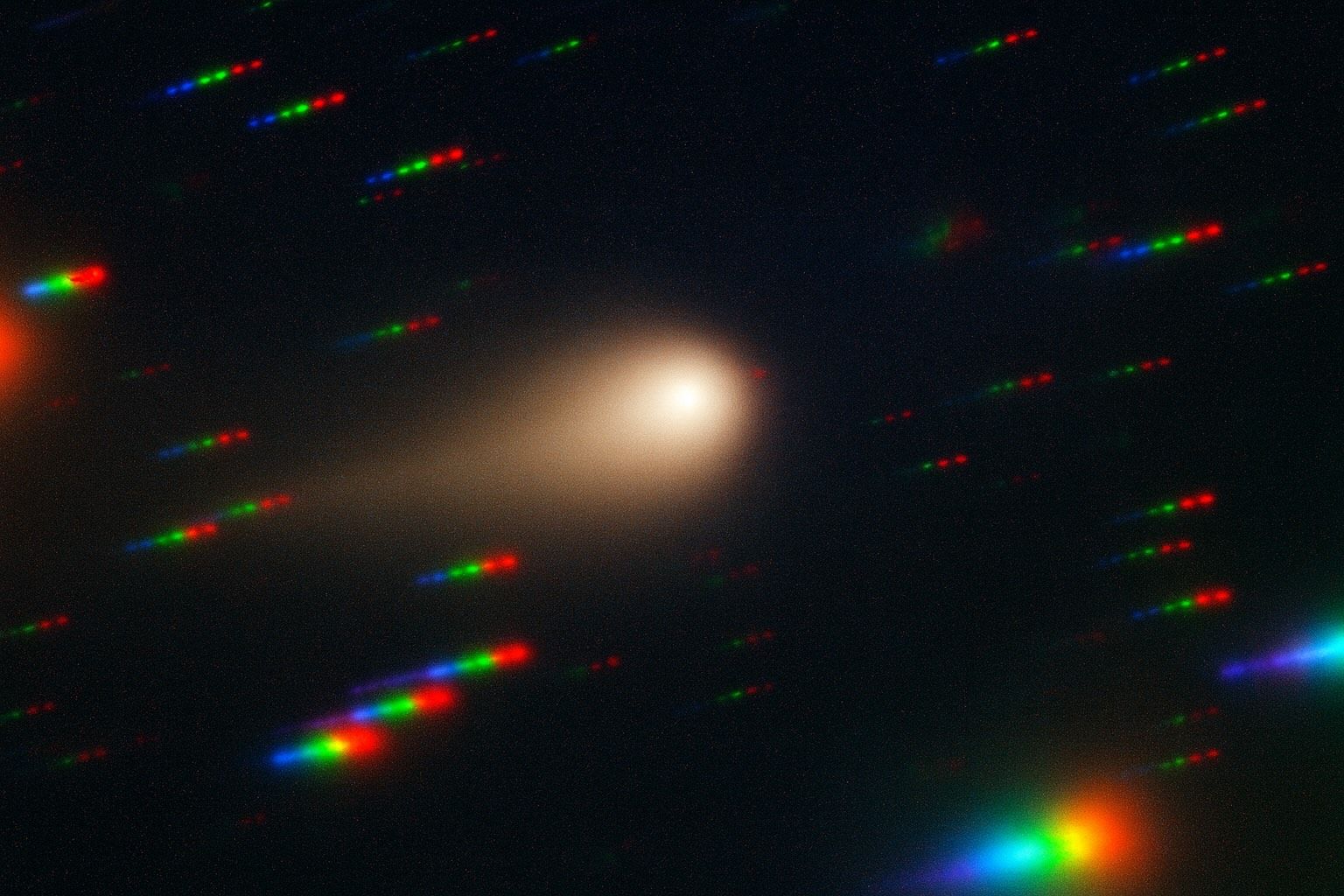
- “Tail or no tail?” A wave of fresh images and reports today revived debate over whether 3I/ATLAS shows a conventional post‑perihelion tail. One widely shared roundup notes images from Nov. 5 that appear tail‑less, even after the comet’s close pass by the sun. www.ndtv.com
- Deep images highlight complex jets. A new analysis posted today highlights a large‑scale jet structure (including sunward anti‑tail features) seen in stacked images captured November 9 (UT) and shared via the British Astronomical Association community. The author argues these structures merit targeted follow‑up with Hubble and JWST. (Interpretation is under active discussion.
- Color‑change claim pushed back. Two days ago, researchers clarified that headlines about 3I/ATLAS “changing color” were misleading; the dominant blue‑green glow is consistent with gas in the coma and increased activity near perihelion. Space
- It’s coming back into view for amateurs. After perihelion on Oct. 30, 3I/ATLAS is re‑emerging into the pre‑dawn sky; observers with backyard scopes are already picking it up, with broader visibility expected to improve around Nov. 11.
Today’s snapshot: why the comet’s look is confusing
Some Nov. 5–9 images show a compact coma with little obvious dust tail, which has fueled social-media claims that 3I/ATLAS is behaving “unlike a comet.” But experts caution that viewing geometry matters: a tail can be foreshortened or lost in glare, and gas emissions can dominate the appearance around perihelion. Two days ago Space.com quoted Lowell Observatory’s Qicheng Zhang: there’s no solid evidence the coma “changed color”; instead, the gas coma is simply contributing more to the comet’s brightness. Meanwhile, a fresh deep stack highlighted today shows multiple jets, including a sunward anti‑tail—a geometry sometimes seen in comets when dust sheets align with our line of sight. In short: images are real, interpretations are still being tested. Space+1
Hard numbers that aren’t in dispute
- It’s interstellar and not a threat. NASA and ESA reiterate that 3I/ATLAS (aka C/2025 N1) is only the third confirmed interstellar visitor after ‘Oumuamua (2017) and 2I/Borisov (2019), and it will stay far from Earth. Closest Earth approach is ~270 million km (Dec. 19, 2025).
- Key dates: perihelion (closest to sun) was Oct. 30, 2025 at ~1.4 AU (~210 million km). It’s now receding and climbing into the morning sky.
- Speed & scale: It’s racing through the inner solar system at ~210,000 km/h (relative to the Sun), typical for a hyperbolic interstellar orbit.
What the telescopes are seeing (and planning)
- From Mars orbit: China’s Tianwen‑1 imaged 3I/ATLAS during the Oct. 3 Mars pass, showing the object as a nucleus embedded in a large coma—an important context check as Earth‑based views were poor near solar conjunction.
- Hubble & JWST: Hubble resolved the coma and hinted at dust plume activity earlier in the apparition; JWST spectra detected abundant CO₂ and other volatiles. These datasets frame today’s images within a picture of a gas‑active comet.
- JUICE (ESA) in November: ESA’s Jupiter Icy Moons Explorer is attempting observations this month; because of spacecraft geometry and data‑rate constraints, downlink is expected later, but the vantage point could be superb for studying jets.
Water story: last month’s “fire‑hydrant” clue
Beyond the visuals, Swift space‑telescope observations reported in mid‑October detected ultraviolet OH—the fingerprint of water—unusually far from the Sun, implying that 3I/ATLAS was already “leaking” water at a healthy clip. That’s a strong, independent line of evidence that we’re looking at a very active, natural comet, not an inert object. (Peer‑reviewed work and preprints are still being digested.) WIRED
How to see 3I/ATLAS this week
- When: Pre‑dawn hours, roughly from around Nov. 11 onward, with some imagers already reporting it in the last few days.
- Where: Low in the eastern sky before sunrise, starting in Virgo and sliding higher each morning. Use updated ephemerides to pinpoint it.
- What you need: It is not a naked‑eye object. Plan on at least a small telescope (8‑inch/20 cm recommended) or a sensitive imaging setup; experienced astrophotographers are stacking short exposures to tease out the coma and any delicate tail features.
Tip: Start with a low‑power eyepiece to sweep the field; look for a slightly “fuzzy star” that doesn’t quite focus like the surrounding field. If you’re imaging, compare frames over 10–15 minutes for motion relative to background stars. Space
About those “alien probe” headlines
Some commentary today and in the past week (including blog essays and tabloid aggregations) speculates that jet geometry or brightness changes could hint at non‑natural origins. Mainstream researchers counter that non‑gravitational forces, foreshortened tails, anti‑tails, and rapid brightening all have cometary explanations, especially for an object imaged near the Sun with tricky geometry. Treat such claims as hypotheses awaiting data.
What’s next
- Amateur–pro coordination: As the comet climbs out of solar glare, coordinated photometry and deep imaging should clarify the tail‑and‑jet morphology over the next 1–2 weeks.
- Spacecraft perspectives: Expect more results from Mars‑spacecraft campaigns (ESA, CNSA) and attempts by JUICE this month; archival datasets may also yield precovery clues.
- December milestone: Closest approach to Earth (still a very safe distance) is due Dec. 19, 2025, a good window for follow‑up spectroscopy and imaging from both hemispheres.
Quick reference (key facts)
- Designation: 3I/ATLAS (C/2025 N1)
- Discovered: July 1, 2025 (ATLAS survey)
- Perihelion: Oct. 30, 2025 (~1.4 AU)
- Closest to Earth: Dec. 19, 2025 (~270 million km)
- Status: Interstellar, hyperbolic trajectory; no hazard to Earth.
Sources & further reading (selected)
- NASA background on 3I/ATLAS (distances, safety) and ESA FAQ (mission observations, schedule).
- Today’s tail/jet discussion: NDTV’s Nov. 9 report collating recent images; new jet‑structure analysis posted today; BAA community activity. (Interpretations in flux.
- Debunk on “color change”: Space.com interview with Q. Zhang (Nov. 7). Space
- Post‑perihelion recovery & how to see it: Space.com how‑to and EarthSky finder guidance.
- Water detection context: WIRED on Swift OH detection (Oct. 14).
- Mars‑orbiter imaging: Space.com on Tianwen‑1’s views from Mars orbit (Nov. 6).
Editor’s note: This article focuses on Nov. 9, 2025 developments and the latest vetted context. Comet science moves quickly; as more calibrated datasets arrive from spacecraft and professional observatories, some interpretations (especially around jets and color) may be refined.




![UK Stock Market Today 29/08/2026 [UPDATE: 08:49 BST] [Weekly Recap + Week Ahead: Midcaps Lead Before Bailey and Gilt Auction]](https://ts2.tech/wp-content/uploads/2026/08/UK-market-dashboard-2026-08-29-0843-480x384.jpg "UK Stock Market Today 29/08/2026 [UPDATE: 08:49 BST] [Weekly Recap + Week Ahead: Midcaps Lead Before Bailey and Gilt Auction]")