
Published: November 16, 2025
Summary (today): A free global livestream will show interstellar comet 3I/ATLAS racing away from the Sun late Sunday, Nov. 16 (11:15 p.m. ET / 04:15 GMT on Nov. 17). ESA just tightened the comet’s trajectory using Mars-orbiter data, and NASA has updated distance/visibility guidance. On the observing side, the comet is a telescope target (~mag 10) low in Virgo before dawn.
What’s happening today (Nov. 16)
- Watch it live: The Virtual Telescope Project is streaming 3I/ATLAS with robotic scopes from Italy tonight at 11:15 p.m. ET (04:15 GMT). Space.com’s viewing alert includes the direct start time and location details for the show.
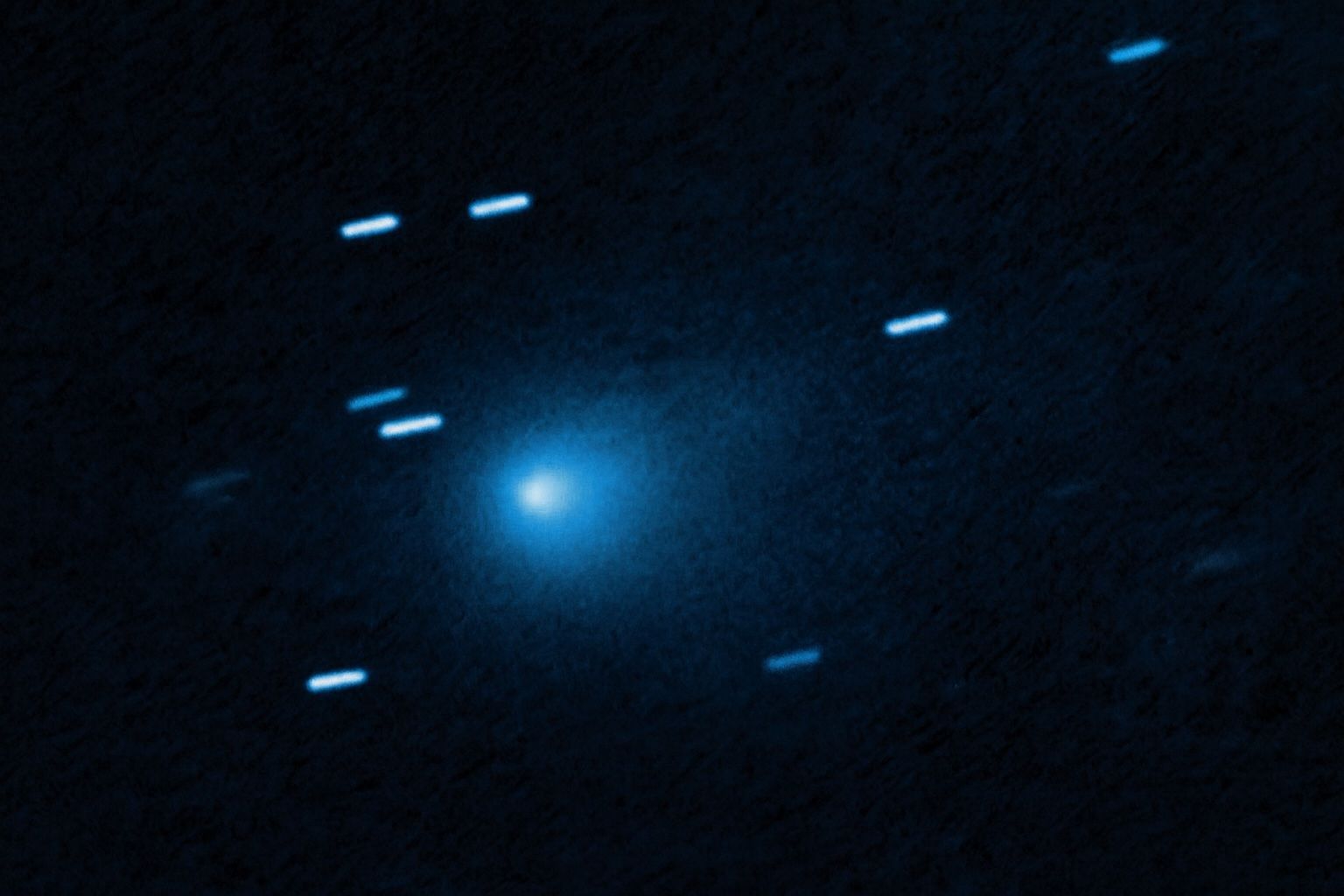
- Where it is and how bright: Aggregated amateur/pro data today place 3I/ATLAS around magnitude ~10 with its field in Virgo—well beyond naked‑eye visibility, but within reach of small to medium telescopes and modest astrophotography rigs. (COBS/TheSkyLive reports mag 9.8 with a visible tail today; expect values to vary by method and sky conditions.
- Safety & distance: NASA reiterates that 3I/ATLAS poses no danger. Its closest approach to Earth will be Dec. 19, 2025, at about 1.8 AU (~170 million miles / 270 million km)—nearly twice Earth’s distance from the Sun.
The latest science headlines you should know
- Trajectory nailed down using Mars: On Nov. 14, the European Space Agency reported a ten‑fold improvement in predicting 3I/ATLAS’s position by triangulating Earth-based data with imaging and astrometry from the ExoMars Trace Gas Orbiter during the comet’s early‑October pass by Mars (~30 million km). That precision helps observatories and missions aim instruments as 3I/ATLAS exits the inner solar system.
- Water confirmed—again, and in surprising ways: Earlier analyses using NASA’s Swift observatory found hydroxyl (OH)—a telltale sign of water—and suggested the comet was releasing water farther from the Sun than expected, perhaps via icy fragments that sublimate in sunlight.
- First radio detections from the interstellar visitor: New coverage this week highlighted MeerKAT radio observations of OH linked to water breakdown in the coma. It’s natural cometary outgassing—not technology—bolstering the consensus that 3I/ATLAS is a normal (if rare) interstellar comet.
- Fresh ground images show the tail growing again: On Nov. 11, the Virtual Telescope Project recorded an increasingly developed ion tail (and an anti‑tail in the changing geometry) as the comet emerged from solar conjunction. Expect the dust/ion structures to keep evolving over the next few weeks.
When and where to look (practical guide)
- Timing: In mid‑November, 3I/ATLAS climbs before dawn. If you have a tracking mount or a small imaging setup, that’s the easiest time to record the faint coma and tail. Space.com’s alert notes it’s newly visible from the ground after rounding the Sun.
- Sky position: Today’s ephemerides place the comet in Virgo (near the star Porrima on some charts), with RA ~12h 48m, Dec ~–3° 37′ and a reported observed magnitude ~9.8 from the Comet Observers Database. Your specific coordinates and altitude will vary by location and time.
- Gear & expectations: Because it’s around 10th magnitude, plan on at least a small telescope (a few inches / ~80–150 mm aperture) or a plate‑solving smart telescope to record it. Long exposures help reveal the tail; visual observers may see only a faint, diffuse “smudge.” (Space.com lists a similar brightness estimate of ~+10–11.) Space
What NASA and ESA say about the trajectory
- Perihelion: 3I/ATLAS passed closest to the Sun around Oct. 30, 2025 at roughly 1.4 AU, just inside Mars’s orbit. It’s now outbound and slowing as expected on its hyperbolic, never‑to‑return path.
- Closest to Earth:Dec. 19, 2025, but still distant at ~1.8 AU—a safe miss by any definition.
- Who’s watching: NASA’s comet page lists an unusual multi‑mission lineup—Hubble, Webb, Swift, TESS, Perseverance, MRO, Curiosity, Parker Solar Probe, PUNCH, and more—plus ESA’s ExoMars and Juice contributing opportunistic looks.
Don’t confuse it with the other “ATLAS” comets in the news
- C/2025 K1 (ATLAS)—a completely different, solar‑system comet discovered by the same survey—fragmented after its Oct. 8 perihelion and has been trending in images and videos this week. That breakup story is not about interstellar 3I/ATLAS.
- Earlier in the year, another ATLAS‑discovered comet (C/2024 G3 [ATLAS]) lit up SOHO images around January; it’s unrelated to 3I/ATLAS.
Fast facts to share (for Google Discover readers)
- What is it? The third confirmed interstellar object (after ’Oumuamua and 2I/Borisov), officially designated 3I/ATLAS = C/2025 N1 (ATLAS) by the Minor Planet Center.
- Size range: NASA estimates the nucleus between ~440 m and 5.6 km across, based on Hubble constraints.
- Speed: Roughly 153,000 mph (246,000 km/h) at perihelion; decelerating outbound as expected.
- Today’s visibility: Around mag 10 in Virgo before dawn; livestream tonight if skies or gear are an issue.
What’s next
- Observing window: As the elongation from the Sun grows through late November into December, more backyard telescopes will have a shot, though it will remain a faint target. Keep an eye on live ephemerides and community reports for magnitude updates.
- Science returns: Expect additional analyses of water and dust activity (Swift/MeerKAT follow‑ups) and refined orbit solutions as spacecraft teams process data. ESA notes Juice is also observing, with results expected in early 2026.
How to watch 3I/ATLAS tonight
- Start time:11:15 p.m. ET Sun, Nov. 16 (04:15 GMT Mon).
- Where: The Virtual Telescope Project YouTube/WebTV feed. If you’re on a phone, cast to a larger screen to see the faint ion tail more easily.
Editor’s note on misinformation
If you’ve seen claims about explosions, alien probes, or “color switches” implying technology, current peer‑reviewed and mission results support natural comet physics (outgassing, geometry‑driven tail changes, and standard nongravitational effects). Recent radio and Swift detections point to water—not Wi‑Fi. Live Science+1
Sources & further reading:
- NASA 3I/ATLAS overview and Facts & FAQs (distances, dates, size, mission list).
- ESA: Ten‑fold trajectory improvement using ExoMars TGO data (Nov. 14).
- Space.com: Tonight’s livestream details and current ground‑based visibility notes.
- Virtual Telescope Project: Live event page and Nov. 11 ion‑tail update.
- TheSkyLive/COBS: Today’s ephemerides, magnitude and sky position.
- Wired and Live Science: Recent science coverage on water/OH detections and Mars‑orbiter views.
- Not the interstellar one: C/2025 K1 (ATLAS) fragmentation coverage for context.