On December 8, 2025, interstellar comet 3I/ATLAS is racing through the inner solar system, past the Sun and on its way to a safe but scientifically thrilling flyby of Earth on December 19. In the last 24–48 hours, new Hubble photos, Mars-orbiter results, and a fresh analysis from a Harvard astrophysicist have pushed this icy visitor back into the headlines. Live Science+2FOX Weather+2
Here’s a deep, news-ready look at what 3I/ATLAS is, what’s new today, and how skywatchers can try to catch it before it disappears back into interstellar space.
What is Comet 3I/ATLAS?
3I/ATLAS — also cataloged as C/2025 N1 (ATLAS) — is the third confirmed interstellar object ever seen passing through our solar system, after 1I/ʻOumuamua (2017) and 2I/Borisov (2019). Wikipedia
Key facts:
- Discovered: 1 July 2025 by the ATLAS survey telescope in Río Hurtado, Chile. Wikipedia
- Origin: Arrived from deep interstellar space in the direction of Sagittarius, near the Milky Way’s galactic center. Wikipedia
- Orbit: Extremely hyperbolic (eccentricity ~6.1), moving too fast to be bound to the Sun, so it will leave the solar system forever. Wikipedia+1
- Speed: Roughly 58 km/s, or about 130,000 mph relative to the Sun — faster than any previously recorded comet visitor. European Space Agency+1
- Size: Early estimates from Mars-orbiter observations suggest the nucleus could be up to ~3.5 miles (≈6 km) across. University of Colorado Boulder
- Age: Studies of its galactic orbit imply it may be several billion years old; some models allow 7.6–14 billion years, likely making it older than our 4.6‑billion‑year‑old solar system (though the upper end brushes against the 13.8‑billion‑year age of the universe, so there are big uncertainties). Wikipedia
Chemically, 3I/ATLAS is anything but boring. Space telescopes including JWST and NASA’s SPHEREx mission have shown a coma dominated by carbon dioxide, along with water, cyanide compounds and nickel — a mix that resembles but is not identical to typical solar-system comets. Wikipedia+2Wikipedia+2
What’s New Today (December 8, 2025)?
Multiple new data releases and articles dropped today or within the last couple of days. Here’s a rundown.
1. PUNCH Tracks 3I/ATLAS Behind the Sun
A new press release from Southwest Research Institute (SwRI) and related coverage today highlight how NASA’s PUNCH mission has been following 3I/ATLAS even when it was hidden behind the Sun from Earth’s point of view. Southwest Research Institute+1
Highlights:
- PUNCH (Polarimeter to Unify the Corona and Heliosphere) is a constellation of four small spacecraft that continuously image the solar corona and inner heliosphere. Southwest Research Institute
- Because it stares so close to the Sun, PUNCH could keep 3I/ATLAS in view for almost two months, including several weeks in October when no ordinary telescope on or near Earth could safely observe it. Southwest Research Institute
- The mission collects roughly one image per minute, letting scientists watch changes in the comet’s tail and its interaction with the solar wind on timescales of minutes to weeks. Southwest Research Institute
- As a polarimeter, PUNCH also measures how light from the tail is polarized, revealing details about dust grain sizes and how material is being stripped off the comet. Southwest Research Institute
Researchers involved in the project describe 3I/ATLAS as the start of “a whole new field of study” of interstellar comets — the kind of bodies that can reveal how planets and possibly life’s building blocks form in other star systems. Southwest Research Institute
2. New Hubble Photos and NASA’s Imaging Campaign
This afternoon, Fox Weather and other outlets showcased fresh Hubble Space Telescope images of 3I/ATLAS, taken on November 30 with the Wide Field Camera 3 instrument. FOX Weather
Key points from today’s coverage and NASA’s summary:
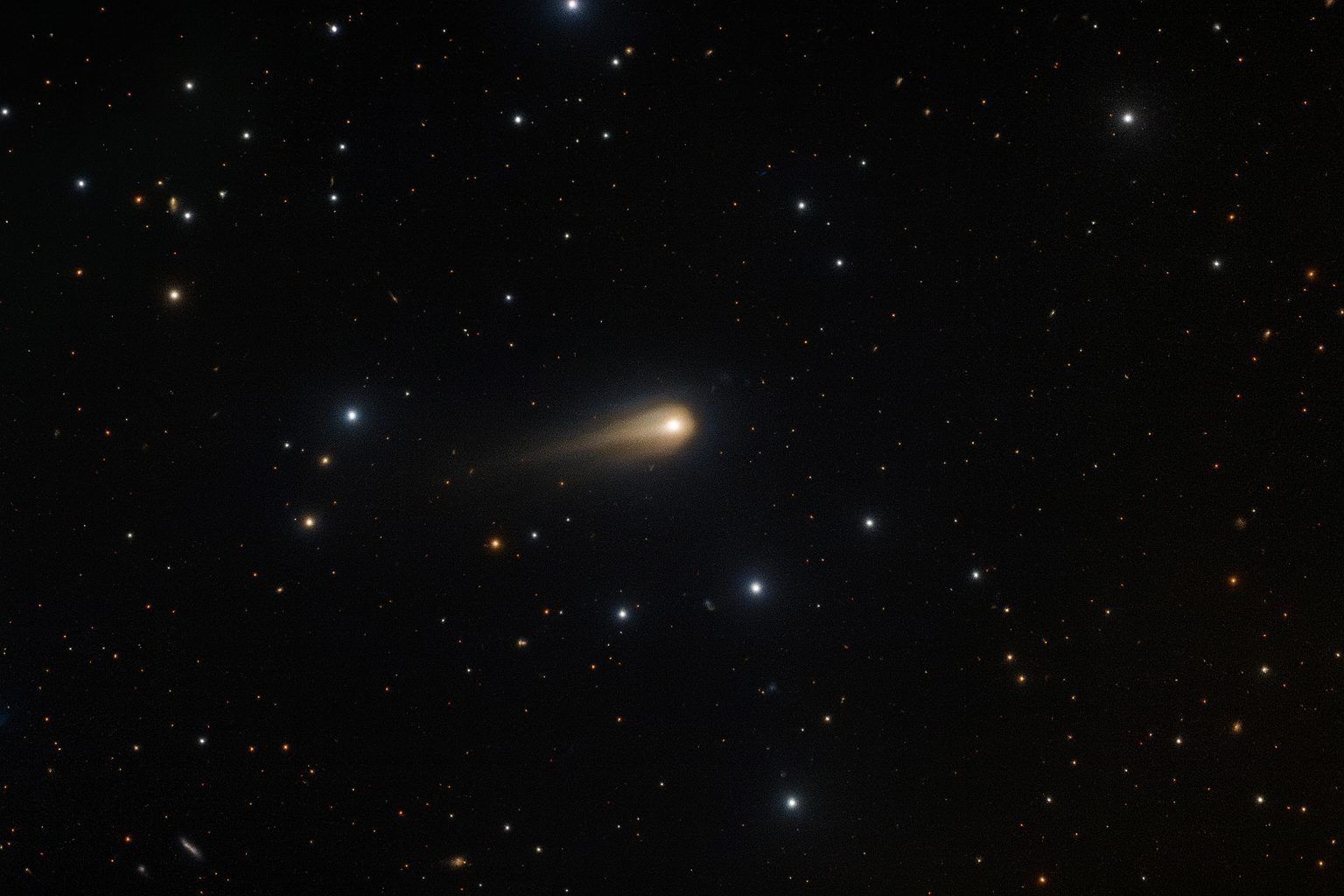
- Hubble recorded the comet about 178 million miles from Earth, with the central nucleus and surrounding coma sharply resolved while background stars appear as streaks due to the comet’s high speed. FOX Weather+1
- NASA emphasises that 3I/ATLAS follows a hyperbolic trajectory, meaning the Sun’s gravity cannot capture it; it truly comes from interstellar space and is just passing through once. FOX Weather+1
- The agency reiterates that the comet will approach no closer than about 170 million miles (1.8 AU) from Earth and poses no threat. FOX Weather+2NASA Science+2
A separate NASA blog post on 3I/ATLAS and the Psyche mission frames these new images as part of a coordinated campaign across many spacecraft to “use all the tools at our disposal” before the comet vanishes back into the dark. NASA Science
3. MAVEN’s View from Mars
Also today, the University of Colorado Boulder detailed how NASA’s MAVEN spacecraft — designed to study Mars’ upper atmosphere — turned its ultraviolet spectrograph toward 3I/ATLAS in September and October. University of Colorado Boulder
From that report:
- MAVEN imaged the comet over 10 days, catching it when it passed about 18.6 million miles from Mars on October 3, while Earth was on the opposite side of the Sun and effectively blind to it. University of Colorado Boulder
- The data show a bright object shrouded in a haze of gas and dust, with emissions revealing hydrogen derived from water streaming off the comet. University of Colorado Boulder
- MAVEN is uniquely placed to measure how fast 3I/ATLAS is losing water into space, giving scientists a direct handle on its activity level. University of Colorado Boulder
- Crucially, mission scientists stress that all of MAVEN’s measurements — size, trajectory, water loss, coma — are entirely consistent with a natural comet, pushing back on claims that it might be artificial. University of Colorado Boulder+1
4. JUICE and ESA: Early Image from a Jupiter-Bound Probe
The European Space Agency’s Juice spacecraft, en route to explore Jupiter’s icy moons, used an observing window in November to take a surprise look at 3I/ATLAS. European Space Agency+1
ESA’s latest update (December 4) explains:
- Juice used five science instruments plus its navigation camera to observe the comet in November 2025, just after perihelion. European Space Agency
- A partial NavCam frame downloaded early shows the comet as a bright haze with hints of two tails: a plasma tail and a fainter dust tail. European Space Agency
- Full science data from Juice — including high‑resolution images and spectroscopy — will not arrive on Earth until February 18 and 20, 2026, because the spacecraft is using its main antenna as a heat shield and downlinking over a slower backup antenna. European Space Agency
The BBC Sky at Night team pulled together these Juice views with images from Swift, PUNCH, SOHO, STEREO‑A, ExoMars and other missions in a “latest images” feature published today, giving the public a one‑stop visual gallery of 3I/ATLAS so far. Sky at Night Magazine
5. The ‘Friendly Visitor or Serial Killer?’ Chemical Debate
Today’s most attention‑grabbing headline may be from the New York Post, which asks whether 3I/ATLAS is a “friendly visitor” or a “serial killer” comet based on its chemistry, citing work by Harvard astrophysicist Avi Loeb. New York Post
According to that coverage:
- New spectra, including data connected to ALMA and space‑based observations, suggest that 3I/ATLAS is unusually rich in methanol (a simple organic molecule) relative to hydrogen cyanide, which is more toxic. New York Post+1
- Loeb argues that this methanol‑heavy profile could make the comet an efficient carrier of life’s building blocks, feeding into long‑standing ideas about panspermia — the possibility that comets help spread prebiotic material between star systems. New York Post+1
- At the same time, he points out the presence of hydrogen sulfide, a gas used in early chemical weapons, and plays with the rhetorical contrast between a benevolent and a “poisonous” interstellar visitor. New York Post
It’s important to stress, as other scientists and even Loeb himself have elsewhere, that the most likely explanation remains entirely natural: 3I/ATLAS looks and behaves like an active comet whose unusual chemistry simply reflects different formation conditions in another planetary system. Wikipedia+2University of Colorado Boulder+…
6. Image Round‑ups: All the Best Views So Far
A Sky at Night article published today compiles images from:
- Hubble (multiple epochs),
- JWST,
- Gemini North and South,
- Swift,
- PUNCH, SOHO and STEREO‑A,
- Mars orbiters like ExoMars and MAVEN,
- and ESA’s Juice. Sky at Night Magazine+1
Together with NASA and ESA galleries, this confirms that 3I/ATLAS has:
- a large, evolving coma,
- a growing dust and plasma tail,
- and an intriguing sun‑facing plume that behaves somewhat differently from tails in typical comets. Wikipedia+2Live Science+2
Where Is 3I/ATLAS Right Now and How Bright Is It?
As of early December:
- 3I/ATLAS passed perihelion (closest to the Sun) on October 29, 2025, at about 1.36 AU from the Sun, between Earth and Mars. Wikipedia+1
- It was behind the Sun from Earth’s perspective for much of late October, which is why space‑based solar observatories and PUNCH were so critical. Wikipedia+1
- By December 6, the comet’s brightness was around magnitude 11.5 and it was located in the constellation Virgo. Wikipedia
- Interactive ephemeris tools now place it on December 8 crossing from Virgo into Leo, moving toward the bright star Regulus, where it will be near its closest approach to Earth on December 19. TheSkyLive+1
A magnitude of ~11.5 means:
- Not visible to the naked eye and very challenging in ordinary binoculars.
- Accessible to moderate and large amateur telescopes under dark skies.
Wikipedia’s observing notes and December skywatching guides suggest at least an 8–12‑inch (20–30 cm) telescope for visual observing, with smaller but sensitive “smart” scopes capturing it via long exposures. Wikipedia+2Midland Reporter-Telegram+2
Practical Skywatching Tips (December 2025)
If you’re writing for or advising observers:
- Best time: Pre‑dawn hours, when Leo is high in the eastern sky. Around December 19, look for the region near Regulus before morning twilight brightens the sky. Midland Reporter-Telegram+1
- Equipment:
- Visual: 20–30 cm (8–12‑inch) telescope or larger, low‑power eyepiece to sweep the area.
- Imaging: Short, stacked exposures with sensitive cameras or smart scopes can reveal the coma and tail even if visual detection is marginal. Wikipedia+1
- Safety: The comet is now comfortably separated from the Sun in the pre‑dawn sky, but observers should neverpoint optics close to the horizon near sunrise without care.
Remember, even at “closest approach” on December 19, 3I/ATLAS will still be around 1.8 AU (≈170 million miles)away — nearly twice the Earth–Sun distance. It is spectacular scientifically, but visually it will remain a subtle, telescopic object. Wikipedia+2NASA Science+2
Is 3I/ATLAS Dangerous?
Short answer: No.
NASA’s official 3I/ATLAS page states that the comet “poses no threat to Earth”, with the closest approach at about 1.8 astronomical units on December 19. NASA Science+1
While today’s headlines play up metaphors like “serial killer” to discuss its mix of life‑friendly and poisonous chemicals, the actual hazard is effectively zero:
- Its orbit never brings it remotely close to Earth’s path. Wikipedia+1
- The dust and gas it sheds are incredibly diffuse by the time they fan out through the inner solar system.
- There is no credible evidence that 3I/ATLAS is an artificial object, and extensive observations from Hubble, JWST, MAVEN and others all show normal cometary behaviour. University of Colorado Boulder+2Wikipedia+…
For Google News and Discover readers, it’s worth being explicit: 3I/ATLAS is scientifically exciting, not a doomsday threat.
Why 3I/ATLAS Matters So Much to Scientists
3I/ATLAS is scientifically golden for several reasons.
A Rare Interstellar Sample
Only three confirmed interstellar objects have ever been seen darting through our solar system. Each one offers a direct sample of material from another planetary system:
- 1I/ʻOumuamua was weirdly non‑cometary and sparked intense debate.
- 2I/Borisov looked much more like a “normal” comet.
- 3I/ATLAS is both chemically distinctive (CO₂‑rich, unusual CO₂/H₂O and methanol/HCN ratios) and exceptionally fast, making it an important data point in between. Wikipedia+2Wikipedia+2
A Possible Relic of the Galactic Thick Disk
Dynamical studies suggest 3I/ATLAS may belong to the Milky Way’s thick disk, a population of older, more metal‑poor stars whose planets and comets formed with different chemical recipes than our own. Wikipedia
If that’s right, this comet:
- likely formed far from its parent star, beyond the CO₂ frost line in a cold protoplanetary disk,
- was later slung into interstellar space by interactions with a giant planet or passing star,
- and has spent billions of years wandering the galaxy before dropping into our neighbourhood. Wikipedia+1
Testing Ideas About Panspermia and Planet Formation
The combination of:
- CO₂‑dominated gas,
- water ice,
- organic molecules like methanol,
- and trace cyanide and heavy metals Wikipedia+1
gives researchers a real‑world laboratory for questions like:
- How similar are comets from other stars to those in our own solar system?
- Could interstellar comets transport prebiotic material — or even hardy spores — between planetary systems?
- Do comets from older, metal‑poor stars carry a different mixture of ices and organics than those born around Sun‑like stars?
Today’s “friendly visitor vs serial killer” headlines are essentially public‑facing shorthand for these deeper scientific debates about whether comets in general are life‑givers, life‑threats, or both depending on context. New York Post+2Wikipedia+2
Key Dates to Watch
For an ongoing news timeline or explainer box, these are the main dates around 3I/ATLAS:
- July 1, 2025 – Discovery by ATLAS survey; later confirmed as the third interstellar object. Wikipedia+1
- October 3, 2025 – Close pass by Mars; MAVEN and other Mars orbiters image the comet. University of Colorado Boulder+1
- October 21, 2025 – Solar conjunction; 3I/ATLAS passes behind the Sun as seen from Earth. Wikipedia
- October 29, 2025 – Perihelion (closest to the Sun) at ~1.36 AU. Wikipedia
- November 2–4, 2025 – ESA’s Juice spacecraft captures NavCam images and science data from about 66 million km away. European Space Agency+1
- Late November 2025 – New Hubble images and ground‑based pictures reveal complex jets and an unusual sunward plume structure. Medium+1
- December 3, 2025 – NASA highlights Psyche and other missions tracking the comet. NASA Science
- December 5–6, 2025 – Hubble revisits 3I/ATLAS; NASA and ESA release new images; Livescience runs a detailed article on the comet’s increasing activity. Astrobiology+2Live Science+2
- December 8, 2025 (today) – SwRI/PUNCH press release; Fox Weather’s Hubble photo feature; CU Boulder’s MAVEN article; “latest images” round‑ups; and Avi Loeb’s “friendly visitor or serial killer” media splash. New York Post+4Southwest Research Institut…
- December 13–14, 2025 – Geminid meteor shower peak; 3I/ATLAS is a faint bonus target in the same season of skywatching. Midland Reporter-Telegram
- December 19, 2025 – Closest approach to Earth at about 170 million miles (1.8 AU), in Leo near Regulus. Live Science+2Wikipedia+2
- February 18 & 20, 2026 – Expected downlink of Juice’s full science dataset on 3I/ATLAS. European Space Agency+1
Bottom Line
On December 8, 2025, comet 3I/ATLAS is:
- a faint, telescopic speck in the constellations Virgo/Leo,
- a rich target for a whole fleet of spacecraft from Mars to Jupiter,
- the subject of fresh Hubble and MAVEN images,
- the focus of a new PUNCH tracking campaign,
- and the center of a lively (sometimes sensational) conversation about whether interstellar comets are life-bringers, life‑threats, or both.