New York, June 14, 2026, 15:03 ET
- IREN ended the day Friday at $59.77, rising 5.40% on the session. After hours, the stock changed hands at $60.39.
- Investors are now arguing over how quickly IREN can move big AI-cloud deals and recent GPU financing into real revenue.
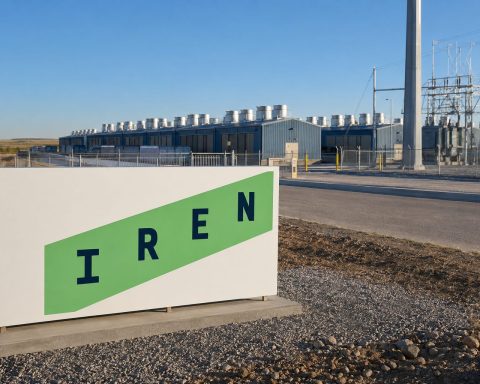
- What’s next is execution — shipping GPUs, bringing them online and logging AI Cloud revenue out of Childress and other locations.
IREN Limited jumped in U.S. trading, finishing up 5.40% at $59.77. The move added $3.06 for the day on volume of roughly 45.5 million shares. The Nasdaq-listed AI infrastructure stock kept climbing in after-hours, last at $60.39. IREN, once focused on Bitcoin mining, is still drawing attention as these firms try to pivot into AI data centers.
IREN’s price move is drawing attention as the market is starting to value the company more for what it does in AI cloud than for its Bitcoin mining business. On June 1, IREN closed a $3.65 billion investment-grade GPU financing facility to back its Microsoft AI Cloud contract. Investment-grade here means the debt is seen as lower risk. IREN said this facility, combined with customer prepayments, covers about 96% of the total $5.81 billion in GPU capital spending planned for Microsoft, with a 3.31% average financing cost. “The financing broadens our access to institutional capital and lowers our cost of capital as we scale,” co-founder and co-CEO Daniel Roberts said. GlobeNewswire
Funding is at the center of the bull case here. IREN has a Microsoft deal worth about $9.7 billion over five years for GPU cloud services. The contract will use Nvidia GB300 GPUs, to be rolled out in phases at the Childress, Texas site through 2026. A GPU is a graphics processing unit—these chips handle parallel calculations, supporting machine learning and other AI-heavy compute. IREN also has a five-year $3.4 billion AI infrastructure cloud services deal with Nvidia, with Blackwell systems set for roughly 60MW of existing Childress data center space.
Needham’s John Todaro kept a Hold rating on IREN, per TipRanks, after cutting revenue estimates for fiscal 2026 and 2027. Todaro doesn’t see IREN hitting its $3.7 billion ARR goal until Q1 of fiscal 2027, pushing it out from the end of fiscal 2026. ARR is annualized recurring revenue from contracts or ongoing services. TipRanks The bear case is that deals and contract headlines have not yet turned into recognized revenue. IREN’s Q3 FY26 update showed the shift in business. Revenue dropped to $144.8 million from $184.7 million in Q2. Net loss got bigger at $247.8 million after some mining hardware was shut down ahead of GPU installation and billing.
The index angle matters for IREN, but it’s less important than execution. TipRanks said Friday that CoreWeave and Nebius were getting a boost from being added to the Nasdaq-100, while IREN already picked up visibility with its addition to the Russell 3000 and MSCI USA indices. Index inclusion can push up institutional ownership since passive and benchmark-driven funds may have to buy in, but it doesn’t replace the hard work of proving utilization, margins, or customer delivery.
Bullish arguments are tied to scale, power supply and having customers locked in. IREN says its 2026 push to 480MW is still set, and all operational capacity so far is fully contracted. The company reported $3.1 billion ARR under contract, and aims to reach $3.7 billion ARR by the end of 2026. IREN also signed a $1.6 billion deal with Dell for air-cooled Blackwell systems, expected to be commissioned in early 2027. After those systems go live, IREN is targeting a jump in ARR from $3.7 billion up to $4.4 billion.
IREN is trading at levels that look risky rather than outright cheap, despite bullish analyst calls. According to StockAnalysis, 15 analysts rate the stock a Buy with a $81.07 average 12-month target, about 35.6% above its closing price on Friday. But the stock’s price-to-earnings ratio is around 110, so the market is valuing shares at roughly 110 times current earnings. StockAnalysis The next thing to watch is not another financing deal. It’s whether Microsoft and Nvidia GPU deployments actually go live and start showing up in reported AI Cloud revenue. Delays, high capex, and exposure to Bitcoin are still major risks here.
Related articles: NASDAQ:IREN