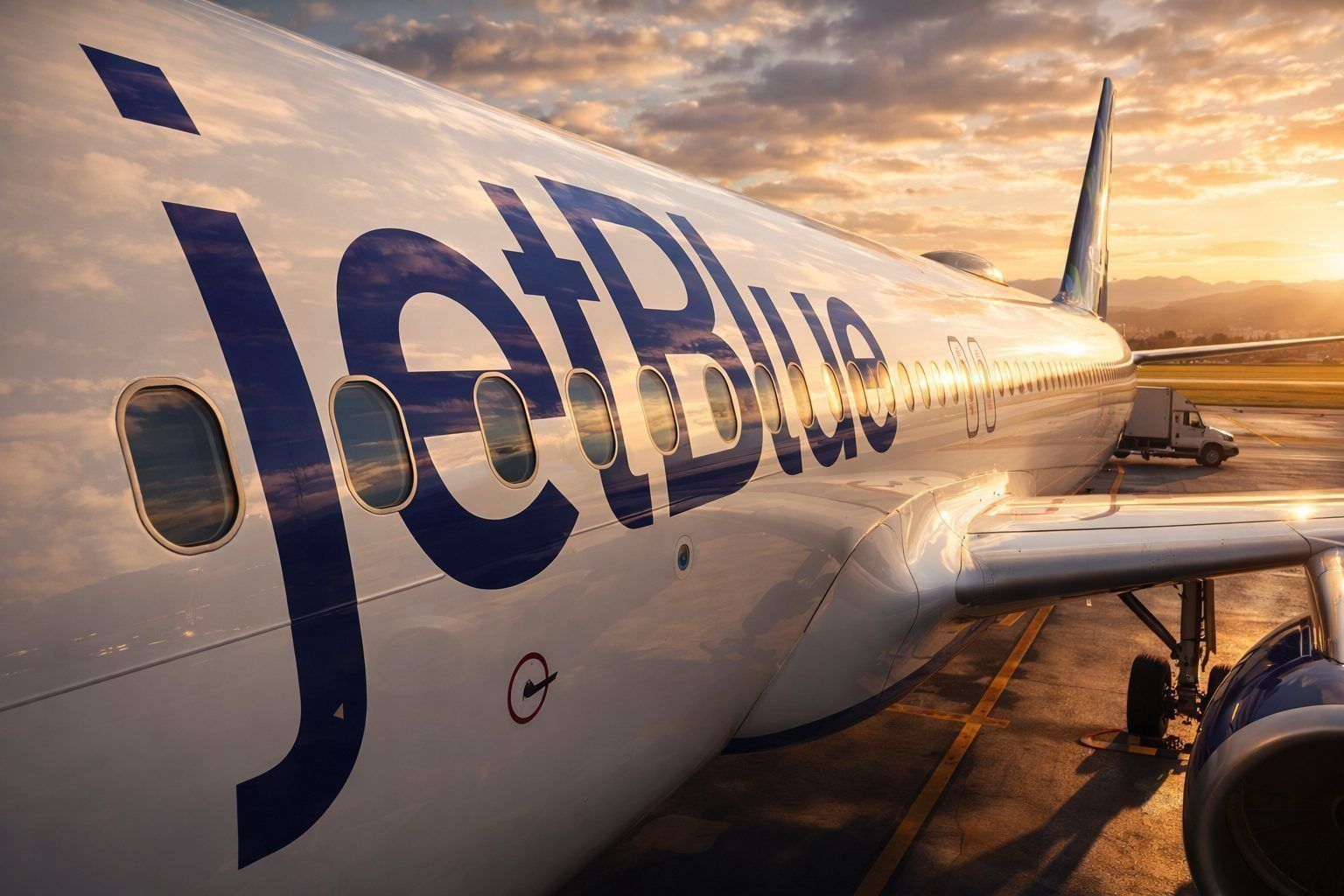

(SEO): JetBlue Airways NASDAQ:JBLU is back in the spotlight on Dec. 12, 2025 as investors weigh aircraft-recall policy changes, JetBlue’s Q4 capacity update, a premium-lounge launch at JFK, and the latest analyst price targets.
NEW YORK — JetBlue Airways Corporation NASDAQ:JBLU ends 2025 with a familiar mix of catalysts: operational disruption headlines tied to Airbus’s A320-family software action, renewed scrutiny on what airlines owe passengers during recall-driven delays, and a steady drumbeat of “JetForward” strategic milestones aimed at rebuilding margins.
On Friday, December 12, 2025 , JetBlue shares traded around $4.86 in the latest market snapshot, leaving the stock still deep in “turnaround” territory after a turbulent year for US leisure-focused carriers.
Below is what’s moving JetBlue stock now, what management has said about near-term performance, and how current forecasts frame the bull and bear cases heading into 2026.
JBLU stock snapshot: where JetBlue shares stand today
JetBlue stock is trading in the mid-$4 range after a volatile week that included strong volume and sharp day-to-day swings.
A key reference point for investors is Thursday’s close (Dec. 11, 2025): $4.89 , when JBLU fell 2.78% and snapped a four-day winning streak. Trading volume was elevated at 30.9 million shares , well above its recent average, and the stock remained about 41% below its 52-week high of $8.31 .
That “high volume + low price” setup often signals a market trying to reprice risk: investors aren’t just debating demand—they’re debating execution, reliability, and balance-sheet resilience.
The biggest headline risk: Airbus A320-family software action and what it means for JetBlue
JetBlue’s fleet profile makes Airbus-related events especially stock-relevant: JetBlue operates an all-Airbus mainline fleet , so A320-family operational issues can land more directly on its network compared with carriers that have mixed Boeing/Airbus exposure.
What happened
Airbus issued a major fleet action affecting around 6,000 A320-family aircraft , after analysis of a recent event indicated intense solar radiation could corrupt flight-control-critical data.
The incident that focused attention included a JetBlue flight that suffered a sudden altitude event earlier this fall, with reports of passenger injuries—sparking regulators and operators to move quickly.
What JetBlue told investors
JetBlue it disclosed completed the required software updates on its A320 and A321 fleet and resumed normal operations , but flagged that the episode reduced expected fourth-quarter ASM (available seat miles) growth by about 0.25% .
In plain English: even a “quick” fix can still dent capacity and nudge unit costs higher if it forces cancellations, schedule adjustments, or short-notice maintenance coordination.
Why markets care
For a career working to rebuild profitability, the fear isn’t only the immediate disruption—it’s the possibility of repeat operational shocks that interrupt momentum in premium revenue, loyalty engagement, and cost execution.
New today: DOT guidance shifts the “who pays?” debate after recall disruptions
One of the most consequential developments dated Dec. 12, 2025 isn’t a route launch or an earnings preview—it’s policy.
The US Department of Transportation issued guidance indicating airlines are not required to cover passenger expenses such as meals or hotels when delays/cancellations are caused by aircraft recalls , framing those events as outside airline control (even though refunds still apply for cancellations under US rules).
Why this matters for JetBlue stock
For investors, this cuts two ways:
- Potential cost containment: If a recall triggers disruptions, the guidance reduces the chance airlines are obliged to provide compensation beyond refunds—limiting variable costs at the worst possible moment.
- Brand and customer-experience risk: JetBlue’s brand equity has historically leaned on customer-friendly service. If the industry shifts toward “refund only” behavior in recall scenarios, airlines may face reputational blowback—even if compliant.
The key takeaway: policy can reduce financial exposure while still increasing competitive pressure to voluntarily do more than the minimum.
JetBlue’s premium push accelerates: “BlueHouse” lounge opens at JFK next week
JetBlue’s most investor-relevant company announcement this week is its move into airport lounges—an important strategic signal that it’s leaning harder into premium travelers and loyalty monetization.
JetBlue says its first-ever airport lounge, “BlueHouse,” will open at 5 am ET on Dec. 18, 2025 in JFK Terminal 5 , spanning 9,000 square feet across two floors .JetBlue Investor Relations
Access is positioned as a loyalty-and-premium benefit (not a mass-market lounge), with complimentary entry for Mosaic 4 members , JetBlue Premier Cardmembers , and transatlantic Mint customers , plus plans for paid access pathways beginning in 2026.
Investor angle: why a lounge can move a stock
Lounges are expensive to build and operate, but they can materially support:
- Higher-yield customer retention (premium leisure + some business demand),
- Ancillary income (credit card economics, elite tiers, paid access),
- Network defensibility in fortress markets like JFK/BOS.
JetBlue explicitly frames BlueHouse as part of its JetForward strategy and notes a broader terminal refresh and upcoming premium product plans, including a domestic first-class cabin rollout next year.
Network expansion remains a near-term growth lever
JetBlue continues to add leisure-tilted flying where it believes it has structural strength—especially Florida.
On Dec. 11, 2025 , JetBlue launched new daily service to Vero Beach (VRB) from JFK and Boston , positioning it as another step in expanding its Florida network and strengthening its Northeast–Florida footprint.
Management also pointed to additional Florida growth ahead, including a new Florida destination debuting in March 2026 (Destin-Fort Walton Beach).
For the stock, these moves matter less as standalone routes and more as proof that JetBlue is still shaping its network around:
- higher-demand leisure flows,
- focus cities like Fort Lauderdale,
- premium cabin “Mint” deployment where yields justify it.
The Q4 2025 reality check: disruptions hit capacity growth
Even with demand described as “healthy,” JetBlue has acknowledged multiple disruptions that pressured fourth-quarter performance.
In regulatory disclosure and reporting around early December, JetBlue said:
- FAA-related disruptions tied to a government shutdown period affected operations,
- Hurricane Melissa in Jamaica added impact,
- combined events reduced Q4 ASM growth by about one point , with a knock-on effect to non-fuel unit costs.
This is the core tension in the JetBlue story: demand can be OK, but irregular operations can still erase margin progress.
Earnings context: what JetBlue delivered in Q3 and what it’s targeting longer term
JetBlue’s most recent quarter (Q3 2025) reinforced the “premium helps, costs hurt” narrative.
Reuters reported JetBlue posted a smaller-than-expected loss in Q3 2025, helped by premium travel demand and cost-control efforts, while still facing headwinds from high costs and aircraft issues.
JetBlue’s own Q3 release emphasized improved execution against guidance ranges and reiterated that its JetForward plan was on track to deliver $290 million of incremental EBIT per year-end .
Looking further out, JetBlue has pointed to an ambition of reaching an operating profit of $800 million to $900 million by the end of 2027 , according to Reuters’ Q3 coverage—an explicit “north star” for the turnaround debate.Reuters
Wall Street forecasts: price targets remain cautious and widely dispersed
Analyst sentiment on JBLU remains mixed, and the dispersion in price targets tells the story: investors disagree on whether JetBlue is “cheap for a reason” or “cheap with a catalyst.”
- A Nasdaq summary citing Fintel data said Morgan Stanley maintained an Equal-Weight rating (Dec. 8) and showed an average one-year price target around $4.48 , with a range from $3.03 to $8.40 (dataset-dependent).
- Another widely followed tracker reported Morgan Stanley cut its target from $8 to $7 while keeping an “equal weight” stance.MarketBeat
How to interpret this range
The low end reflects fears that:
- Cost inflation persists.
- operational disruptions recur,
- debt and refinancing risk grows,
- industry pricing softens.
The high end assumes:
- JetForward drives a sustainable margin step-up,
- premium and loyalty monetization improves,
- disruptions fade and reliability strengthens,
- JetBlue’s partnerships and network re-optimization lift revenue quality.
Balance sheet and credit: still a major overhang for a turnaround stock
Credit markets continue to frame JetBlue as a higher-risk airline credit relative to major network peers. Fitch downgraded JetBlue to ‘B-‘ earlier in 2025 with a Negative Outlook , citing delayed profitability initiatives and weaker demand dynamics.
While equity investors can benefit from operating leverage in a recovery, debt and refinancing needs can cap upside if interest expense and covenant flexibility become binding constraints.
Labor: a new unionization push adds uncertainty to the cost outlook
JetBlue faces a potentially meaningful labor development: Reuters reported that about 3,000 JetBlue ground workers are seeking to hold a union representation vote , driven by concerns including wages, safety, and working conditions.
For investors, labor catalysts typically matter in three ways:
- unit cost trajectory ,
- operational reliability ,
- negotiation risk (timing and headline sensitivity).
The bull case vs. bear case for JetBlue stock into 2026
The bull case: why JBLU could surprise to the upside
- Premium ecosystem buildout is real: The BlueHouse lounge, premium credit card tie-ins, and JetForward milestones point to a structural shift toward higher-value customers.
- Operational disruptions may normalize: JetBlue has already completed the A320-family software updates and resumed normal operations after the recall action.
- Partnership leverage: JetBlue’s “Blue Sky” collaboration with United expands earn-and-redeem access across networks—potentially improving loyalty utility and customer stickiness over time.Reuters+ 1
The bear case: why JBLU could stay depressed (or re-test lows)
- Disruption risk remains a pattern: Q4 ASM growth took hits from multiple events (FAA-related issues, storm disruptions, aircraft actions).
- Credit and refinancing constraints: A lower-rated credit profile can limit strategic flexibility and weigh on equity valuation.
- Labor and cost uncertainty: A union drive among ground workers could increase costs and elevate execution risk if negotiations become contentious.
3 things investors are watching next for JBLU
- BlueHouse opening (Dec. 18) and premium uptake: Investors will look for evidence that premium initiatives translate into loyalty engagement and higher ancillary revenue—not just higher costs.
- Any follow-on impact from Airbus A320-family actions: Even after fixes, markets will track whether there’s laundry operational or financial fallout for JetBlue’s all-Airbus fleet.
- Next guidance reset into 2026: With management targeting a multi-year profitability ramp, the next earnings cycle becomes a key “trust event” for whether JetForward is compounding as promised.Reuters+ 1
Related articles: EPA:AIR









![Australia Stock Market Today 28/08/2026 [UPDATE: 13:36 AEST] [Banks and BHP Lift ASX as WAM, PEXA Sink 18%]](https://ts2.tech/wp-content/uploads/2026/08/AU-market-dashboard-2026-08-28-1334-480x384.jpg "Australia Stock Market Today 28/08/2026 [UPDATE: 13:36 AEST] [Banks and BHP Lift ASX as WAM, PEXA Sink 18%]")