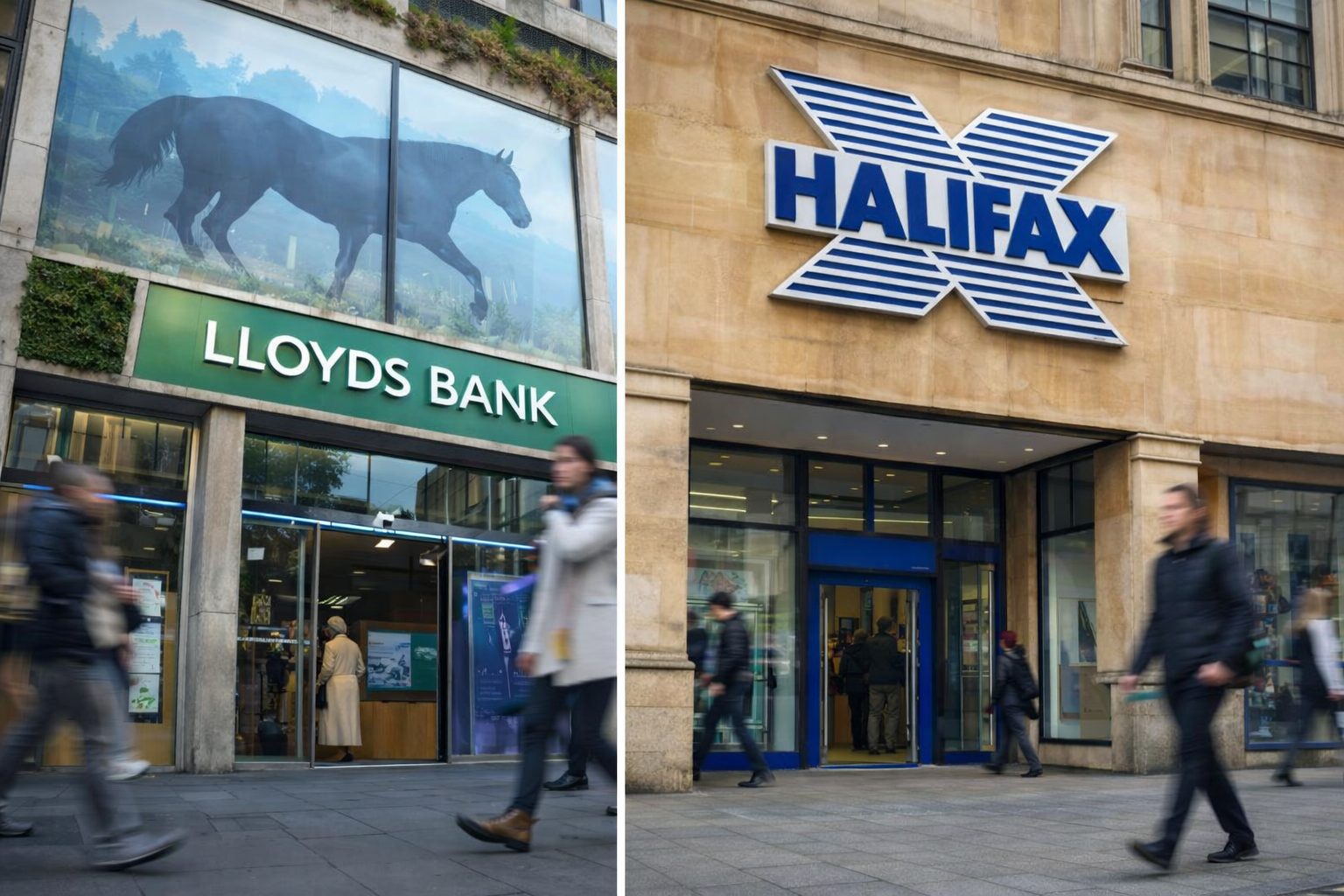

Dozens of Lloyds Bank and Halifax branches are set to close across the UK in 2026, as Lloyds Banking Group continues to reshape its high-street footprint amid a long-term shift toward digital banking.
A widely shared closure schedule lists 55 sites earmarked to shut next year — 40 Lloyds Bank branches and 15 Halifax branches — with closures starting in January 2026 and further dates running into October 2026.
Alongside the closure timetable, both banks publish branch-specific “Closing Branch Review” documents and guidance on alternatives such as nearby branches, Post Offices, and planned Banking Hubs. Lloyds Bank+1
Below is the full list of closures and dates, followed by what the changes mean for communities, what replacement services may be offered, and practical steps customers can take.
Full list: Lloyds Bank branch closures in 2026 (40 sites)
January 2026
- Gillingham (Dorset) — January 8, 2026
- Mitcham — January 8, 2026
- Totnes — January 8, 2026
- Ammanford — January 12, 2026
- Bideford — January 13, 2026
- Fleet — January 13, 2026
- Chester-le-Street — January 14, 2026
- Ivybridge — January 14, 2026
- New Addington — January 14, 2026
- Alfreton — January 19, 2026
- Havant — January 19, 2026
- Lewes — January 19, 2026
- Swadlincote — January 20, 2026
- Penzance — January 21, 2026
- Petersfield — January 21, 2026
- Southampton Hedge End — January 21, 2026
- Hedon — January 28, 2026 GB News+1
February 2026
- Thornbury (Avon) — February 26, 2026 GB News
March 2026
- Leominster — March 3, 2026
- Peterlee Yoden Way — March 3, 2026
- Hucknall — March 4, 2026
- Brigg — March 5, 2026
- Caterham — March 5, 2026
- Falmouth — March 5, 2026
- Glossop — March 9, 2026
- Tunstall — March 9, 2026
- Houghton-le-Spring — March 10, 2026
- Manchester Moston — March 11, 2026
- Seaton — March 11, 2026
- Sleaford — March 12, 2026
- Wymondham — March 12, 2026
- Okehampton — March 25, 2026 GB News+1
October 2026
- Camborne — October 7, 2026
- Chepstow — October 7, 2026
- Ryde — October 7, 2026
- Deal — October 8, 2026
- Harborne — October 8, 2026
- Gorseinon — October 12, 2026
- Southampton Totton — October 12, 2026
- Stamford — October 13, 2026 GB News+1
Full list: Halifax branch closures in 2026 (15 sites)
- Middleton — January 8, 2026
- Yeovil — January 12, 2026
- Havant — January 15, 2026
- Wandsworth (London) — January 15, 2026
- Seaford — January 19, 2026
- Deal — January 22, 2026
- Hastings — January 22, 2026
- Skipton — January 26, 2026
- Horsforth — February 24, 2026
- Birmingham Bearwood — March 2, 2026
- Peterlee — March 3, 2026
- Nelson — March 4, 2026
- Sleaford — March 12, 2026
- Camborne — October 7, 2026
- Buxton — October 13, 2026 GB News+1
Where to verify your branch and read the closure rationale
Both brands maintain an official “branch closures” page that lists impacted branches alphabetically and links to two review documents for each closure:
- Part 1: explains the decision and includes local data and alternatives
- Part 2: summarises feedback gathered from the community, typically published closer to the closure date Lloyds Bank+1
Those documents can include details such as the nearest alternative branch, local Post Office options, cash machine alternatives, and whether a Banking Hub or Community Banker service is planned.
Why Lloyds and Halifax say branches are closing
Across individual closure notices, the core reason is consistent: in-person visits have fallen as more customers bank via mobile apps, online banking, or phone.
In a closure notice for Falmouth (Cornwall) — scheduled to shut on 5 March 2026 — Lloyds says customers are “using branches much less” as digital and telephone banking become the default for everyday tasks. Lloyds Bank
In a broader statement reported alongside the 2026 closure list, a Lloyds Banking Group spokesperson said: “We’re providing more choice than ever before, bringing together the best in digital convenience with our people.” GB News
The pattern mirrors what has been reported across the industry. The Guardian previously noted that Lloyds Banking Group linked closures to falling in-branch usage, citing an average 48% decline in on-site transactions across a set of branches over five years.
A bigger trend: bank branch closures and the fight for cash access
The Lloyds/Halifax closures are part of a much larger reshaping of high-street banking.
Consumer group Which? has tracked the pace of closures nationally and reported that the UK passed a major milestone of more than 6,000 bank branch closures since the start of 2015.
Which? Money deputy editor Sam Richardson warned that while many customers can switch to online banking, “for others reliant on face-to-face services, the impact can be disastrous.” Which?
The debate is now as much about financial inclusion as it is about convenience — especially for older customers, people with disabilities, and small businesses that still handle regular cash takings.
Spotlight on Cornwall: Falmouth, Penzance and Camborne closures — and what’s replacing them
Several of the most closely watched closures are in Cornwall, where closures are paired with plans for Banking Hubs, new ATMs, or shared-service options.
Lloyds Bank Falmouth — closing 5 March 2026
Lloyds’ closure document for Falmouth states the branch will close on 5 March 2026 and notes that a Banking Hub and a new free-to-use ATM are planned for the area, with a Lloyds Community Banker expected to visit the hub on a weekly basis.
Lloyds Bank Penzance — closing 21 January 2026
The Penzance closure document confirms a closure date of 21 January 2026 and points customers toward an existing Banking Hub in Hayle. It also emphasises “co-servicing” across the group, noting that customers can use Halifax or Bank of Scotland branches for everyday banking. Lloyds Bank
Camborne — Lloyds and Halifax both listed to close on 7 October 2026
Both Lloyds and Halifax documents for Camborne show a closure date of 7 October 2026, and both reference a LINK access-to-cash assessment recommending a Banking Hub and a free-to-use cash machine for the area.
This pairing — closures alongside plans for shared infrastructure — reflects how banks and regulators increasingly frame branch exits: not as the end of in-person banking, but as a move to shared, multi-bank services.
What is a Banking Hub and how does it work?
Banking hubs are shared spaces designed to keep face-to-face banking available when a town loses branches.
Cash Access UK explains that hubs are owned by Cash Access UK and operated by the Post Office, with a counter for basic cash services and the ability for customers of major banks to use the facility.
The Post Office has also positioned hubs as a key part of the UK’s cash infrastructure going into 2026. In a late-2025 announcement, Post Office confirmed a five-year agreement to continue operating Banking Hubs starting 1 January 2026, describing hubs and Post Office branches as increasingly central to everyday banking as bank branches close.
Post Office banking services are expanding into 2026–2030
For customers affected by Lloyds and Halifax branch closures, the Post Office often becomes the most immediate alternative for everyday services — especially cash withdrawals and deposits.
Post Office Corporate says it has secured a new five-year partnership agreement underpinning cash access at Post Office branches from January 2026 until December 2030, enabling customers of 30 banks and building societies to withdraw and deposit cash, make balance queries and deposit cheques.
That matters because it extends and strengthens a service that has increasingly acted as the “bank counter” for many communities — particularly those left with no local branch.
New FCA cash-access rules: what banks are required to do before closures
Branch closures are no longer just a commercial decision; they sit inside a growing regulatory framework aimed at preventing communities from being left without reasonable access to cash.
The House of Commons Library notes that Parliament passed the Financial Services and Markets Act 2023, giving the FCA responsibility to maintain cash access. It also summarises that FCA rules effective from September 2024 require banks not to close services until they have assessed the impact on local withdrawal and deposit services.
In September 2025 — one year after the rules took effect — the FCA said the rules mean that before banks change cash services (including closing a branch or ATM), they must assess the impact and “plug” significant gaps. FCA
Government policy has also set expectations for geographic coverage. HM Treasury’s 2023 cash-access policy statement said the vast majority of people should be able to access deposit and withdrawal services within roughly one mile in urban areas and three miles in rural areas, and that if a replacement is needed it should be in place before the service is withdrawn.
In practical terms: if your community is losing a branch, the next question is whether alternative cash services (and in-person support) are being provided quickly enough — and whether the local assessment has been properly carried out.
LINK assessments and appeals: how communities can push back
Several Lloyds and Halifax closure documents reference assessments by LINK (the UK’s cash machine network) and outline the steps communities can take.
For example, the Lloyds Camborne closure review states that LINK completed an access-to-cash assessment and recommended a Banking Hub and free-to-use ATM — and that community organisations can appeal within 28 days of an outcome announcement and request reviews through LINK’s website.
Separately, the FCA has highlighted real-world examples of communities using the rules to maintain access — including the opening of a new Banking Hub in Monmouth, Wales, as part of the regime’s first-year impact.
What to do now if your Lloyds or Halifax branch is closing in 2026
If your branch is on the 2026 list, the most useful actions are practical — and early.
1) Confirm the date on official bank pages and download your branch review
Start with the bank’s closure pages and the “Closing Branch Review” PDFs, which outline the closure rationale and local alternatives. Lloyds Bank+1
2) Check whether you’ll be covered by a Banking Hub or Community Banker
Some areas are explicitly told a hub is planned or already open. Examples include:
- A planned hub and new free-to-use ATM noted in the Lloyds Falmouth closure document Lloyds Bank
- An existing hub referenced in the Lloyds Penzance closure document (Hayle Banking Hub) Lloyds Bank
3) If you rely on cash, map out your replacement options
Common alternatives include:
- Post Office counter services, which Post Office says will be supported by a new framework agreement from January 2026 to December 2030 Post Office
- Banking hubs, owned by Cash Access UK and operated by the Post Office Cash Access+1
- Free-to-use ATMs, including new ATMs planned in some areas Lloyds Bank+2Lloyds Bank+2
4) If you need face-to-face help, ask about co-servicing and support options
Lloyds Banking Group’s brands increasingly point customers to other branches within the group. Closure documents for Cornwall locations explicitly state customers can use other group branches (Lloyds/Halifax/Bank of Scotland) for everyday banking tasks.
5) If you believe your area is being left without adequate cash access, escalate it
Given the FCA’s access-to-cash rules and LINK assessment process, communities can challenge whether a proposed closure leaves a gap — including through LINK reviews and appeals where applicable.
The bottom line
The 2026 closure schedule for Lloyds and Halifax underlines how quickly UK banking is moving away from traditional branches — but it also shows how the system is attempting to manage the fallout, through Banking Hubs, Post Office counter services, and new regulatory rules around access to cash.
As Which? has repeatedly argued, the issue isn’t simply whether closures happen — it’s whether the people who still depend on in-person services are protected when they do.