NEW YORK, July 30, 2026, 06:00 EDT – Microsoft shares leapt almost 9% as a reduction in its broader AI backlog helped allay concerns over continued spending.
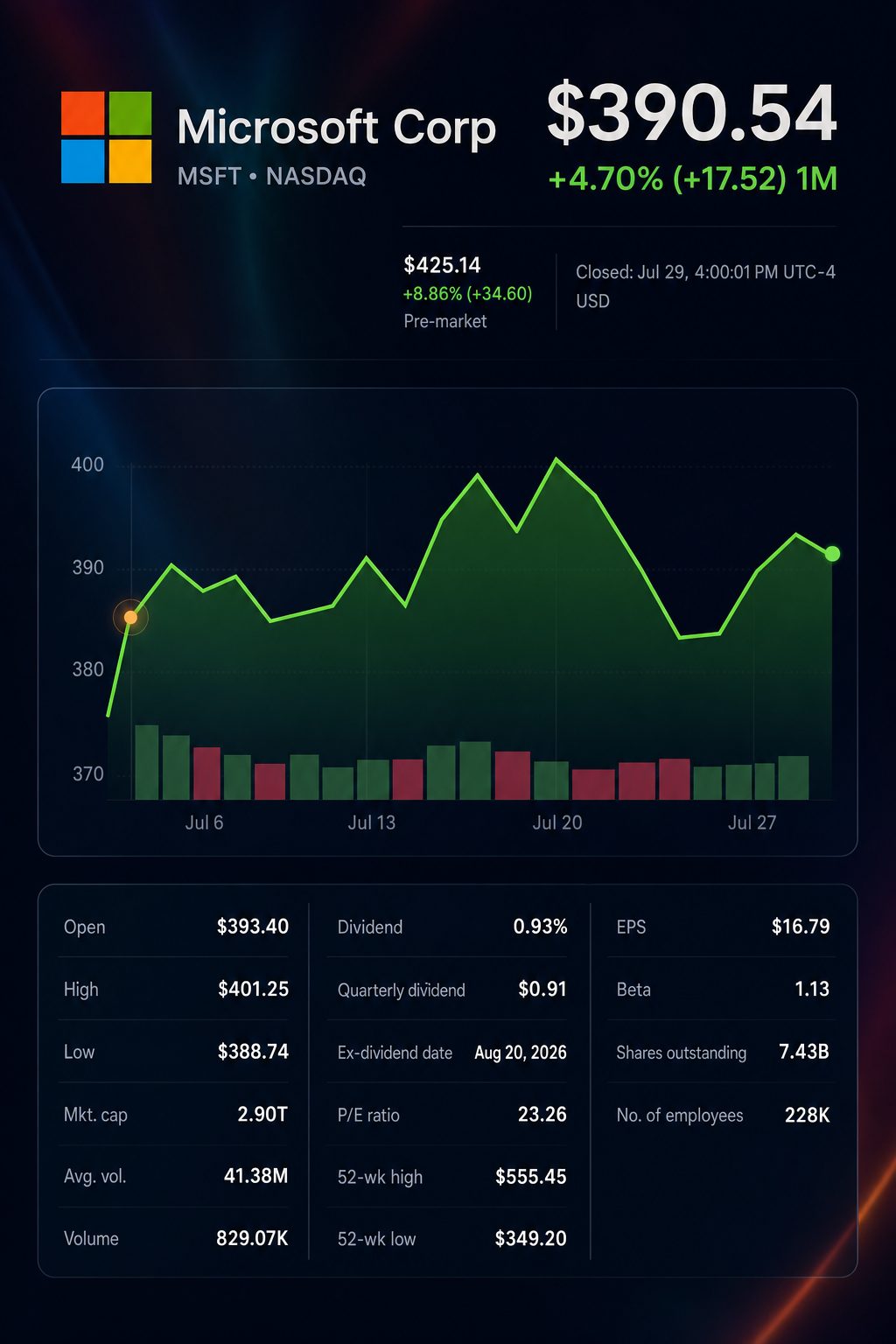
Shares of Microsoft rose 8.81% in premarket trading to $424.93, compared to its closing price on Wednesday.
Azure revenue increased by 43%, and Microsoft 365 Copilot exceeded 30 million paid subscriptions.
The commercial backlog under contract increased to $678 billion. The entire sequential rise was driven by clients other than top AI-model developers.
Shares of Microsoft Corporation NASDAQ:MSFT gained 8.8%, reaching $424.93 during Thursday’s premarket session. U.S. regular trading hours had not yet begun. The stock closed at $390.54 on Wednesday.
The shift surpassed projections made by options markets. Traders had anticipated a 6.6% change following the earnings report. The increase seen in premarket trading was greater by 2.21 percentage points, which is about one-third higher.
Stock reaction
Value
Wednesday closing price
$390.54
Premarket quote at 06:00 ET
$424.93
Change in price
+$34.39, or +8.81%
Options-expected move
±6.6%
Movement beyond expectations
+2.21 percentage points
Estimated increase in market value
About $256 billion
The valuation is calculated based on the premarket increase and a total of 7.43 billion shares outstanding. Prices during extended trading hours are subject to change ahead of the market open.
The key indicator for investors was a broader base of contracted demand. Commercial remaining performance obligation (RPO) totaled $678 billion. RPO tracks contracted revenue that has yet to be recognized. Sequential growth this period was driven entirely by customers beyond the frontier-model firms, referring to top AI developers.
Diversification remains important, yet concentration persists. RPO increased 84% year-on-year, rising 25% without including OpenAI. Customers outside of frontier-model companies accounted for close to 90% of cloud revenue during the fiscal year.
Microsoft anticipates that around 30% of its RPO will convert to revenue in the next 12 months. Initial estimated figure: this equates to approximately $203.4 billion. The short-term segment increased by 37% compared with the previous year.
The quarter surpassed consensus expectations in all key operating metrics.
Azure’s growth pace increased from 40% in the previous quarter. Microsoft forecasted approximately 45% constant-currency growth for the September quarter. Visible Alpha’s consensus was 40.92%.
Copilot opened an alternative path for AI earnings. The number of paid Microsoft 365 Copilot seats increased from 20 million to over 30 million. Sequential net additions more than doubled.
Nadella stated Azure revenue had “crossed $100 billion for the first time.” Bryan Hayes from Zacks commented that investors realized “the spending is buying something real.” Microsoft
The remainder of the portfolio showed varied performance. Productivity and Business Processes increased by 14%. Intelligent Cloud advanced 32%. More Personal Computing decreased by 4%. Windows and Devices slipped 7%, and Xbox content and services were down 10%.
Cash flow is still the main metric. Operating cash flow increased by 30% to $55.4 billion. Capital expenditure totaled $41 billion. Free cash flow slipped 23% to $19.6 billion, but surpassed expectations by a wide margin.
Caution is warranted with the reduced $175 billion 2026 capex figure. Microsoft lengthened the expected lifespan of its data centers and facilities from 15 to 25 years. An increased number of leases will now be accounted for outside reported capex. Executives said the company’s core investment plans remain the same.
Significant risks persist. Microsoft reported $329.1 billion in unstarted data-center leases. Capital expenditure is set to climb further in fiscal 2027, while Azure demand continues to outpace capacity. Should backlog conversion slow, Thursday’s premarket rerating could come under pressure.
Microsoft ended Wednesday’s session at $390.54, marking a 0.71% decline. Shares rose to $422.64 in early Thursday premarket trading, up 8.22%. The increase boosted Microsoft’s implied equity value by around $238 billion. The gain topped the 6.6% pre-earnings move priced in by options markets. Microsoft’s rally is likely to benefit capitalization-weighted indexes, though the precise index impact will be determined by the stock’s opening price.
How significant was the fiscal fourth-quarter earnings outperformance?
Revenue climbed to $90.0 billion, up 18%, surpassing the $87.62 billion consensus forecast. Adjusted earnings came in at $4.74 per share, ahead of the $4.24 per share analysts had expected. Operating income increased 18% to $40.6 billion, with a margin of 45.1%. Quarterly unusual items contributed $0.27 per share, above the company’s prior guidance. These included a $3.2 billion gain from Anthropic and were partly offset by impairments related to Xbox.
Does Azure’s growth sufficiently support the investment rationale for AI?
Azure revenue increased by 43%, outpacing the 39.98% consensus from Visible Alpha. Microsoft projected first-quarter Azure growth of nearly 45% in constant currency, topping the analyst consensus of 40.92% by about four percentage points. For the first time, Azure's yearly revenue went above $100 billion. Customer demand continues to exceed current capacity, with new capacity rapidly monetized. Growth could fluctuate based on timing of capacity additions and differences in contract mix.
Is Microsoft 365 Copilot starting to have a significant financial impact?
Microsoft 365 Copilot surpassed 30 million paid seats, rising from 20 million. Net paid-seat gains more than doubled from the prior quarter. Analysts were looking for around 26.9 million seats, so the adoption rate topped expectations. Adjusted commercial-cloud revenue for Microsoft 365 climbed 16% year over year. Higher average revenue per user was driven by premium products, including Copilot. Microsoft has not yet broken out individual revenue or operating margin figures for Copilot.
Does having a $678 billion backlog increase the predictability of growth?
Commercial remaining performance obligations totaled $678 billion, representing an 84% increase year over year. Of this amount, approximately 30%, or $203.4 billion, is expected to be recognized as revenue over the next twelve months. When excluding OpenAI, remaining performance obligations rose by 25%. Sequential backlog growth was driven entirely by customers not classified as frontier-model companies. The average contract length, weighted, stood at 2.3 years. Backlog offers greater visibility but does not translate to immediate revenue or cash.
Has Microsoft scaled back its planned spending on AI?
Economically, there is no change. Capital expenditures in the fourth quarter totaled $41 billion, marking an increase of more than 70% year-on-year. Approximately two-thirds of this sum was directed to assets with shorter lifespans, predominantly CPUs and GPUs. Capital spending for calendar-2026 is now projected to approach $175 billion, a reduction attributed to adjustments in lease accounting. Core investment strategy remains the same. First-quarter spending is expected to surpass $50 billion, with fiscal-2027 capital expenditure set to rise further.
Is Microsoft able to finance the expansion without compromising its financial flexibility?
Operating cash flow for the fourth quarter increased by 30% to $55.4 billion. Free cash flow declined 23% to $19.6 billion as capital investments rose. Using stated cash capital expenditures, free cash flow for fiscal 2026 was $67.0 billion, approximately 6.5% lower than the prior year’s $71.6 billion calculation. Cash and short-term investments stood at $76.8 billion, compared with debt of about $40.3 billion. The balance sheet remains robust, but cash-flow pressure persists.
How does management forecast performance for fiscal 2027?
Microsoft projects first-quarter revenue between $89.85 billion and $90.95 billion, signaling a 16% to 17% increase compared to a year ago. The midpoint of $90.4 billion comes in just above the LSEG consensus of $89.66 billion. The company anticipates double-digit growth in both annual revenue and operating income. Management forecasts operating expenses will climb in the mid-to-high single digits, while operating margins are expected to decrease by less than one point. Microsoft has not provided full-year EPS guidance; analysts on average predict $19.49.
Is Microsoft stock overvalued following the premarket surge?
Microsoft's current share price of $422.64 puts its market capitalization near $3.14 trillion. Shares trade at around 23.5 times projected GAAP earnings for fiscal 2026 and at approximately 21.7 times expected consensus earnings for fiscal 2027. Analysts' average price target is $555.66, indicating an estimated 31% upside. Price targets span from $400 to $870, highlighting wider than usual forecasting uncertainty. Barclays lowered its target to $512 today but maintained an Overweight rating. The consensus target may update as more analyst revisions arrive following earnings.
What factors might disrupt the positive Microsoft outlook?
Company gross margin dropped from a year ago to 67%. Microsoft Cloud’s gross margin also moved lower, standing at 65% even with efficiency improvements. Capital expenditure for fiscal 2027 is set to increase, which will continue to weigh on free cash flow. Windows OEM and Devices revenue is projected to decrease by high teens this fiscal year. Xbox content-and-services revenue for the first quarter is expected to fall by a mid-single-digit percentage. Total uncommitted data-center leases stand at $329.1 billion, with some still subject to conditions. The positive outlook is tied to sustained Azure demand, utilization, and margins.
Mateusz Kaczmarek is a financial and technology journalist at TS2.tech. His coverage ranges from stocks and artificial intelligence to semiconductors and developments across global markets. He graduated from the Poznań University of Economics and Business and worked in financial analysis before becoming a business journalist. Follow Mateusz Kaczmarek on Google News.